Tag Archives: History

Election days, then and now

4 Nov

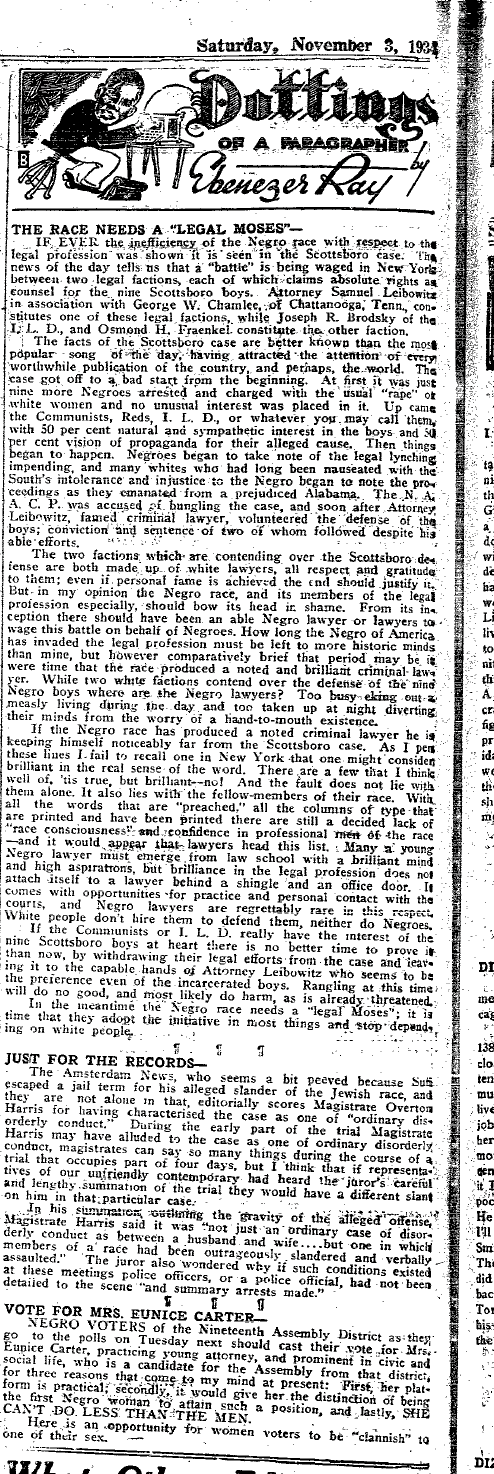
Looking for something fresh to write about on Election Day, I searched my father’s columns for wisdom from the past. A footnote in a column published in the New York Age on November 3, 1934, implored readers to elect “Mrs. Eunice Carter” to the New York State Assembly. The name had a familiar ring.

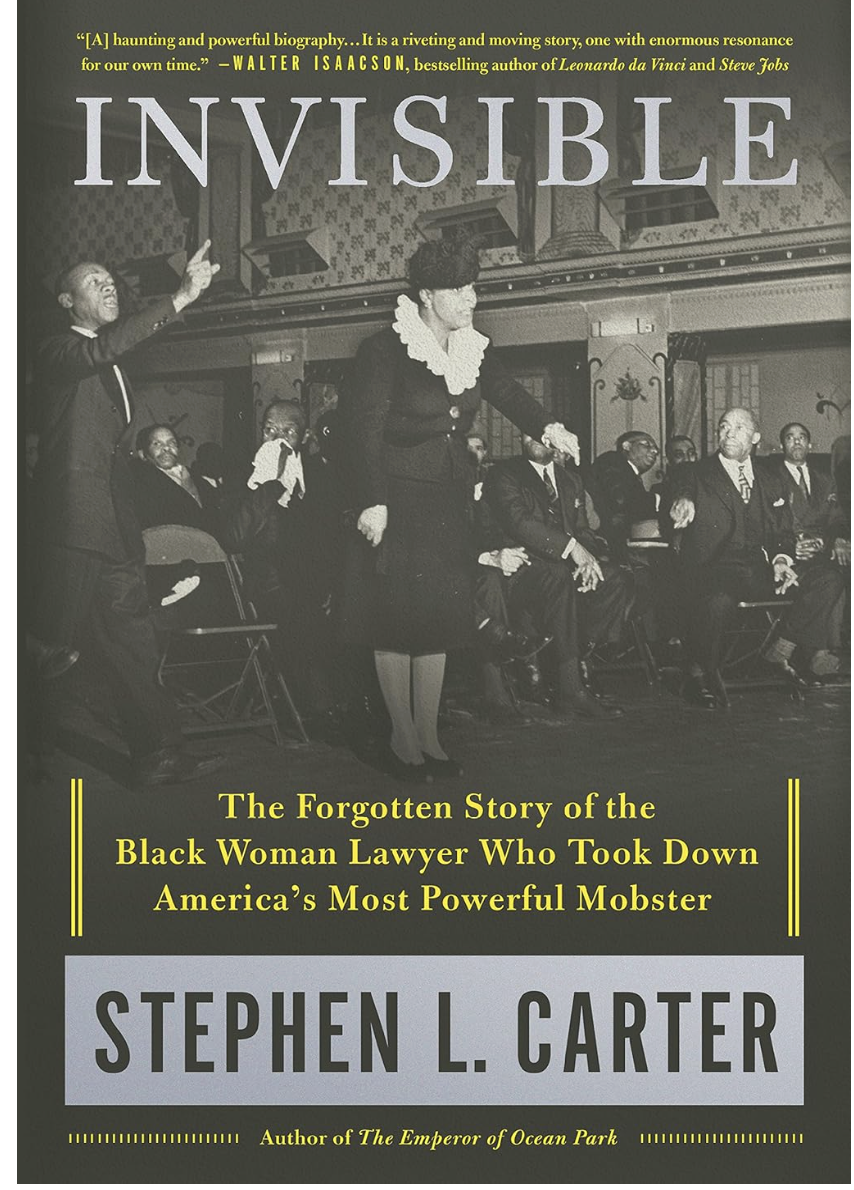
Five years ago, my cousin, Evelyn, sent me a text message with a copy of a paragraph from a book that quoted Ebenezer. The book, Invisible, by author and Yale legal scholar, Stephen L. Carter, is the biography of Stephen’s grandmother, Eunice Hunton Carter.  The book’s subtitle is: “The Forgotten Story of the Black Woman Lawyer Who Took Down America’s Most Powerful Mobster.”  
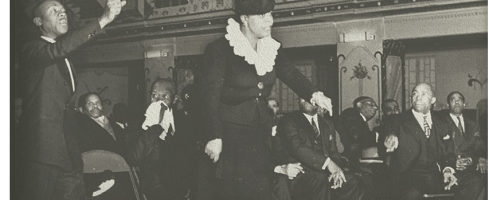
But before Eunice Carter became a prosecutor, developing the strategy that would bring down Mafia boss Lucky Luciano, she was picked by the Republican Party as their candidate for the Nineteenth District of the New York State Assembly. According to Stephen Carter, the GOP “needed a warm body” to run for the seat occupied by James Stephens, a Democrat and the only “colored” member of the Assembly at the time.

My father and his newspaper, The New York Age, were all in for Mrs. Carter.

“The Age, the more traditionalist of New York’s major Negro papers, labeled Eunice ‘exceptionally well qualified.’ The paper predicted ‘with certainty’ that she would win,” Stephen Carter wrote. “Age columnist Ebenezer Ray offered three reasons: ‘First, her platform is practical; secondly, it would give her the distinction of being the first Negro woman to attain such a position, and lastly, SHE CAN’T DO LESS THAN THE MEN.’  The column added: ‘Here is an opportunity for women voters to be clannish to one of their own sex.’”

Despite support from the Black press in New York and beyond and predictions that she was the “odds-on favorite,” Eunice Carter lost the election. The Baltimore Afro-American, which also had endorsed her, expressed surprise.

“The paper told readers that even as Eunice gave a conciliatory concession speech, she ‘looked as if her faith in humanity had been shaken,’” Stephen Carter wrote. “What went wrong?”

The author listed several possible reasons his grandmother lost, despite a “spirited campaign.” Her incumbent had likely benefitted from the patronage of Tammany Hall, the New York City Democratic political machine that dominated the city’s politics for decades. “In addition, although the impact would not be obvious for another decade, the segment of the community Eunice was seen to represent — tradition-bound, clannish, respectably middle-class — was losing its stranglehold on the politics of the darker nation. And, of course, at this time a substantial portion of the Negro and white electorate alike remained skeptical or perhaps even hostile toward female candidates,” Stephen Carter wrote.
Vote for Mrs. Eunice Carter

I’m happy to know that my father was forward-thinking enough to champion a woman’s candidacy. Still, there are echoes of today’s political climate.

My faith in humanity was shaken when Kamala Harris lost the 2024 presidential election.

Stories of Eunice crisscrossing Harlem, inspiring crowds at churches, political clubs and civic organizations; her direct appeals to specific constituencies such as Black beauticians, took me back to Harris’ whirlwind 107 days on the campaign trail.

In Invisible, Carter added that another factor in Eunice’s defeat was that Black folks were going through a “partisan transformation.” In 1929 “African America still trended Republican. By 1934, Harlem was voting Democratic— the party won every contest in the neighborhood that year—and the same partisan tide that defeated Eunice was sweeping the darker nation in election precincts around the country.”

The 2024 presidential election exposed some partisan realignments as well, including an increased portion of Black men who voted for Harris’ opponent. And while I would not call their slight right shift a tide, it is worrisome. I also worry that the “tradition bound,” Democratic establishment might court Republicans at the expense of its progressive left flank.

I wonder what Ebenezer and Eunice would think about Harris or New York Democratic Mayoral candidate Zohran Mamdani.

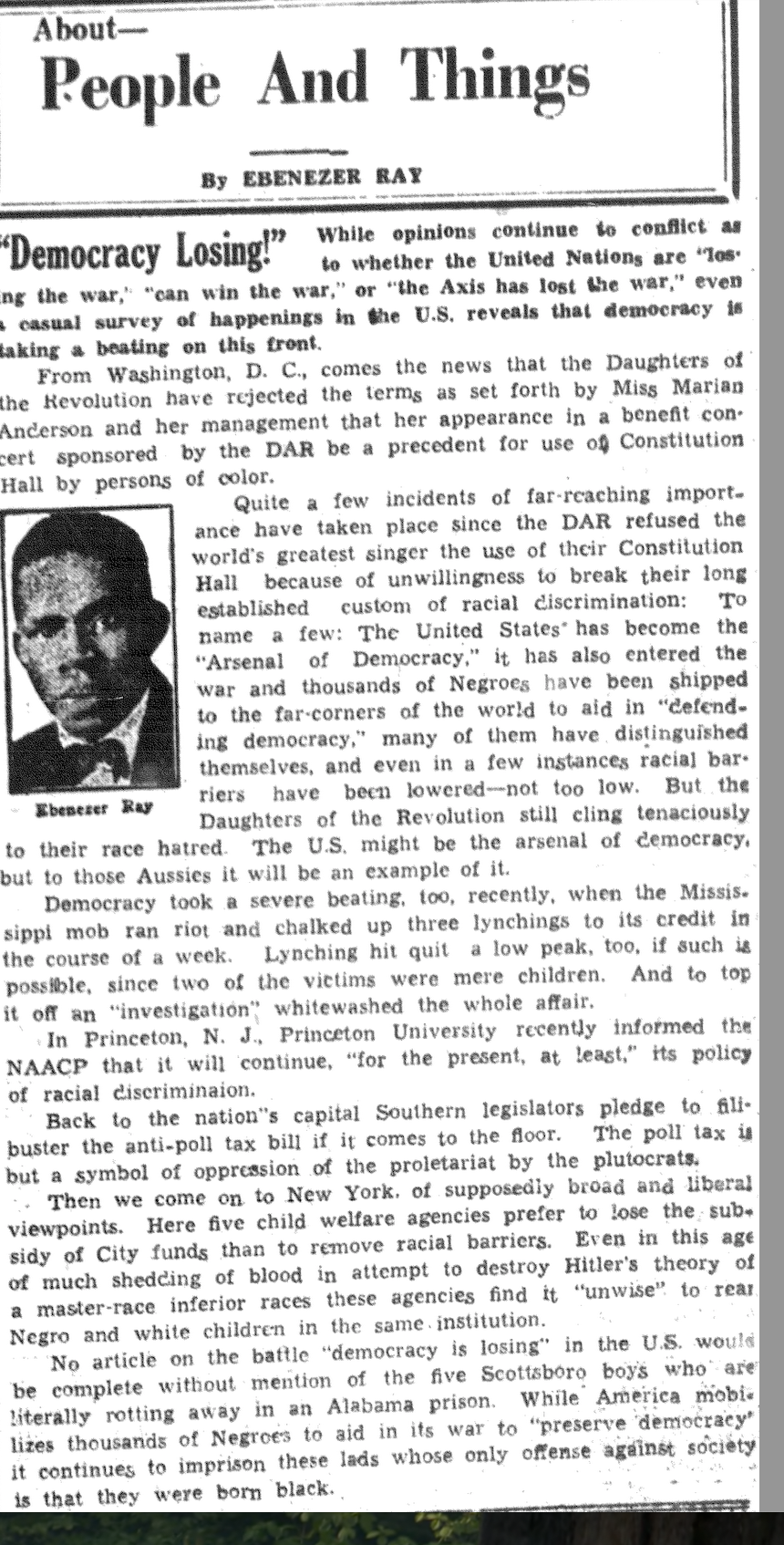
Eerie Echos of ‘Democracy Losing’

25 Oct People and Things November 14, 1942

Eighty-three years ago, my father wrote a column titled “Democracy Losing!” asserting that while Americans were debating whether the world was winning or losing the war against the Nazis, “a casual survey of happenings in the U.S. reveals that democracy is taking a beating on this front.”

In November of 1942, Ebenezer lamented that the Daughters of the American Revolution (DAR), were still balking at the terms “set forth by, Miss Marian Anderson, and her management that her appearance in a benefit concert sponsored by the DAR be precedent for use of Constitution Hall by persons of color.”

My father loved Marian Anderson, so it is no surprise that three years after her historic 1939 Easter concert at the Lincoln Memorial  —  an alternative venue arranged with the help of First Lady Eleanor Roosevelt after the DAR refused to abandon its whites-only policy — Ebenezer was still outraged.

But that was not the only bee in his bonnet.

“Quite a few incidents of far-reaching importance have taken place since the DAR refused the world’s greatest singer the use of the Hall because of unwillingness to break their long-established custom of racial discrimination.”

My father pointed to three lynchings in Mississippi  — two of the victims were children — and that an ‘”investigation’ whitewashed the whole affair.”

He also mentioned that Princeton University had informed the NAACP that it would continue ”’for the present at least,’ its policy of discrimination.”

There also was the pledge by Southerners in Congress to filibuster an anti poll-tax bill. “The poll tax is but a symbol of oppression of the proletariat by the plutocrats.”

“Then we come to New York,” he added. “Here five child welfare agencies prefer to lose the subsidy of City funds than to remove racial barriers. Even in this age of much shedding of blood in attempt to destroy Hitler’s theory of a master race, these agencies find it ‘unwise’ to rear Negro and white children in the same institution.”

Several months after this column, in 1943, the DAR agreed to allow Marian Anderson to perform for a racially integrated audience in their venue.

I have not been able to pinpoint my father’s NAACP/Princeton University reference,. However, according to April Armstrong, author of “Erased Pasts and Altered Legacies: Princeton’s First African American Students,” the first African American to receive an A.B. from Princeton University was John Leroy Howard in 1947. (At least two other Black men had received graduate degrees in 1891 and 1893. Bruce Wright, a future member of the New York Supreme Court, was accepted into Princeton as an undergraduate in the mid-1930s, but his admission was revoked when he showed up on campus and administrators realized he was Black.)

While there has been significant progress since my father wrote this column 83 years ago, “Democracy Losing” is certainly a concept that is currently trending. With President Donald Trump’s takeover of the Kennedy Center for the Performing Arts; Republican efforts to put the final nail in the coffin of the Voting Rights Act; the assault on universities, particularly their commitment to Diversity, Equity and Inclusion; and the violent attacks on people perceived to be undocumented immigrants by Immigration and Customs Enforcement agents based on their race, has eery echoes of the past.

People and Things November 14, 1942

Happy 120th birthday

24 May


May 24 would have been my father’s 120th birthday.

I don’t know what would resonate with him today, but back in the 1930s, when he was in his mid-to-late 30s, he was given to quoting Henry Wadsworth Longfellow on his birthday.

For three consecutive years, in columns that ran near May 24, Ebenezer would quote the same lines from Longfellow’s “The Spanish Student,” a play in three acts.

s-l300

“Approaching one of those inevitable milestones imposed by Father Time, this paragrapher pauses in reflection and does a little audible thinking. Methinks Longfellow was correct when he wrote of persons born on May 24. ‘The strength of thine own arm is thy salvation.’ But I think he stretched his optimism a bit far when he said, ‘Behind those riftless [sic] clouds there is a silver lining [sic]; be patient,’” my father wrote in the New York Age, May 28, 1934.

Longfellow actually wrote “rifted clouds,” and in at least one edition, that one line was not about a silver lining. It was, “there shines a glorious star!” Also, I could not find any verification that the 19th-century poet and essayist was specifically referring to those who were born on May 24.

But, ok, Dad.

More often than not, my father used his weekly column for a little of this and a little of that. In one paragraph, he would rail against racially discriminatory hiring practices in Harlem and in the next, he would chide an acquaintance for falling under the spell of Father Devine. Then he’d wax about a social event or musical performance that moved him. Often, he used his column to express his outrage about lynchings and the trumped-up charges against the Scottsboro Boys. During the years when my father was quoting Longfellow in his birthday columns, the United States was in the throes of the Great Depression; Adolf Hitler and the Nazi Party had begun their reign. You couldn’t fault him for seeing no rift in the clouds.

These days, the press is literally being punched and kicked simply for the “crime” of asking questions.

A Republican Congress is poised to denude health care, the environment, public education and women’s agency over our bodies.

Our president and his family are raiding our treasury.

Law enforcement officers who kill unarmed black and brown civilians, including children, do so with impunity.

Immigrants are being harassed, deported and maligned.

White supremacists in this country have been given license to spew hate and kill.

Has anyone seen a glorious star lately?

Actually, yes.

When a Supreme Court majority (that includes Justice Clarence Thomas!) rejects North Carolina’s voter suppression efforts.

When reporters fight back with fierce investigative journalism.

When constituents yell “you lie” at those to try to sell us alternative facts.

When we forge authentic alliances strong enough to demolish and deconstruct silly walls.

When we vote like our lives depend on it, because apparently, they do.

So, in honor of Ebenezer’s 120th birthday, I will take a few liberties of my own with Longfellow:

Only the strength of [OUR] own [COLLECTIVE] arm[S] will be [OUR] salvation.

Let’s get to work.


Happy Thanksgiving

20 Nov

My father plagiarized himself frequently, most notably in his Thanksgiving columns. In 1934, 1936 and 1938, he wrote about the Pilgrim fathers, who in 1623 faced “their second winter of hunger, cold and peril” until, after a day of prayer, sighted “a ship loaded with friends and supplies.” He ended every one of these columns with the question of whether “Negroes” should be thankful. He would give a nod to the Scottsboro Boys, who were  incarcerated in Alabama. A favorite refrain was that the  “Negro’s winter is still on” and the ideals of safety and happiness continued to elude American blacks.

In 1939 his column still included these elements, but had a more optimistic tone. That year, President Franklin Roosevelt decided that Thanksgiving should be celebrated the next to the last Thursday of the month, rather than the last Thursday, which had been American tradition dating back to the end of the Civil War.

“Now, in the year of 1939, Americans find themselves sandwiched between two Thanksgiving Days,”  Ebenezer wrote. According to my father about half of the nation’s bosses  “preferred to adhere to the traditional (Lincoln’s). . .”

Apparently, my father  thought the whole debate was silly.

“It is safe to say that the idea of giving thanks on this day has been lost in its routine acceptance. It is now rather a day of feasting. And to hear the opposition tell it, one is almost moved to believe that there IS a difference between gormandizing vittles and guzzling corn liquor on one Thursday as against another Thursday. But this is a Democracy.”

Under Stalin, Hitler or Mussolini, he asserted, the “thanksgiving edict” would have come without choice and accepted with the “clicking of the heels. Dictators’ proclamations have but one ‘alternative’: yes or YES.  . . Not in America. And that’s a good reason for giving thanks – any day.”

Ebenezer gave his customary nod to the Scottsboro boys.  Five of the original nine were still imprisoned. “Should the question of Thanksgiving Day penetrate those prison walls, those lads could well ask: What have we to be thankful for on the 23rd or the  30th of November?” he asked. “Their oppressors quibble over trifles.”

“Quibbling over when one should give thanks is hardly productive of the spirit of gratefulness  – at that. “

As for me, I’m giving thanks every day that America is changing, as evidenced by the recent election. Thankful that more Americans will have access to health care and that women will have agency over their own bodies. That race-baiting and big money don’t always prevail and that the Supreme Court’s activist slide will be slowed.

No doubt, our nation is still deeply divided between those who “want to  take their country back” and those who want to move forward.  But, as Ebenezer said,  “This is Democracy.”

By the way, I was going to wait until tomorrow to add a photo of President Obama pardoning a turkey, but I thought this video said more about thankfulness.

‘The Negro is a marked race’

6 Nov

“Not many generations out of slavery, and forging our own existence despite heavy odds, the Negro is a marked race, hence our activities share the spotlight of constant scrutiny. when we reach the height of success none will be able to deny us our rightful share of recognition and applause. We should strive to leave great footprints in the sands of time,” my father writes below.
But I cannot help but think that 75 years later it’s still not so easy.  In this so-called “post-racial era,” the struggle continues. I’m sure my father could not have imagined that in his children’s lifetime America would have a black president. And though Barack Obama has reached the “height of success” by any measure, he continues to be a member of a “marked race.” Conservatives cry that they “want to take their country back,” which is code for we want to take the country back to a time when having blacks in power was only a dream. They call him elitist, which is code for “uppity Negro.”

I also found the last item, about the assaults on domestics by the men they work for, interesting. That’s one subject that was not broached in The Help.

As he did when he wrote about the illegal numbers, or so-called “policy games,” Ebenezer expressed sympathy  for prostitutes, who he referred to as “pavement pounders.” He argued that the lack of legal means available for these men and women to support themselves made it almost impossible for folks to avoid “easier money.”

“When social and economic agencies move to protect their youngsters vice crusades will not be necessary; when they do not – vice crusades will be ineffective,” he said.

P. S.: I’m still trying to find a source of information on the Mills brothers and the incident my father notes regarding their being barred from watching white baseball players play in Detroit.

The New York Age, March 23, 1935