Tag Archives: Marian Anderson

Eerie Echos of ‘Democracy Losing’

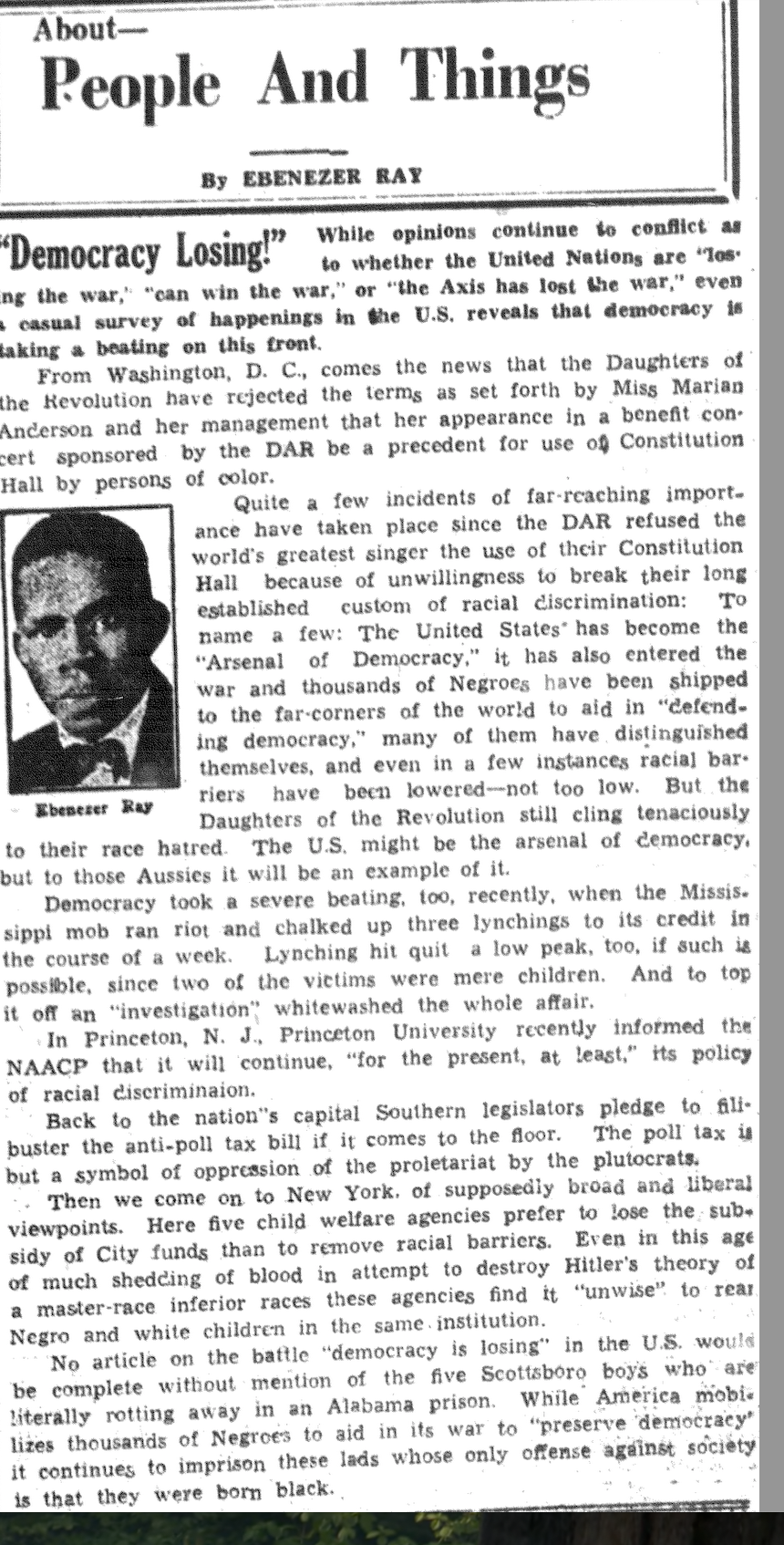
25 Oct People and Things November 14, 1942

Eighty-three years ago, my father wrote a column titled “Democracy Losing!” asserting that while Americans were debating whether the world was winning or losing the war against the Nazis, “a casual survey of happenings in the U.S. reveals that democracy is taking a beating on this front.”

In November of 1942, Ebenezer lamented that the Daughters of the American Revolution (DAR), were still balking at the terms “set forth by, Miss Marian Anderson, and her management that her appearance in a benefit concert sponsored by the DAR be precedent for use of Constitution Hall by persons of color.”

My father loved Marian Anderson, so it is no surprise that three years after her historic 1939 Easter concert at the Lincoln Memorial  —  an alternative venue arranged with the help of First Lady Eleanor Roosevelt after the DAR refused to abandon its whites-only policy — Ebenezer was still outraged.

But that was not the only bee in his bonnet.

“Quite a few incidents of far-reaching importance have taken place since the DAR refused the world’s greatest singer the use of the Hall because of unwillingness to break their long-established custom of racial discrimination.”

My father pointed to three lynchings in Mississippi  — two of the victims were children — and that an ‘”investigation’ whitewashed the whole affair.”

He also mentioned that Princeton University had informed the NAACP that it would continue ”’for the present at least,’ its policy of discrimination.”

There also was the pledge by Southerners in Congress to filibuster an anti poll-tax bill. “The poll tax is but a symbol of oppression of the proletariat by the plutocrats.”

“Then we come to New York,” he added. “Here five child welfare agencies prefer to lose the subsidy of City funds than to remove racial barriers. Even in this age of much shedding of blood in attempt to destroy Hitler’s theory of a master race, these agencies find it ‘unwise’ to rear Negro and white children in the same institution.”

Several months after this column, in 1943, the DAR agreed to allow Marian Anderson to perform for a racially integrated audience in their venue.

I have not been able to pinpoint my father’s NAACP/Princeton University reference,. However, according to April Armstrong, author of “Erased Pasts and Altered Legacies: Princeton’s First African American Students,” the first African American to receive an A.B. from Princeton University was John Leroy Howard in 1947. (At least two other Black men had received graduate degrees in 1891 and 1893. Bruce Wright, a future member of the New York Supreme Court, was accepted into Princeton as an undergraduate in the mid-1930s, but his admission was revoked when he showed up on campus and administrators realized he was Black.)

While there has been significant progress since my father wrote this column 83 years ago, “Democracy Losing” is certainly a concept that is currently trending. With President Donald Trump’s takeover of the Kennedy Center for the Performing Arts; Republican efforts to put the final nail in the coffin of the Voting Rights Act; the assault on universities, particularly their commitment to Diversity, Equity and Inclusion; and the violent attacks on people perceived to be undocumented immigrants by Immigration and Customs Enforcement agents based on their race, has eery echoes of the past.
People and Things November 14, 1942

Marian Anderson’s Easter Sunday triumph

10 Apr

Reposting this in honor of the 75th anniversary of Marian Anderson’s concert at the Lincoln Memorial. It’s hard to believe that I wrote that Boston Globe editorial 25 years ago.

Regular readers of this blog know that the legacy of singer Marian Anderson looms large in my consciousness. My mother held her up as a hero. My sister was named for her. My father, a contemporary, was apparently smitten with her.

One of the first assignments as an editorial writer for the Boston Globe was to write a piece in honor of the 50th anniversary of Anderson’s  concert on the Lincoln Memorial, Easter Sunday 1939.

In that first Globe editorial, published on April 9, 1989, I wrote:

“Fifty years ago today, Marian Anderson stood on the steps of the Lincoln Memorial before 75,000 awed spectators and offered up her brilliant operatic contralto.
The concert was a triumph in an era of legal and customary segregation. Anderson, by then an accomplished performer in the US, Europe and South America, had hoped to perform at Washington’s Constitution Hall. The Daughters of the American Revolution refused to let her perform there because she was black. Amid protests from musicians and public figures, Eleanor Roosevelt resigned from the DAR, and with her help, the show went on at the Lincoln Memorial.
Since then, Anderson has been a symbol of pride and achievement. Introducing her at the Lincoln Memorial that Easter Sunday in 1939, Interior Secretary Harold L. Ickes said: “Genius knows no color line. She has endowed Marian Anderson with such a voice as lifts any individual above his fellows as a matter of exulted pride to any race.”

Unbeknownst to me then, my father had written about that concert in 1939:

“‘Whereas only about four thousand persons usually listen to her concert, seventy-five thousand persons in a visible audience and millions in an invisible audience heard Marian Anderson sing her program of triumph on Easter Sunday afternoon in the Lincoln Memorial Park within striking distance of the Capitol’s dome.
Miss Anderson’s unusually large audience was swept to her on the wings of bigotry and racial intolerance. Since a couple of nations in Europe seem to vie with each other in acts of racial persecution, it seems to be Uncle Sam’s serious ambition today to be on the right side of the pale – a sort of see-how-good-I-am attitude.
America’s escutcheon is well blotched with racial intolerance, discrimination and persecution. Up to now it’s the Negro who is borne the brunt, if not all, of this form of treatment. Lynching, ruthless lynchings, the Scottsboro Boys are inerasable marks. Scoldings, however, from within and jeers without are gradually bringing about actual efforts to earn herself a cleaner slate.
The old Devils of the American Revolution ran true to the Old America and cried ‘color’ to Miss Anderson.  . . .  But seeking no ally with Nazism and Fascism, official America loaned Miss Anderson the Lincoln Memorial Park and facilities for a worldwide audience. “

Coincidentally, Anderson died on April 8, 1993, almost exactly 54 years to the day after her triumphant concert. In another Globe editorial, I wrote that to my mother Anderson “represented a triumph over segregation and a counterweight to Aunt Jemima images.”

“As a youngster, Anderson was denied admission to a Philadelphia music school because she was black. She was given the keys to Atlantic City, but was not allowed to stay in a hotel there. When she sang in segregated concert halls, she demanded that seats be allotted to black ticket buyers in every section of the auditorium. . . Anderson often referred to herself with modest detachment. But for several generations of black women in America such modesty is unnecessary. Marian Anderson’s name and her memory are synonymous with the magnificence of  her voice.”

Happy Easter!

Happy Birthday, Sis

17 Sep

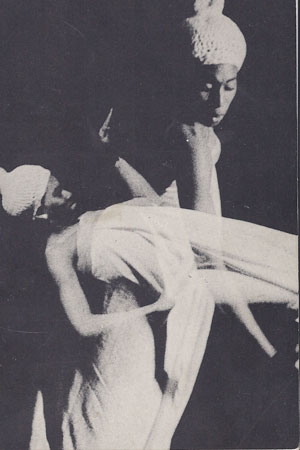
Today is my sister Malaya’s birthday. She is my parents’ second born, a dancer, storyteller, stage mother, earth mother – an artist in every sense of the word. It was preordained. Before she was Nana Malaya Rucker-Oparabea, the name she uses now, she was Marian, named for Marian Anderson.

Marian-Malaya Rucker-Oparabea

I always knew my mother revered the renowned contralto. My mother  admired Anderson’s quiet dignity in the face of the Daughters of the American Revolution (DAR), who refused let Anderson sing before an integrated audience in Washington’s Constitution Hall.  To my mother,  Anderson’s victorious concert on Easter Sunday 1939, before  a crowd of 75,000 at the Lincoln Memorial was a milestone in black history.

But for my father the connection may have been more personal. Marian Anderson was  his contemporary. They were both born at the end of the 19th century.  I believe he was smitten.

“With scores of her elated and admiring auditors standing at the footlights literally drinking the melodious strains which flowed from the fountain of her golden voice, Marian Anderson, internationally acclaimed contralto, sang a farewell number on Sunday evening last, he wrote in a review that appeared on the front page of the New York Age on May 14, 1938. “This was Miss Anderson’s final appearance in America this season and was given at the Carnegie Hall.”

After that concert, my father wrote, well wishers “of both races then repaired to her dressing room to shake hands with her and tender their congratulations. She was presented with a beautiful bouquet of tea roses.”  I suppose he witnessed this firsthand. (Did he offer the roses?)

In a Nov. 13, 1943 review of a Pittsburgh concert, also written for the New York Age, Ebenezer called Anderson the “world’s greatest contralto.”

“Miss Anderson was in excellent voice and charmingly gowned,” he wrote. His only complaint was that the “motley” Pittsburgh audience was too subdued.  Yes, there were plenty of compliments from the audience as they left Pittsburgh’s Syria Mosque, where the performance was held.

“To this erstwhile New Yorker, however, two things were missing from this recital. There were no shouts of ‘Bravo’ from the ‘peanut gallery,’ which was only two tiers up, and there were no American Beauty roses, nor orchids. In brief, Miss Anderson received no flowers. But this is Pittsburgh!”

Ebenezer would come to love, or at least accept, Pittsburgh. He would fall in love with my mother and out of that love would come three daughters, the second of whom was born on this date.

Malaya is very different from her namesake. She leans more toward classical African and Caribbean beats than Scarlatti or Schubert. Of course, these two women came of age in different times. I can only imagine what Malaya would have told the DAR. She might have even taken over the stage.

I’ve often wondered why the only one of the three of us who was named after a historical figure would change her name. The answer is simple. Malaya always has been, and will forever be, her own person.

Happy Birthday, Malaya!