Yesterday, I wrote about a thirty-something New Yorker with little political experience who ran for a seat on the New York State Assembly. Her name was Eunice Hunton Carter, and her 1934 campaign was ultimately unsuccessful.
Today, Zohran Mamdani, already a member of the New York State Assembly from Queens, is New York City’s Mayor Elect. And in addition to his success, Democratic candidates across the country won decisive victories.
In the governors’ races in New Jersey and Virginia, both women candidates, Mikie Sherrill and Abigail Spanberger were more moderate than Mamdani, who unapologetically identifies as a democratic socialist. He has promised to make New York more affordable by freezing the rent on rent-stabilized apartments, by providing universal child care, and by making buses free.
In his book, Invisible, Stephen L. Carter’s biography of his grandmother Eunice, he describes her 1934 election platform as “long on promises and short on the practical means for attaining them.” She pledged to ease qualifications for old-age pensions in the days before Social Security existed. She wanted to lower electric, gas and telephone rates and improve unemployment insurance.
“Familiar goals all,” Stephen Carter wrote, “yet Eunice was able to make people believe she could pull them off.”
I lived in New York for a brief six years, and left the city decades ago, but it continues to have a hold on me, as I believe it had on my father, even after he made Pittsburgh his home.
So, I, like Eunice’s supporters, was electrified by Mamdani’s campaign even from 3,000 miles away. And I am hopeful that as Mayor he has the practical skills and the talented administration necessary to attain at least some of his goals.
The swath of Tuesday’s election outcomes suggests that the Democratic Party is not one-size-fits-all and that it should continue to embrace a wide tent. May the momentum of these victories and the coalitions that made them possible help smooth even the rockiest political roads ahead.
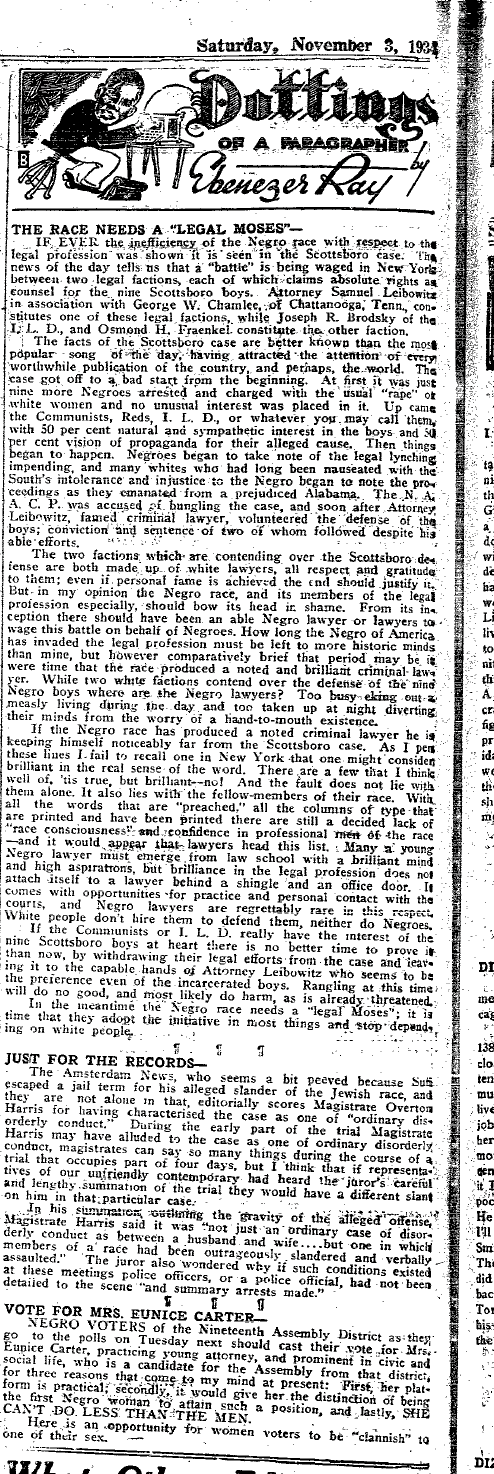
Looking for something fresh to write about on Election Day, I searched my father’s columns for wisdom from the past. A footnote in a column published in the New York Age on November 3, 1934, implored readers to elect “Mrs. Eunice Carter” to the New York State Assembly. The name had a familiar ring.
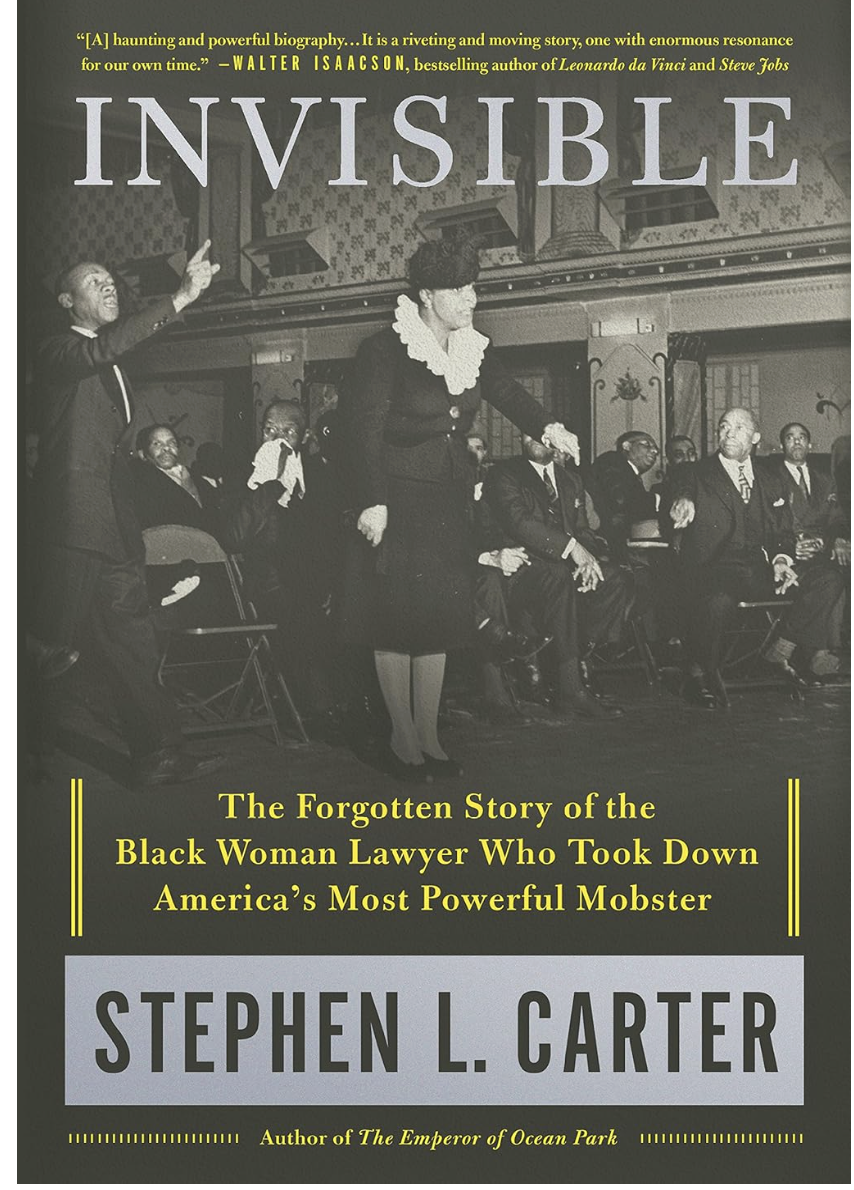
Five years ago, my cousin, Evelyn, sent me a text message with a copy of a paragraph from a book that quoted Ebenezer. The book, Invisible, by author and Yale legal scholar, Stephen L. Carter, is the biography of Stephen’s grandmother, Eunice Hunton Carter. The book’s subtitle is: “The Forgotten Story of the Black Woman Lawyer Who Took Down America’s Most Powerful Mobster.”
But before Eunice Carter became a prosecutor, developing the strategy that would bring down Mafia boss Lucky Luciano, she was picked by the Republican Party as their candidate for the Nineteenth District of the New York State Assembly. According to Stephen Carter, the GOP “needed a warm body” to run for the seat occupied by James Stephens, a Democrat and the only “colored” member of the Assembly at the time.
My father and his newspaper, The New York Age, were all in for Mrs. Carter.
“The Age, the more traditionalist of New York’s major Negro papers, labeled Eunice ‘exceptionally well qualified.’ The paper predicted ‘with certainty’ that she would win,” Stephen Carter wrote. “Age columnist Ebenezer Ray offered three reasons: ‘First, her platform is practical; secondly, it would give her the distinction of being the first Negro woman to attain such a position, and lastly, SHE CAN’T DO LESS THAN THE MEN.’ The column added: ‘Here is an opportunity for women voters to be clannish to one of their own sex.’”
Despite support from the Black press in New York and beyond and predictions that she was the “odds-on favorite,” Eunice Carter lost the election. The Baltimore Afro-American, which also had endorsed her, expressed surprise.
“The paper told readers that even as Eunice gave a conciliatory concession speech, she ‘looked as if her faith in humanity had been shaken,’” Stephen Carter wrote. “What went wrong?”
The author listed several possible reasons his grandmother lost, despite a “spirited campaign.” Her incumbent had likely benefitted from the patronage of Tammany Hall, the New York City Democratic political machine that dominated the city’s politics for decades. “In addition, although the impact would not be obvious for another decade, the segment of the community Eunice was seen to represent — tradition-bound, clannish, respectably middle-class — was losing its stranglehold on the politics of the darker nation. And, of course, at this time a substantial portion of the Negro and white electorate alike remained skeptical or perhaps even hostile toward female candidates,” Stephen Carter wrote.
I’m happy to know that my father was forward-thinking enough to champion a woman’s candidacy. Still, there are echoes of today’s political climate.
My faith in humanity was shaken when Kamala Harris lost the 2024 presidential election.
Stories of Eunice crisscrossing Harlem, inspiring crowds at churches, political clubs and civic organizations; her direct appeals to specific constituencies such as Black beauticians, took me back to Harris’ whirlwind 107 days on the campaign trail.
In Invisible, Carter added that another factor in Eunice’s defeat was that Black folks were going through a “partisan transformation.” In 1929 “African America still trended Republican. By 1934, Harlem was voting Democratic— the party won every contest in the neighborhood that year—and the same partisan tide that defeated Eunice was sweeping the darker nation in election precincts around the country.”
The 2024 presidential election exposed some partisan realignments as well, including an increased portion of Black men who voted for Harris’ opponent. And while I would not call their slight right shift a tide, it is worrisome. I also worry that the “tradition bound,” Democratic establishment might court Republicans at the expense of its progressive left flank.
I wonder what Ebenezer and Eunice would think about Harris or New York Democratic Mayoral candidate Zohran Mamdani.
On Saturday, Feb. 17, I will be among several individuals inducted into the 2024 Class of the Black Legends of Silicon Valley. This is quite an honor. Previous recipients in the News and Documentary category in which I am being honored include journalists with stellar credentials. Loretta Green, an award-winning reporter for several local papers and a former columnist for the San Jose Mercury News, has been a mentor and role model, not only for her work as a journalist but as someone who is well regarded for her community service. David Early, another seasoned award-winning editor and writer whom I also have looked up to since I arrived in the Bay Area, is a previous Legend. Henrietta Burroughs, executive director of the East Palo Alto Center for Community Media, is 2018 winner of this award and someone I deeply admire for her commitment to the East Palo Alto and Belle Haven communities.
The award recognizes my work as a journalist and communications professional including Essence magazine, where I wrote and edited articles on a variety of subjects, including careers, relationships and travel. At the Boston Globe, my editorials effected policy changes in city and state education reform, child welfare, domestic violence and community development. I also wrote editorials, op-ed articles and features on Haiti and South Africa.
This recognition also honors my community service. In addition to my work at Stanford and in journalism, my significant contributions in Silicon Valley have been in the nonprofit and educational advocacy space. I currently serve as vice president of the board of the Pear Theatre, a performance theater based in Mountain View, Calif. The Pear strives to amplify diverse voices through the performing arts. I served for several years as a board member and board president of Foundation for a College Education, an organization based in East Palo Alto, Calif. that is committed to college access and success. In 2005, I co-founded the Parent Network for Students of Color, an advocacy group for students attending the Palo Alto Unified School District. That organization has evolved into Parent Advocates for Student Success. I was a founding board member of the Girls’ Middle School, when it was established in 1998, with a core vision of recruiting and retaining high-achieving girls from diverse racial and socioeconomic backgrounds.
We live in an age in which journalists are verbally denigrated as purveyors of “fake news,” and politicians insult our intelligence with “alternative facts.” Journalists across the world are physically assaulted and even killed simply for trying to do their jobs.
Our democracy requires a free press to ensure that our political leaders and public institutions act in our interests and to make sure our tax dollars are used to support, protect and uplift all of us and particularly those most in need. We need well-resourced media organizations to make sure that corporate interests do not harm or exploit us in the name of profit.
At Saturday’s ceremony I will accept the award on behalf of my father, Ebenezer Ray, a journalist for Harlem’s New York Age and the Pittsburgh Courier, whose commitment to truth telling is in my blood.
In the photo above, I’m the one in the middle.
The Black Legends of Silicon Valley awards ceremony takes place Saturday, Feb. 17 at the Hammer Theatre in San Jose, Calif. Visit the website for information.
Here is a list of all of the 2024 inductees and a bit more information about the award vision behind the effort:
The Alexander-Green News & Documentary Award recipient is Elaine Carolyn Ray. This honor is awarded to journalists, historians, photojournalists, documentarians, editors and community people who record local black community history & events, as well as significant world events that have enhanced the quality of life in the Black Community and the broader community.
The Banks-Gage Education Award recipients are Brenda J. Smith-Ray and Dr. Harriett B. Arnold, (Ed.D). This honor is awarded to individuals who had outstanding careers as teachers, administrators, and policymakers, who had a significant impact on the quality of educational services for the community, and who enhanced the lives of people in the Black community.
The Clay-Williams Business & Entrepreneur Award recipient is Reginald Swilley. This honor is awarded to those business owners and entrepreneurs who created successful businesses or services in the community and used their success to enhance people’s lives in the Black community.
The Dean-Greene S.T.E.M Award recipient is Donald G. James. This honor is awarded to individuals who helped produce, enhance, and improve today’s social network and were instrumental in landmark changes in S.T.E.M. (Science, Technology, Engineering, and Mathematics) to enhance and improve the general public’s lives and those in the Black community.
The English-Higgins Health & Medicine Award recipient is Dr. Carol A. Somersille, (M.D.) This honor is awarded to those doctors, nurses, and health practitioners who provided healthcare to people in the broader community and enhanced the lives of people in the Black community.
The Joyner-Stroughter Community Service Award recipients are Angela Warren and Robert Hoover. This honor is awarded to businesspeople and volunteers who created and/or volunteered for non-profit agencies that provide essential services to enhance the quality of life for people in the Black community.
The Piper-Whye Art/Theater/Music Award recipient is Ron E. Beck. This honor is awarded to individuals who have distinguished themselves and have had outstanding careers in art, theater, television, or movies in the broader community and have used their influence to enhance people’s lives in the Black community.
Community Organization Award recipientsare Santa Clara County Black Lawyers Association and Delta Sigma Theta Sorority, Inc. San Jose Alumnae Chapter.This honor is awarded to Black organizations that have served and enhanced the lives of people in the Black community and Silicon Valley.
Black Legend Awards Silicon Valley also celebrates the publication of Legacy: The History and Stories of African Ancestry & African Americans in Silicon Valley. More than a history book, it is the must-have missing piece of the puzzle that firmly reinserts African Ancestry and African Americans back into the halls of history. Legacy is available in Hardcover and Paperback and can be purchased on site at the Hammer Theatre before the event begins. It can also be purchased online at Barnes & Noble, Amazon and various bookstores. For bulk purchase for schools and other organizations, please contact Black Legend Awards Silicon Valley at 408.320.2111 or info@blacklegendawards.org. The books are available for individual purchase online or at bookstores.
Looking for something fresh to write about on Election Day, I searched my father’s columns for wisdom from the past. A footnote in a column published in the New York Age on November 3, 1934, implored readers to elect “Mrs. Eunice Carter” to the New York State Assembly. The name had a familiar ring. Five […]
My barber called Kamala Harris a “ho.” The shop I go to is not the stuff of Black culture lore. It’s not a boisterous place. It doesn’t reek with toxic masculinity. It’s a nice, quiet, family friendly kind of enterprise. The worst I have been subjected to in the nearly three years I’ve gone there […]
On Saturday, Feb. 17, I will be among several individuals inducted into the 2024 Class of the Black Legends of Silicon Valley. This is quite an honor. Previous recipients in the News and Documentary category in which I am being honored include journalists with stellar credentials. Loretta Green, an award-winning reporter for several local papers […]


 My Father's Posts