Tag Archives: Politics

Elections: Facing Forward

5 Nov

Yesterday, I wrote about a thirty-something New Yorker with little political experience who ran for a seat on the New York State Assembly. Her name was Eunice Hunton Carter, and her 1934 campaign was ultimately unsuccessful.

Today, Zohran Mamdani, already a member of the New York State Assembly from Queens, is New York City’s Mayor Elect. And in addition to his success, Democratic candidates across the country won decisive victories. 

In the governors’ races in New Jersey and Virginia, both women candidates, Mikie Sherrill and Abigail Spanberger were more moderate than Mamdani, who unapologetically identifies as a democratic socialist. He has promised to make New York more affordable by freezing the rent on rent-stabilized apartments, by providing universal child care, and by making buses free. 

In his book, Invisible, Stephen L. Carter’s biography of his grandmother Eunice, he describes her 1934 election platform as “long on promises and short on the practical means for attaining them.”  She pledged to ease qualifications for old-age pensions in the days before Social Security existed. She wanted to lower electric, gas and telephone rates and improve unemployment insurance. 

“Familiar goals all,” Stephen Carter wrote, “yet Eunice was able to make people believe she could pull them off.” 

I lived in New York for a brief six years, and left the city decades ago, but it continues to have a hold on me, as I believe it had on my father, even after he made Pittsburgh his home. 

So, I, like Eunice’s supporters, was electrified by Mamdani’s campaign even from 3,000 miles away. And I am hopeful that as Mayor he has the practical skills and the talented administration necessary to attain at least some of his goals.

The swath of Tuesday’s election outcomes suggests that the Democratic Party is not one-size-fits-all and that it should continue to embrace a wide tent. May the momentum of these victories and the coalitions that made them possible help smooth even the rockiest political roads ahead. 

Election days, then and now

4 Nov

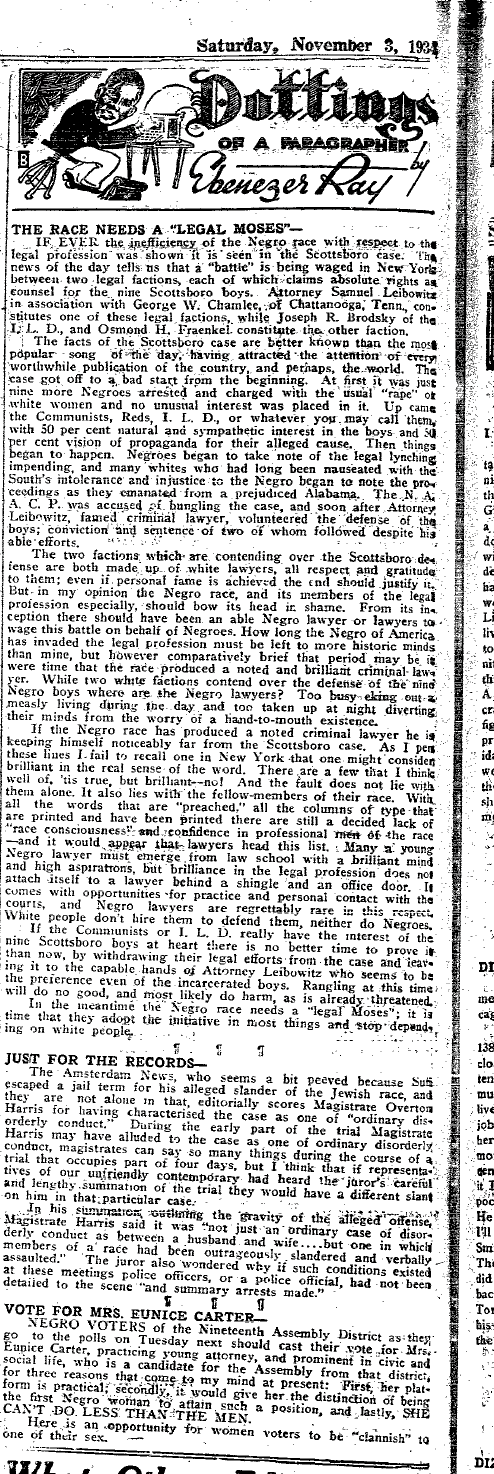
Looking for something fresh to write about on Election Day, I searched my father’s columns for wisdom from the past. A footnote in a column published in the New York Age on November 3, 1934, implored readers to elect “Mrs. Eunice Carter” to the New York State Assembly. The name had a familiar ring.

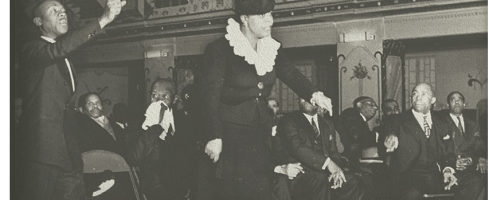
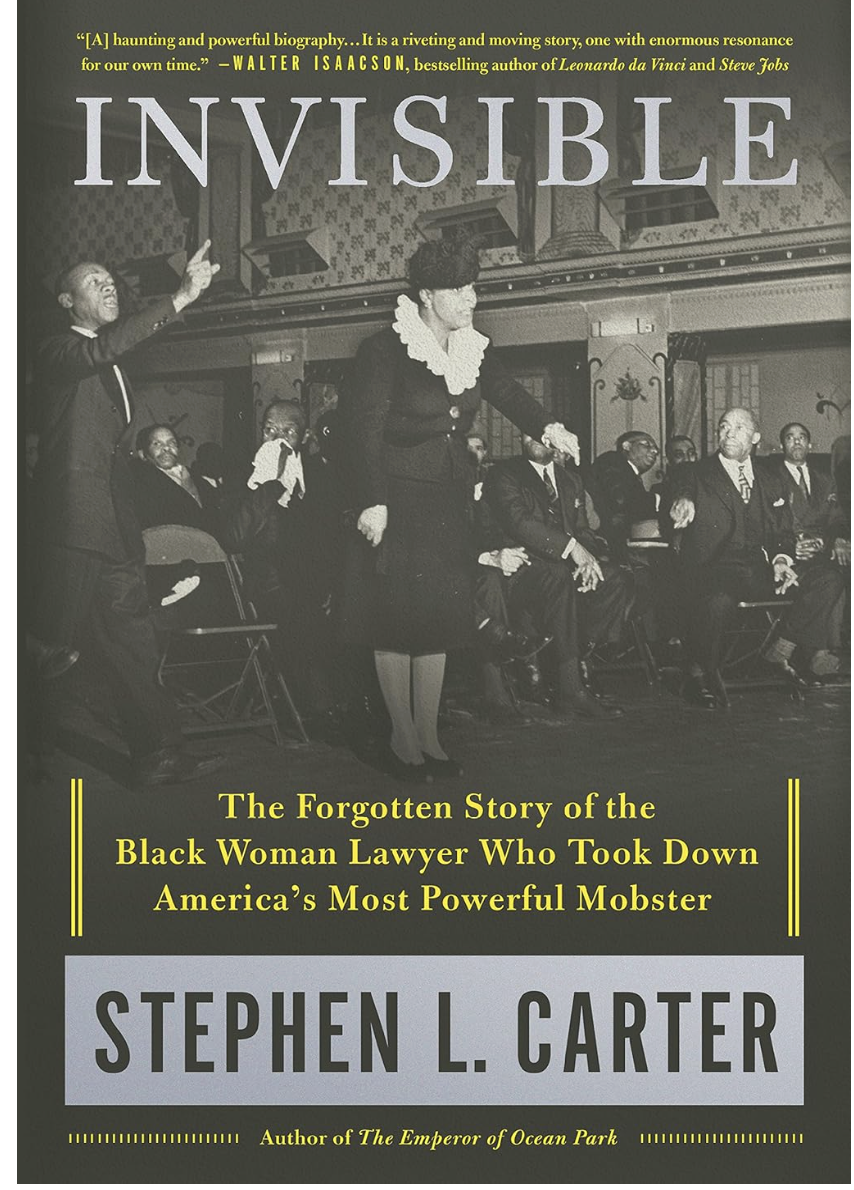
Five years ago, my cousin, Evelyn, sent me a text message with a copy of a paragraph from a book that quoted Ebenezer. The book, Invisible, by author and Yale legal scholar, Stephen L. Carter, is the biography of Stephen’s grandmother, Eunice Hunton Carter.  The book’s subtitle is: “The Forgotten Story of the Black Woman Lawyer Who Took Down America’s Most Powerful Mobster.”  

But before Eunice Carter became a prosecutor, developing the strategy that would bring down Mafia boss Lucky Luciano, she was picked by the Republican Party as their candidate for the Nineteenth District of the New York State Assembly. According to Stephen Carter, the GOP “needed a warm body” to run for the seat occupied by James Stephens, a Democrat and the only “colored” member of the Assembly at the time.

My father and his newspaper, The New York Age, were all in for Mrs. Carter.

“The Age, the more traditionalist of New York’s major Negro papers, labeled Eunice ‘exceptionally well qualified.’ The paper predicted ‘with certainty’ that she would win,” Stephen Carter wrote. “Age columnist Ebenezer Ray offered three reasons: ‘First, her platform is practical; secondly, it would give her the distinction of being the first Negro woman to attain such a position, and lastly, SHE CAN’T DO LESS THAN THE MEN.’  The column added: ‘Here is an opportunity for women voters to be clannish to one of their own sex.’”

Despite support from the Black press in New York and beyond and predictions that she was the “odds-on favorite,” Eunice Carter lost the election. The Baltimore Afro-American, which also had endorsed her, expressed surprise.

“The paper told readers that even as Eunice gave a conciliatory concession speech, she ‘looked as if her faith in humanity had been shaken,’” Stephen Carter wrote. “What went wrong?”

The author listed several possible reasons his grandmother lost, despite a “spirited campaign.” Her incumbent had likely benefitted from the patronage of Tammany Hall, the New York City Democratic political machine that dominated the city’s politics for decades. “In addition, although the impact would not be obvious for another decade, the segment of the community Eunice was seen to represent — tradition-bound, clannish, respectably middle-class — was losing its stranglehold on the politics of the darker nation. And, of course, at this time a substantial portion of the Negro and white electorate alike remained skeptical or perhaps even hostile toward female candidates,” Stephen Carter wrote.

Vote for Mrs. Eunice Carter

I’m happy to know that my father was forward-thinking enough to champion a woman’s candidacy. Still, there are echoes of today’s political climate.

My faith in humanity was shaken when Kamala Harris lost the 2024 presidential election.

Stories of Eunice crisscrossing Harlem, inspiring crowds at churches, political clubs and civic organizations; her direct appeals to specific constituencies such as Black beauticians, took me back to Harris’ whirlwind 107 days on the campaign trail.

In Invisible, Carter added that another factor in Eunice’s defeat was that Black folks were going through a “partisan transformation.” In 1929 “African America still trended Republican. By 1934, Harlem was voting Democratic— the party won every contest in the neighborhood that year—and the same partisan tide that defeated Eunice was sweeping the darker nation in election precincts around the country.”

The 2024 presidential election exposed some partisan realignments as well, including an increased portion of Black men who voted for Harris’ opponent. And while I would not call their slight right shift a tide, it is worrisome. I also worry that the “tradition bound,” Democratic establishment might court Republicans at the expense of its progressive left flank.

I wonder what Ebenezer and Eunice would think about Harris or New York Democratic Mayoral candidate Zohran Mamdani.

Happy 120th birthday

24 May


May 24 would have been my father’s 120th birthday.

I don’t know what would resonate with him today, but back in the 1930s, when he was in his mid-to-late 30s, he was given to quoting Henry Wadsworth Longfellow on his birthday.

For three consecutive years, in columns that ran near May 24, Ebenezer would quote the same lines from Longfellow’s “The Spanish Student,” a play in three acts.

s-l300

“Approaching one of those inevitable milestones imposed by Father Time, this paragrapher pauses in reflection and does a little audible thinking. Methinks Longfellow was correct when he wrote of persons born on May 24. ‘The strength of thine own arm is thy salvation.’ But I think he stretched his optimism a bit far when he said, ‘Behind those riftless [sic] clouds there is a silver lining [sic]; be patient,’” my father wrote in the New York Age, May 28, 1934.

Longfellow actually wrote “rifted clouds,” and in at least one edition, that one line was not about a silver lining. It was, “there shines a glorious star!” Also, I could not find any verification that the 19th-century poet and essayist was specifically referring to those who were born on May 24.

But, ok, Dad.

More often than not, my father used his weekly column for a little of this and a little of that. In one paragraph, he would rail against racially discriminatory hiring practices in Harlem and in the next, he would chide an acquaintance for falling under the spell of Father Devine. Then he’d wax about a social event or musical performance that moved him. Often, he used his column to express his outrage about lynchings and the trumped-up charges against the Scottsboro Boys. During the years when my father was quoting Longfellow in his birthday columns, the United States was in the throes of the Great Depression; Adolf Hitler and the Nazi Party had begun their reign. You couldn’t fault him for seeing no rift in the clouds.

These days, the press is literally being punched and kicked simply for the “crime” of asking questions.

A Republican Congress is poised to denude health care, the environment, public education and women’s agency over our bodies.

Our president and his family are raiding our treasury.

Law enforcement officers who kill unarmed black and brown civilians, including children, do so with impunity.

Immigrants are being harassed, deported and maligned.

White supremacists in this country have been given license to spew hate and kill.

Has anyone seen a glorious star lately?

Actually, yes.

When a Supreme Court majority (that includes Justice Clarence Thomas!) rejects North Carolina’s voter suppression efforts.

When reporters fight back with fierce investigative journalism.

When constituents yell “you lie” at those to try to sell us alternative facts.

When we forge authentic alliances strong enough to demolish and deconstruct silly walls.

When we vote like our lives depend on it, because apparently, they do.

So, in honor of Ebenezer’s 120th birthday, I will take a few liberties of my own with Longfellow:

Only the strength of [OUR] own [COLLECTIVE] arm[S] will be [OUR] salvation.

Let’s get to work.


Accepting democracy in theory, while nullifying it in practice

3 Sep


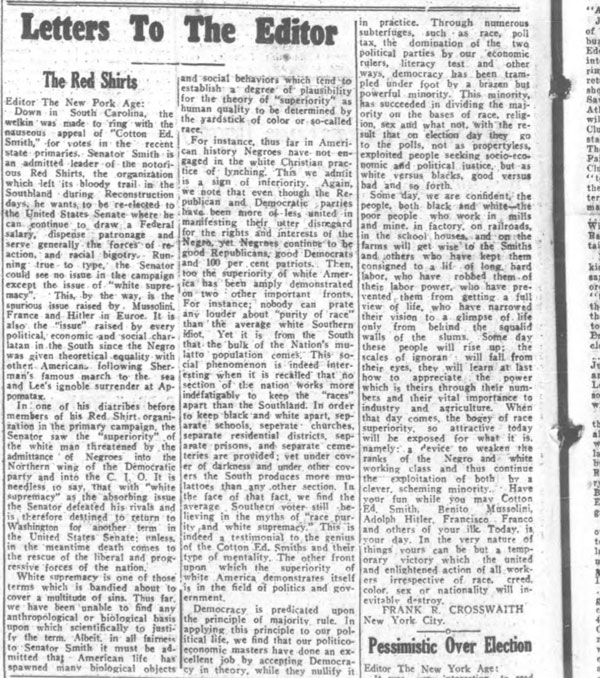
“Democracy is predicated upon the principle of majority rule. In applying this principle to our political life, we find that our politico-economic masters have done an excellent job by accepting Democracy in theory, while they nullify it in practice. Through numerous subterfuges, such as race, poll tax, the domination of the two political parties by our economic rulers, literacy tests and other ways, democracy has been trampled under foot by a brazen but powerful minority. This minority has succeeded in dividing the majority on the bases of race, religion, sex, and what not, with the result that on election day they go to the polls, not as propertyless, exploited people seeking socioeconomic and political justice, but as white vs. blacks, good vs. bad, and so forth,” Frank Crosswaith, letter to the editor, the New York Age, Oct. 8, 1938.

One of the added delights of this research into my father’s writings is stumbling upon the voices of his colleagues and contemporaries.  For weeks, I have been looking for something that might have some historical resonance to the voter suppression activities that are taking place in 2012. I also was looking for something that might be appropriate for Labor Day.

I found a twofer, not among my father’s columns, but in a letter to the editor that ran in his paper written by Frank Crosswaith (1892-1965), a New York labor leader.  Born in what is now the U. S. Virgin Islands, Crosswaith came to New York at the age of 13 and devoted his life to improving labor conditions for workers, particularly those in Harlem.  A biography on the New York Public Library’s website describes him as “one of the most effective organizers of black workers in New York City,” during the 20s and 30s.

Though Crosswaith was based in Harlem and worked closely with unions that had significant numbers of blacks among their ranks, he also embraced and championed the cause of the white working class. He ran as the Socialist candidate for several statewide offices and although his election bids were unsuccessful, he drew strong multiracial support.

Periodically, Crosswaith and my father gave one another a nod in print. Crosswaith wrote a letter praising one of my father’s columns, which Ebenezer then printed in his Dottings space on Jan. 1, 1938. My father once singled out Crosswaith as one of the few orators who took spoke on the streets of Harlem who were worth listening to and would not massacre “the King’s English.”

In that Oct. 8 letter to the editor in the New York Age, Crosswaith singled out Sen. Ellison “Cotton Ed” Smith (D-South Carolina). According to Wikipedia, Smith earned his nickname while serving in the House of Representatives when he said: “Cotton is king and white is supreme.”  Smith opposed women’s suffrage, arguing that it would apply the same rights as the 15th Amendment had granted to “the other half of the Negro race.”

During the 1938 Democratic Convention, Smith walked out when he saw that a black man was going to offer the invocation.

“Some day,” Crosswaith wrote,  “we are confident the people both black and white — the poor people who work in the mills and mine, in factory, on railroads in the school houses and on the farms will get wise to the Smiths and others who have kept them consigned to a life of long hard labor, who have robbed them of their labor power, who have prevented them from getting a full view of life, who have narrowed their vision to a glimpse of life only from behind the squalid walls of the slums. Some day these people will rise up; the scales of ignorance will fall from their eyes, they will learn at last to appreciate the power which is theirs through their numbers and their vital importance to industry and agriculture. And when that day comes, the bogey of race superiority, so attractive today, will be exposed for what it is: namely a device to weaken the ranks of the Negro and the white working class and thus continue the exploitation by a clever, scheming minority. “

To Cotton Ed Smith and “others of his ilk” Crosswaith had this message:

“Have your fun while you may . . .  Today is your day. In the very nature of things yours can be but a temporary victory which the united and enlightened action of all workers irrespective of race, creed, color, sex or nationality will inevitably destroy.“