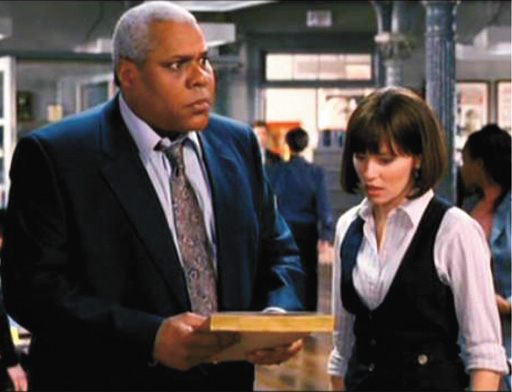
“He went to my high school!” I gestured excitedly in the movie theater last night. It was during the preview of “Won’t Back Down,” a film scheduled for release in late September. The cast includes Viola Davis, Maggie Gyllenhaal, Ving Rhames and Holly Hunter. And it also features Bill Nunn, whose father and grandfather worked with my father at the Pittsburgh Courier. Bill, well, we called him “Bubby,” also is a Morehouse grad.
Bill Nunn with Elizabeth Banks in Spider-man. Source: The Pittsburgh Courier
What I hadn’t noticed until I got home to read up on the film, is that it was shot in Pittsburgh.
And it’s about parents who take a stand to make sure their kids get the quality education they are entitled to. Gotta love that.
I haven’t seen the movie yet. I’ll try not to judge it based on the trailer, which seems pretty high on cheese.
I’ll go see it, though, just to see Bubby, who plays the school principal, and the Pittsburgh skyline, which makes my heart flutter.
This video, made in 2005, features my mother’s “baby” cousin Irving Williams and the work he and his wife, Elvira Fenton Williams, have done with the people of Tanzania, the Gambia and other developing countries.
He’s a devoted husband to Elvira, and a loving father to his four accomplished children: Irving, Donna, Andrea and Michael. He’s a super grandfather, brother, uncle and cousin.
He is funny and infectiously positive, a joy to be around.
Irving spent his early career in pediatric and adolescent medicine in Milwaukee and Boston. Then in 1974 the family went to Tanzania to help establish a pediatric sickle cell clinic for the Ministry of Health there. Inspired by that experience, he and Elvira ultimately founded Adventures in Health Education and Agricultural Development (AHEAD), Inc..
Founded in 1981, AHEAD works to reduce and eliminate disease and premature death, cultivate and advance healthy living and to foster sustainable environmental activity. The organization’s programs have helped more than 1.5 million children.
Cousin Irving celebrated his 80th birthday earlier this week, and even though the video is seven years old, it remains a fitting tribute. Thank you, Cousin Irving, and many happy returns.
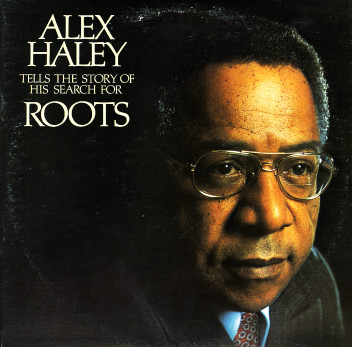
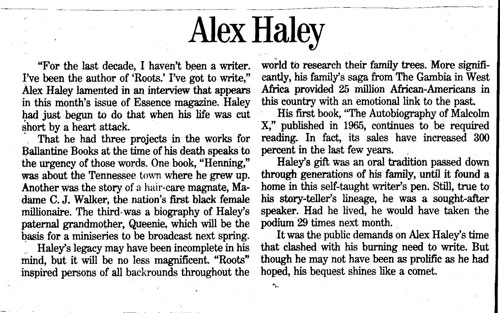
“When the griot dies, it is as if the library has burned to the ground,” Alex Haley wrote in the acknowledgments to his groundbreaking book Roots.
I thought the quote made for a perfect lede to the editorial tribute I wrote in the Boston Globe when Haley died in 1992.
My editor saw it differently. He had never heard of the word “griot,” which refers to the person in the African village who keeps the oral history alive, whether through stories or music. At that time, the word was not in the dictionary.
Cut.
The lead I ended up with was another quote from Haley:
“‘For the last decade. I haven’t been a writer. I’ve been the author of Roots. I’ve got to write,’ Alex Haley lamented in an interview that appears in this month’s issue of Essence magazine. Haley had just begun to do that when his life was cut short by a heart attack.”
That I managed to get Essence magazine in the lead of a Globe editorial is pretty impressive. Nevertheless, 20 years later, I still bristle at the conversation with my editor.
I also wrote that “Roots inspired persons of all backgrounds throughout the world to research their family trees.”
True.
He also can take some credit for inspiring at least the titles of The Root and The Griot, two major blogs focused on the African American experience.
Haley would have celebrated his 91st birthday this weekend.
During the 1936 Summer Olympic Games, James Cleveland “Jesse” Owens won four gold medals in Berlin: He came in first in the 100 meters, the 200 meters, the long jump and was part of the 4×100-meter relay team that also took gold. Owens’ success was a poke in the eye of Adolf Hitler, who had hoped the 1936 games would serve as a showcase his Aryan propaganda.
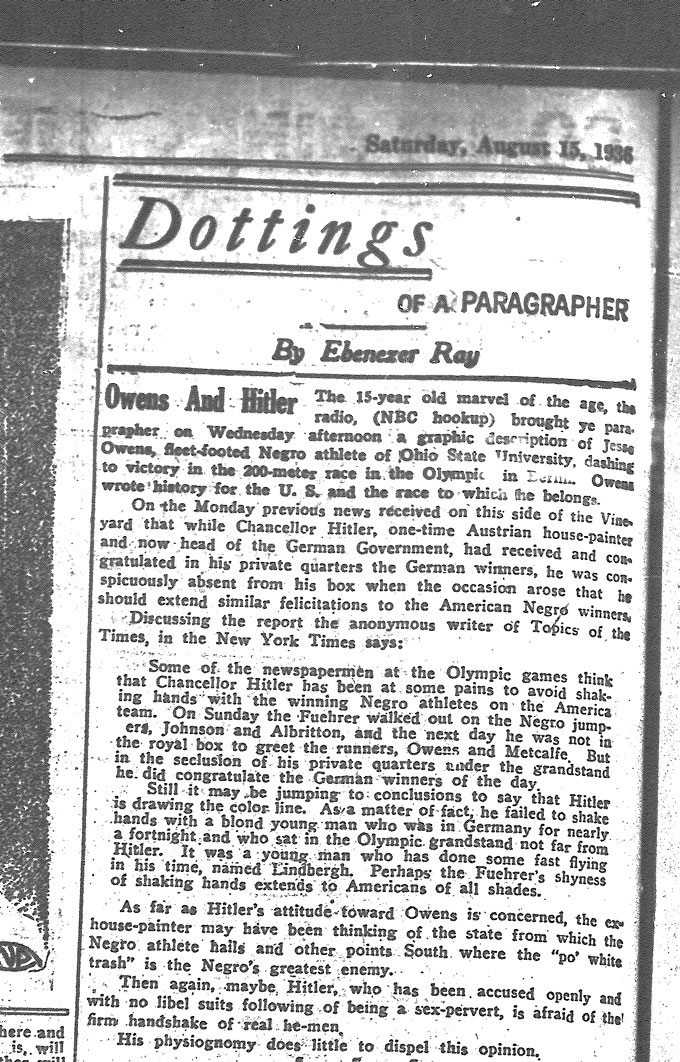
The column below, published Aug. 15, 1936, my father chided Hitler, whom he described as a “one-time Austrian house painter” and a “pervert,” who snubbed Owens. He cited news reports that while Hitler had “received and congratulated in his private quarters the German winners, he was conspicuously absent from his box when the occasion arose that he should extend similar felicitations to the American Negro winners.”
It remains unclear whether the reports of Hitler’s snub are true. The LA Times recently included the story as one of the “Top Ten Olympic Controversies.”
“Perhaps the most enduring myth of the Olympic Games is that Adolf Hitler refused to extend a congratulatory handshake to Jesse Owens, a claim for which Olympic historians have found no supporting evidence. It is clear that Hitler was neither pleased nor impressed by the four gold medals Owens won, even as the German crowd cheered him loudly and mobbed him for pictures and autographs. As Owens pierced the Nazi myth of Aryan superiority, his home country acted with regrettable caution, replacing two Jewish sprinters on the U.S. team. Owens got a hero’s welcome upon returning home, yet as a black man he had to ride the freight elevator to a New York hotel reception in his honor.”
My father’s Aug. 15 column was published the week my grandmother, Malvina Alkins, died. Guest columnists appear in the “Dottings” space in the two issues that followed.
“It is not news to those of you that read Mr. Ray’s columns that he has been an inspiration for many men who later found success in the field of journalism,” wrote Romeo Dougherty, whose bio describes him as a “well-known sports and theatrical writer.”
“To be considered worthy to take his place for even a week makes me feel that I have not labored in vain…,” he wrote in a guest column published Aug. 22, 1936.
“In the splendid showing of our boys in the Olympic Games,” Dougherty added, “we have practically sapped the climax and proved conclusively that we are worthy of being considered in every branch of athletics we seek to enter.”
Today, athletes spanning the African diaspora are representing countries across the world, including Germany.
“Immigrants signed their names to our Declaration and helped win our independence. Immigrants helped lay the railroads and build our cities, calloused hand by calloused hand. Immigrants took up arms to preserve our union, to defeat fascism, and to win a Cold War. Immigrants and their descendants helped pioneer new industries and fuel our Information Age, from Google to the iPhone. So the story of immigrants in America isn’t a story of ‘them,’ it’s a story of ‘us.’ It’s who we are. And now, all of you get to write the next chapter,” President Barack Obama told a group of active-duty service members as he presided over their naturalization ceremony earlier Wednesday.
The ceremony set the perfect tone on Independence Day 2012. As a poisonous strain of anti-immigrant fever runs high in some quarters, the President’s remarks are a powerful reminder that America’s story is at its core the story of immigration.
But it is a complex story; one that the country has been struggling with for decades.
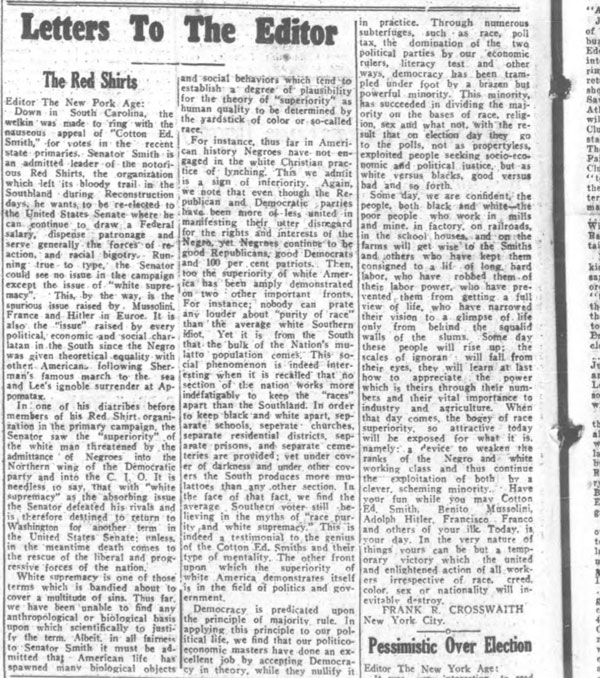
In 1934, one of my father’s fellow New York Age columnists Vere Johns, wrote albeit a bit less delicately:
“Shortly after the Great War, the United States decided that her gates should be closed but for a little crevice where she would allow a few people to slip in each year. In other words, she would keep as many aliens out as possible. But after fourteen years of that policy they are fearing that it was a big mistake and in some way responsible for the depression we are now trying to emerge from . . . .
Speaking of Americans, it is hard to find them. The first ones we claimed to be the Indians and they probably came from somewhere else; then came the Spaniards, followed by the Mayflower boatload of adventurers with no more blue blood in their veins than a cat has. Later came, or rather were dragged here, the Africans, and since then, every country has contributed its quota from Malay to Ireland. The country is one cosmopolitan racial hash, and just try to pick out a pure strain. If everyone were to go back to the land of their origin, all that would be left here is the fleas and the skunks.
But every single one of these groups has made great contributions to the building up of America into one of the world’s greatest and richest nations. America would have been a poor and desolate country with a small population, vast areas of uninhabited land and in a third-rate position,” the Jamaican-born Johns wrote.
My father chronicled his own path to citizenship. In one column published on March 3, 1934, he wrote about the hurdles immigrants scaled to become citizens — the fees, the educational requirements and some seemingly arbitrary hoops:
“Why all the red tape in a time of peace? We learn that in a time of war ‘citizenship’ is distributed for the asking — the reasons being obvious,” Ebenezer wrote, noting that within just a few years the fees for the process had increased from $5 to $20.
“The educational requirements matter but little to English-speaking Negroes, able to read and write. The questions usually asked are, “’What do you know about Abraham Lincoln?’ ‘Who makes the state laws?’ And this writer was asked in addition ‘How many stars are in the American flag? The careful perusal and retention of the contents of a 25 cents book on ‘How to Become a Citizen’ generally solve the educational requirements of becoming a citizen. But there are greater encumbrances and if the theory that that which is easily got is little valued, citizenship should be valued.”
He goes on to chronicle his path: When he initially tries to begin the process, it’s during a presidential election year. He’s told to come back after the election. On the appointed day, he returns and declares his intention to denounce King George V. He waits three more years, fulfilling the five-year U.S. residency requirement. When it’s finally time for him to make his application, he brings with him two witnesses who can vouch for his character. But one has only known him for three and a half years – the requirement was five. His application rejected, he had to start the process again. My father arrived at Ellis Island in the autumn of 1923. He became a citizen in the spring of 1930.
Luckily my father was continuously employed, even during the worst periods of the Great Depression. There was talk back then of denying pubic assistance to non-citizens and there were threats to deport them.
So nothing that he went through comes close to what some immigrants face today and the “encumbrances” he described don’t even come close to the sacrifices made by the 25 individuals who were sworn in at the White House Wednesday.
“All of you did something profound,” Obama said. “You chose to serve. You put on the uniform of a country that was not yet fully your own. In a time of war, some of you deployed into harm’s way. You displayed the values that we celebrate every Fourth of July — duty, responsibility and patriotism.”
Looking for something fresh to write about on Election Day, I searched my father’s columns for wisdom from the past. A footnote in a column published in the New York Age on November 3, 1934, implored readers to elect “Mrs. Eunice Carter” to the New York State Assembly. The name had a familiar ring. Five […]
My barber called Kamala Harris a “ho.” The shop I go to is not the stuff of Black culture lore. It’s not a boisterous place. It doesn’t reek with toxic masculinity. It’s a nice, quiet, family friendly kind of enterprise. The worst I have been subjected to in the nearly three years I’ve gone there […]
On Saturday, Feb. 17, I will be among several individuals inducted into the 2024 Class of the Black Legends of Silicon Valley. This is quite an honor. Previous recipients in the News and Documentary category in which I am being honored include journalists with stellar credentials. Loretta Green, an award-winning reporter for several local papers […]