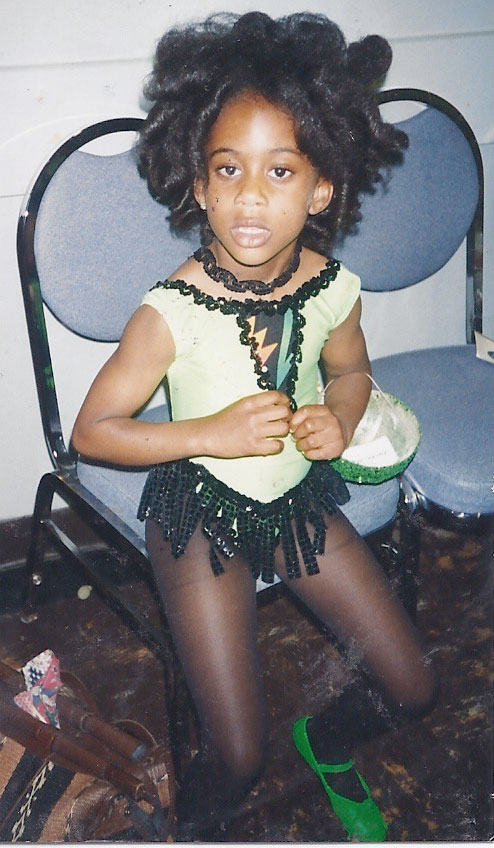
The other day someone asked me if I was worried that my daughter, Zuri Adele, was pursuing a career as an actress. It’s a question I get a lot. And as always, I responded with a confident no. I’m not. For one thing, she’s talented. For another she works hard. She’s smart, and she’s not going to starve. And, besides, it’s not as if I could discourage her if I wanted to.
( Hair by Kim Alladice-Paul)
Our family is full of people with artists’ souls who chose more “practical” paths out of necessity. I believe she has what it takes to make it.
I admit that today’s news that Tyler Perry had cast Kim Kardashian in his next movie gave me pause, but I recalled the advice veteran producer Reuben Cannon gave Zuri a few weeks ago during a talk at Morehouse College. Zuri asked Cannon what serious actors should do to survive when they are competing for attention with reality stars and people who are famous for being famous. Cannon’s advice was not to worry about them. Focus on the craft, he said. Excellence will win out in the end.
Last Spring, Zuri attended the Cannes Film Festival as an intern with Creative Minds in Cannes. In this video montage, Zuri gets the last word: “It can only get better from here,” she says.
It’s Sunday morning. We’re standing outside Highland Bakery in midtown Atlanta waiting for our brunch party to arrive. We tell the hostess there will be eight. Then comes a text. Better make that 10. Another text: How about a dozen? Text: Can we add two more? Four more? After a while I lose count.
This slideshow requires JavaScript.
We make our own family reunions. Wherever. On the spot. Sunday’s was a melange of the Williams, the Rays, the Alladices and the Cains. From Atlanta, Macon, D.C., Stanford, Chicago.
“So how is he/she related?” He’s my mother’s cousin Otto’s son. That’s cousin Catherine’s granddaughter. Byron’s daughter. Judy’s daughter. Ricky’s daughter. Darryl’s sister. Joy and Jasper’s eldest. Then there were the godchildren, the boyfriends, the sister/girlfriends and ex-girlfriends who will always be family.
The hostess finally said, “We’re never going to be able to seat you at one table.”
No problem. We hope it is always like this: a family capable of its own flash mob.
***
And speaking of family trees, if you are in the Atlanta area next weekend, be sure to check out Tree at the Horizon Theater. Written by award-winning writer Julie Hébert, Tree is a masterfully crafted, complex tale about family ties – those we know about, those we come upon by accident and those that have been purposely kept in the closet with the skeletons.
Tree is a story about letters. Love letters, written between a young white man named Ray and a young black woman, Jessalyn, in the 50s. A love so tender, so pure and naive that the young lovers were willing to defy Jim Crow and every other southern Louisiana convention to be together. Well, nearly every convention. Ultimately, they couldn’t make it work. So they buried their dream and moved on.
But memory, like love, is a hard thing to suppress.
When Ray dies and his adult daughter, Didi, finds hundreds of Jessalyn’s letters, she tracks down Jessalyn, by then living in Chicago, her mind ravaged by dementia. She wants the letters her father has written to Jessalyn so she can complete that 50-year-old conversation.
The story had the potential to be overwrought and full of clichés. But in the hands of Hébert and with fine acting and directing, the language is poetic, even at its most profane. The characters are authentic and the story intriguing.
Tree runs Wednesday, Oct. 12 through Sunday, Oct. 16, at Horizon Theatre 1083 Austin Avenue NE, corner of Euclid and Austin Avenues.
The cast includes Donna Briscoe, Megan Hayes, Geoffrey D. Williams and Joy Brunson and is directed by Lisa Adler.
Here’s a clip:
At Troy Davis’ funeral today, activist Dick Gregory asked those in attendance to say a prayer or meditation every day at noon that capital punishment will cease.
“You can’t pick and choose when you’re dealing with God’s children,” Gregory said.
Gregory demonstrated that conviction on Sept. 21, when rather than protest outside of the Georgia prison where Davis was executed, he was in Texas, holding an anti-execution vigil outside of the prison where Lawrence Russell Brewer was put to death.
Davis, convicted in the murder of Mark MacPhail, an off-duty police officer, was executed by the State of Georgia for a murder in which there was no physical evidence tying him to the 1989 crime and in which seven of nine witnesses recanted all or portions of their testimonies.
Brewer was one of three white supremacists convicted in the gruesome 1998 lynching of James Byrd. Brewer also was executed Sept. 21.
I have spent the past week trying to decide whether I could have stood beside Gregory in Texas. I’m not sure.
What I am sure of is that no one should be executed in cases like Davis’ in which there remains lots of “reasonable doubt.”
My father, who spent a good part of his career covering court proceedings in Harlem, supported the death penalty. He was convinced it was a deterrent.
“Capital punishment for ruthless murderers should stand until something better supplants it . . . . I think somewhere in Genesis we read: Whoso sheddeth man’s blood, by man shall his blood be shed,” Ebenezer Ray wrote in a column in 1934.
Whether my father changed his views later in life, I have no clue. But even he might agree that Troy Davis’ guilt had not been proved and therefore capital punishment was not appropriate in that case.
Based on his writings about Southern lynchings and the railroading of the Scottsboro Boys, I can assume Ebenezer would have been pleased to know that Brewer and his ilk were headed for the death chamber. But then again, it is likely that when my father was writing in the 1930s and 40s, no one would have even been arrested for Byrd’s heinous murder. No doubt, he would have had a lot to say about that.
I would like to think I am one of those who believe that all life is sacred and that as a civilized society we shouldn’t put anyone to death. But I wasn’t unhappy when Navy Seals blew Osama bin Laden’s brains out. But maybe the rules are different in times of war.
Back in September of 1934, my dad engaged in a fierce war of words over the death penalty with a reader, George Streator, who accused Ebenezer of being a “muddled reactionary.” I have to admit, Streator’s description was on point, and his views on the death penalty were more in line with mine.
“Capital punishment will not check murder in America, any more than lynching as a means of keeping Negroes in their places is effective except against the individual. Both the instances cited are instruments of the herd. In the matter of capital punishment, the herd is sanctioned by the law. In the matter of lynching, the herd invokes its own law. Both are sadistic outbursts,” Streator wrote.
Looking for a way to mark the 10-year anniversary of my eldest sister Ellen-Marie’s death, I looked to my father’s column’s for wisdom and inspiration.
On a couple of occasions in honoring the dead, his inspiration came from Thanatopsis, said to be the most famous work of romantic poet William Cullen Bryant. It must have hit home for my father; he included the poem’s final stanza in a column he wrote after his mother died in 1936. He used it again several years later when honoring the death of a colleague’s mother.
The New York Age, September 5, 1936
My reading of Thanatopsis is that Bryant’s point is that death and dying are part of life’s natural cycle, to which all of us will succumb. And when we do, we will join the company of the wise and the good. We should not fear death, but live life fully so that when our time comes we will enjoy our eternal rest.
This is not really much consolation when you are in the throes of grief. When I got that 3 a.m. call on Sept. 25, 2001, that Ellen had died of a heart attack in her sleep, leaving two children and a whole host of other family members and friends, I spent the following days and months alternately wanting to die and fearing that I would.
A decade does give you some perspective. And if tragedy teaches you anything, it is that you must put one foot in front of the other and press on, celebrating life’s abundance every day.
In the last stanza of Thanatopsis, Bryant wrote:
“So live, that when thy summons comes to join
That innumerable caravan that moves
To that mysterious realm where each shall take
His chamber in the silent halls of death,
Thou go not, like a quarry-slave at night
Scourged to this dungeon; but sustain’d and soothed
By an unfaltering trust, approach thy grave,
Like one who wraps the drapery of his couch
About him. and lies down to pleasant dreams.”
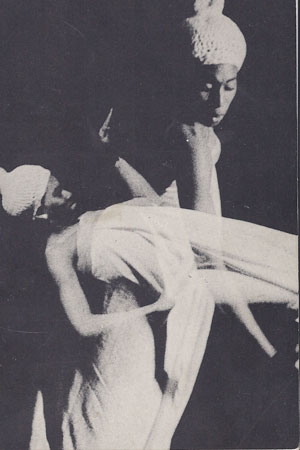
Today is my sister Malaya’s birthday. She is my parents’ second born, a dancer, storyteller, stage mother, earth mother – an artist in every sense of the word. It was preordained. Before she was Nana Malaya Rucker-Oparabea, the name she uses now, she was Marian, named for Marian Anderson.
Marian-Malaya Rucker-Oparabea
I always knew my mother revered the renowned contralto. My mother admired Anderson’s quiet dignity in the face of the Daughters of the American Revolution (DAR), who refused let Anderson sing before an integrated audience in Washington’s Constitution Hall. To my mother, Anderson’s victorious concert on Easter Sunday 1939, before a crowd of 75,000 at the Lincoln Memorial was a milestone in black history.
But for my father the connection may have been more personal. Marian Anderson was his contemporary. They were both born at the end of the 19th century. I believe he was smitten.
“With scores of her elated and admiring auditors standing at the footlights literally drinking the melodious strains which flowed from the fountain of her golden voice, Marian Anderson, internationally acclaimed contralto, sang a farewell number on Sunday evening last, he wrote in a review that appeared on the front page of the New York Age on May 14, 1938. “This was Miss Anderson’s final appearance in America this season and was given at the Carnegie Hall.”
After that concert, my father wrote, well wishers “of both races then repaired to her dressing room to shake hands with her and tender their congratulations. She was presented with a beautiful bouquet of tea roses.” I suppose he witnessed this firsthand. (Did he offer the roses?)
In a Nov. 13, 1943 review of a Pittsburgh concert, also written for the New York Age, Ebenezer called Anderson the “world’s greatest contralto.”
“Miss Anderson was in excellent voice and charmingly gowned,” he wrote. His only complaint was that the “motley” Pittsburgh audience was too subdued. Yes, there were plenty of compliments from the audience as they left Pittsburgh’s Syria Mosque, where the performance was held.
“To this erstwhile New Yorker, however, two things were missing from this recital. There were no shouts of ‘Bravo’ from the ‘peanut gallery,’ which was only two tiers up, and there were no American Beauty roses, nor orchids. In brief, Miss Anderson received no flowers. But this is Pittsburgh!”
Ebenezer would come to love, or at least accept, Pittsburgh. He would fall in love with my mother and out of that love would come three daughters, the second of whom was born on this date.
Malaya is very different from her namesake. She leans more toward classical African and Caribbean beats than Scarlatti or Schubert. Of course, these two women came of age in different times. I can only imagine what Malaya would have told the DAR. She might have even taken over the stage.
I’ve often wondered why the only one of the three of us who was named after a historical figure would change her name. The answer is simple. Malaya always has been, and will forever be, her own person.
Looking for something fresh to write about on Election Day, I searched my father’s columns for wisdom from the past. A footnote in a column published in the New York Age on November 3, 1934, implored readers to elect “Mrs. Eunice Carter” to the New York State Assembly. The name had a familiar ring. Five […]
My barber called Kamala Harris a “ho.” The shop I go to is not the stuff of Black culture lore. It’s not a boisterous place. It doesn’t reek with toxic masculinity. It’s a nice, quiet, family friendly kind of enterprise. The worst I have been subjected to in the nearly three years I’ve gone there […]
On Saturday, Feb. 17, I will be among several individuals inducted into the 2024 Class of the Black Legends of Silicon Valley. This is quite an honor. Previous recipients in the News and Documentary category in which I am being honored include journalists with stellar credentials. Loretta Green, an award-winning reporter for several local papers […]

 On a couple of occasions in honoring the dead, his inspiration came from Thanatopsis, said to be the most famous work of romantic poet William Cullen Bryant. It must have hit home for my father; he included the poem’s final stanza in a column he wrote after his mother died in 1936. He used it again several years later when honoring the death of a colleague’s mother.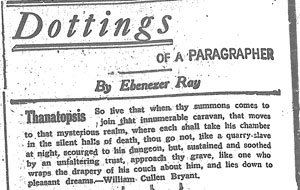


 My Father's Posts