Archive by Author

Send the Rockefellers, Fords and Mellons to war first

8 Jan

It’s an age-old argument:

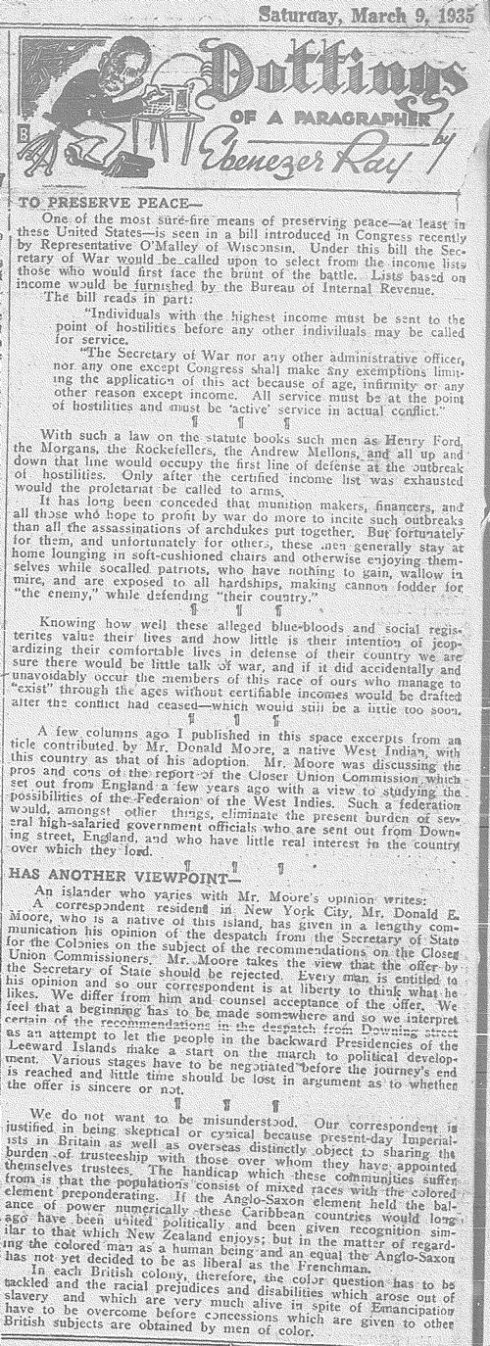
In his March 9, 1935 “Dottings” column, Ebenezer wrote about legislation forwarded by Wisconsin Democratic Congressman Thomas O’Malley, calling for the wealthy to be drafted for the U.S. military first.

“Individuals with the highest income must be sent to the point of hostilities before any other individuals called to service,” the bill read.

The only other reference I could find on this legislation was in a book titled Wealth, War & Wisdom by Barton Biggs.

Ebenezer wrote: “It has long been conceded that munition makers, financers, and all those who hope to profit by war do more to incite such outbreaks than all the assassinations of archdukes put together. But fortunately for them, and unfortunately for others, these men generally stay at home lounging in soft-cushioned chairs and otherwise enjoying themselves while so-called patriots, who have nothing to gain, wallow in mire and are exposed to all hardships, making cannon fodder for ‘the enemy,’ while defending ‘their country.'”

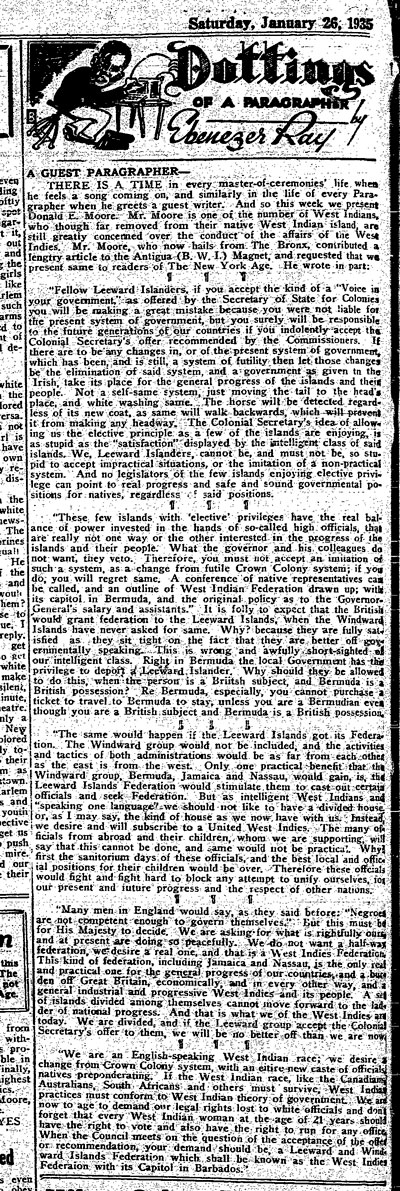
In the latter half of the column Ebenezer offers a counter argument to fellow West Indian writer Donald Moore, whom my father quoted extensively in his “Dottings” column on Jan. 26 of that year.  The column examined the recommendations of what was called the Closer Union Commission, which was considering a West Indian Federation.

“Such a federation, amongst other things, would eliminate the present burden of several high-salaried government officials who are sent out from Downing Street, England and have little interest in the country over which they lord,” Ebenezer wrote.

“We do not want to be misunderstood.  Our correspondent is justified in being skeptical or cynical because present day Imperialists in Britain as well as overseas distinctly object to sharing the burden of trusteeship with those over whom they have appointed themselves trustees. . .  In each British colony, therefore, the color question has to be tackled and the racial prejudices and  disabilities which arose out of slavery and which are very much alive in spite of Emancipation have to be overcome before concessions which are given to other British subjects are obtained by men of color.”
Guest column: The Closer Union Federation

8 Jan

Ebenezer offers his space to colleague Donald Moore. You’ll see in the “Dottings” column March 9, 1935, that Ebenezer offers his own take on the Closer Union Federation. If there are to be any changes in or of the present system of government which has been, and is still, a system of futility,” Moore wrote, “then let those changes be the elimination of said system and a government as given to the Irish, take its place for the general progress of the islands and their people.”

The New York Age, January 26, 1935

Our fathers . . .

1 Jan

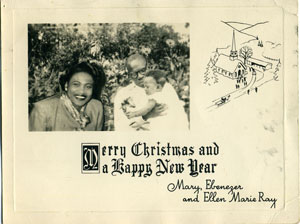
My parents with Ellen-Marie in 1949

With all of the blessings many of us enjoyed in 2010, there was a great deal of sorrow.  A few of my dearest friends lost their fathers in the waning months and days of 2010 and are facing the new year without them.  Some were blessed with very close and loving bonds. Others had relationships that were more complicated.  All of  those relationships will now take on a more poignant cast in 2011. But 2010 also brought an abundance of gifts. A year ago, I had no idea this gold mine of my father’s columns existed in the universe! And speaking of his writings, he may have had his own complicated relationship with his dad. At least so far, Ebenezer has not mentioned his father in his writings, though he gives props to his mom on a regular basis. Our fathers, living and dead, present or absent, helicopter dads and rolling stones, are alive in us and have a profound impact on who we are. Here’s hoping that their legacy makes us stronger and wiser.

A road map for a new year

1 Jan

Bruno Hauptmann

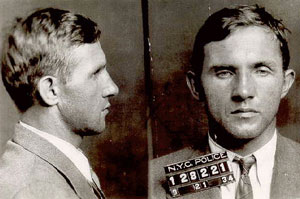
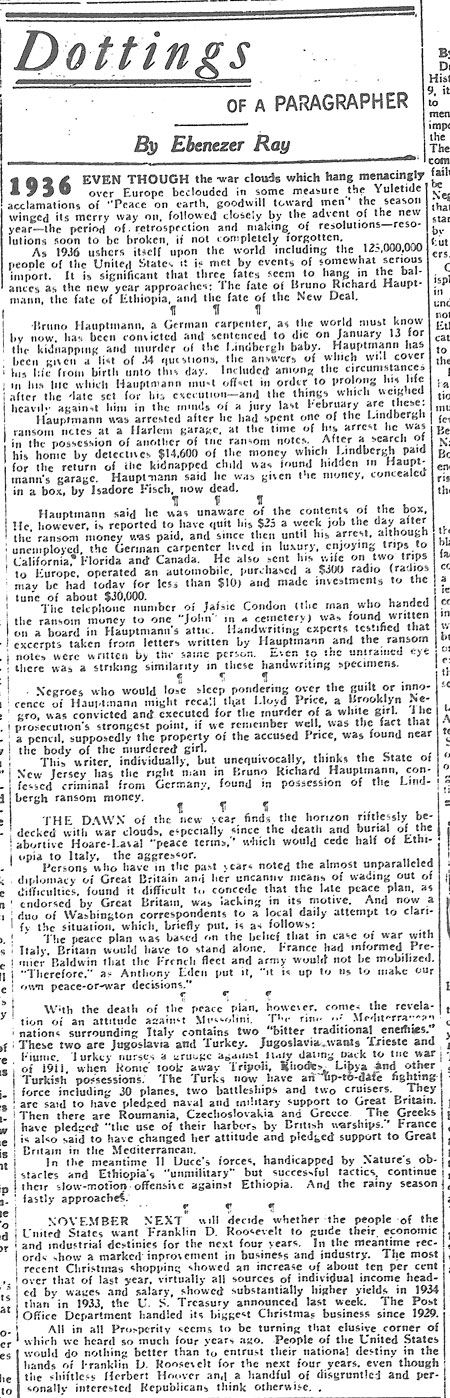
As the world welcomed 1936, the Lindbergh kidnapping case continued to capture the world’s attention.
“This writer individually but unequivocally thinks the State of New Jersey has the right man in Bruno Richard Hauptmann,” Ebenezer  wrote. He compared the Hauptmann matter with the case of Lloyd Price, a “Brooklyn Negro” who was “convicted and executed for the murder of a white girl. The prosecution’s strongest point, if we remember well, was  the fact that a pencil, supposedly the property of the accused Price, was found near the body of the murdered girl.”
My father also weighed in on Ethiopia, a recurring theme of his in 1935 and 1936, as well as FDR’s fitness for another four years:
“November next will decide whether the people of the United States want Franklin D. Roosevelt to guide their economic and industrial destinies for the next four years. In the meantime, records show a marked improvement in business and industry. the most recent Christmas shopping showed an increase of about ten per cent over that of last year, virtually all sources of individual income headed by wages and salary showed substantially higher yields n 1934 than in 1933, the U.S. Treasury announced last week. The Post office Department handled its biggest Christmas business since 1929. All in all, Prosperity seems to be turning that elusive corner of which we heard so much four years ago. People of the United States would do nothing better than to entrust their national destiny in the hands of Franklin D. Roosevelt for the next four years, even though the shiftless Herbert Hoover and a handful of disgruntled and personally interested Republicans think otherwise.”

The New York Age, January 4, 1936


Merry Christmas, Joe Louis, the Communists, the Scottsboro Boys and Mother

25 Dec

Joe Louis 1935

I love the fact that my father gave a shout out to his mom, whom he said was responsible for all that was good in him.  (Sadly, he used the same line nine months later when she died.) He also sent greetings to Joe Louis, the “uncrowned king,” “the Scottsboro lads with a sincere hope for their ultimate freedom,” and  the Communists who took up the Scottsboro Boys cause and saved their lives. There was some reluctance among supporters of the NAACP about whether the Communists efforts on behalf of the Scottsboro Boys would hurt their cause.  Ebenezer did not seem to have those concerns. He did give props to the NAACP for its “untiring efforts on behalf of the Negro race.”

The New York Age, December 28, 1935