Archive | 1934 RSS feed for this section

Elections: Facing Forward

5 Nov

Yesterday, I wrote about a thirty-something New Yorker with little political experience who ran for a seat on the New York State Assembly. Her name was Eunice Hunton Carter, and her 1934 campaign was ultimately unsuccessful.

Today, Zohran Mamdani, already a member of the New York State Assembly from Queens, is New York City’s Mayor Elect. And in addition to his success, Democratic candidates across the country won decisive victories. 

In the governors’ races in New Jersey and Virginia, both women candidates, Mikie Sherrill and Abigail Spanberger were more moderate than Mamdani, who unapologetically identifies as a democratic socialist. He has promised to make New York more affordable by freezing the rent on rent-stabilized apartments, by providing universal child care, and by making buses free. 

In his book, Invisible, Stephen L. Carter’s biography of his grandmother Eunice, he describes her 1934 election platform as “long on promises and short on the practical means for attaining them.”  She pledged to ease qualifications for old-age pensions in the days before Social Security existed. She wanted to lower electric, gas and telephone rates and improve unemployment insurance. 

“Familiar goals all,” Stephen Carter wrote, “yet Eunice was able to make people believe she could pull them off.” 

I lived in New York for a brief six years, and left the city decades ago, but it continues to have a hold on me, as I believe it had on my father, even after he made Pittsburgh his home. 

So, I, like Eunice’s supporters, was electrified by Mamdani’s campaign even from 3,000 miles away. And I am hopeful that as Mayor he has the practical skills and the talented administration necessary to attain at least some of his goals.

The swath of Tuesday’s election outcomes suggests that the Democratic Party is not one-size-fits-all and that it should continue to embrace a wide tent. May the momentum of these victories and the coalitions that made them possible help smooth even the rockiest political roads ahead. 

Election days, then and now

4 Nov

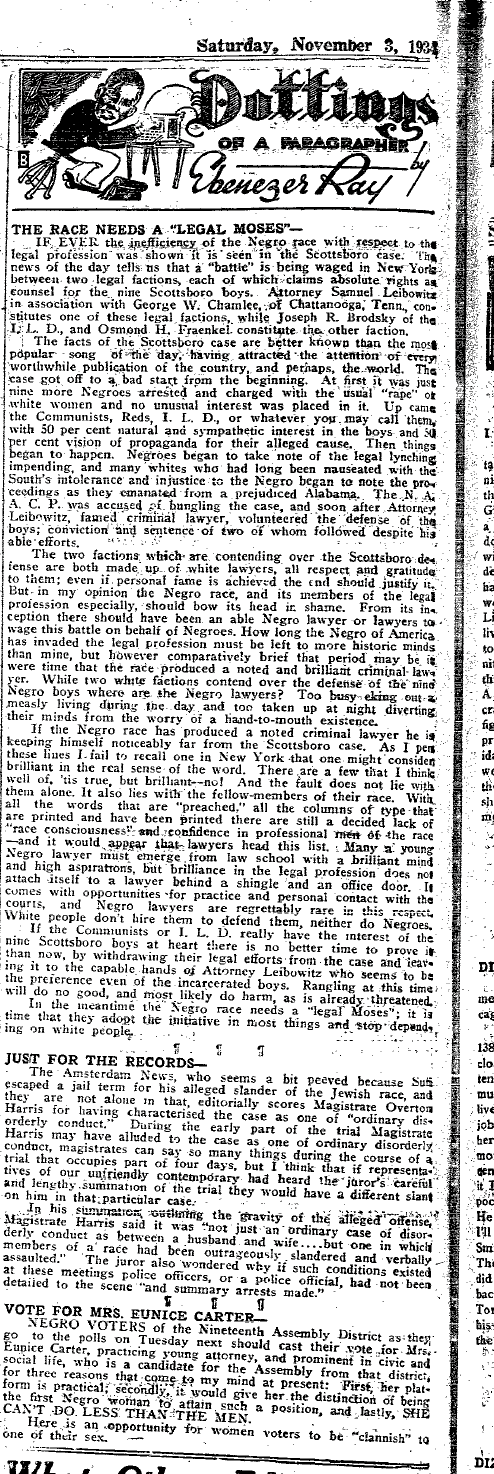
Looking for something fresh to write about on Election Day, I searched my father’s columns for wisdom from the past. A footnote in a column published in the New York Age on November 3, 1934, implored readers to elect “Mrs. Eunice Carter” to the New York State Assembly. The name had a familiar ring.

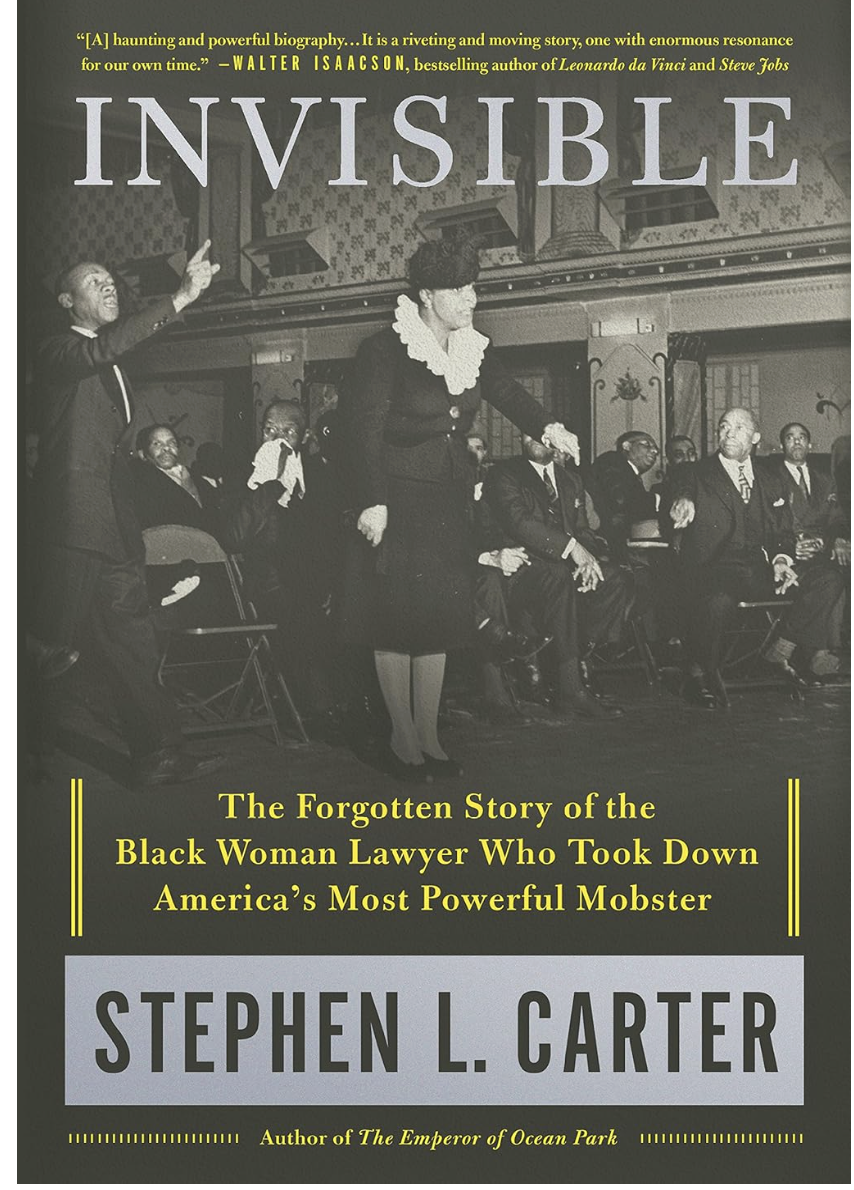
Five years ago, my cousin, Evelyn, sent me a text message with a copy of a paragraph from a book that quoted Ebenezer. The book, Invisible, by author and Yale legal scholar, Stephen L. Carter, is the biography of Stephen’s grandmother, Eunice Hunton Carter.  The book’s subtitle is: “The Forgotten Story of the Black Woman Lawyer Who Took Down America’s Most Powerful Mobster.”  

But before Eunice Carter became a prosecutor, developing the strategy that would bring down Mafia boss Lucky Luciano, she was picked by the Republican Party as their candidate for the Nineteenth District of the New York State Assembly. According to Stephen Carter, the GOP “needed a warm body” to run for the seat occupied by James Stephens, a Democrat and the only “colored” member of the Assembly at the time.

My father and his newspaper, The New York Age, were all in for Mrs. Carter.

“The Age, the more traditionalist of New York’s major Negro papers, labeled Eunice ‘exceptionally well qualified.’ The paper predicted ‘with certainty’ that she would win,” Stephen Carter wrote. “Age columnist Ebenezer Ray offered three reasons: ‘First, her platform is practical; secondly, it would give her the distinction of being the first Negro woman to attain such a position, and lastly, SHE CAN’T DO LESS THAN THE MEN.’  The column added: ‘Here is an opportunity for women voters to be clannish to one of their own sex.’”

Despite support from the Black press in New York and beyond and predictions that she was the “odds-on favorite,” Eunice Carter lost the election. The Baltimore Afro-American, which also had endorsed her, expressed surprise.

“The paper told readers that even as Eunice gave a conciliatory concession speech, she ‘looked as if her faith in humanity had been shaken,’” Stephen Carter wrote. “What went wrong?”

The author listed several possible reasons his grandmother lost, despite a “spirited campaign.” Her incumbent had likely benefitted from the patronage of Tammany Hall, the New York City Democratic political machine that dominated the city’s politics for decades. “In addition, although the impact would not be obvious for another decade, the segment of the community Eunice was seen to represent — tradition-bound, clannish, respectably middle-class — was losing its stranglehold on the politics of the darker nation. And, of course, at this time a substantial portion of the Negro and white electorate alike remained skeptical or perhaps even hostile toward female candidates,” Stephen Carter wrote.

Vote for Mrs. Eunice Carter

I’m happy to know that my father was forward-thinking enough to champion a woman’s candidacy. Still, there are echoes of today’s political climate.

My faith in humanity was shaken when Kamala Harris lost the 2024 presidential election.

Stories of Eunice crisscrossing Harlem, inspiring crowds at churches, political clubs and civic organizations; her direct appeals to specific constituencies such as Black beauticians, took me back to Harris’ whirlwind 107 days on the campaign trail.

In Invisible, Carter added that another factor in Eunice’s defeat was that Black folks were going through a “partisan transformation.” In 1929 “African America still trended Republican. By 1934, Harlem was voting Democratic— the party won every contest in the neighborhood that year—and the same partisan tide that defeated Eunice was sweeping the darker nation in election precincts around the country.”

The 2024 presidential election exposed some partisan realignments as well, including an increased portion of Black men who voted for Harris’ opponent. And while I would not call their slight right shift a tide, it is worrisome. I also worry that the “tradition bound,” Democratic establishment might court Republicans at the expense of its progressive left flank.

I wonder what Ebenezer and Eunice would think about Harris or New York Democratic Mayoral candidate Zohran Mamdani.

Happy 120th birthday

24 May


May 24 would have been my father’s 120th birthday.

I don’t know what would resonate with him today, but back in the 1930s, when he was in his mid-to-late 30s, he was given to quoting Henry Wadsworth Longfellow on his birthday.

For three consecutive years, in columns that ran near May 24, Ebenezer would quote the same lines from Longfellow’s “The Spanish Student,” a play in three acts.

s-l300

“Approaching one of those inevitable milestones imposed by Father Time, this paragrapher pauses in reflection and does a little audible thinking. Methinks Longfellow was correct when he wrote of persons born on May 24. ‘The strength of thine own arm is thy salvation.’ But I think he stretched his optimism a bit far when he said, ‘Behind those riftless [sic] clouds there is a silver lining [sic]; be patient,’” my father wrote in the New York Age, May 28, 1934.

Longfellow actually wrote “rifted clouds,” and in at least one edition, that one line was not about a silver lining. It was, “there shines a glorious star!” Also, I could not find any verification that the 19th-century poet and essayist was specifically referring to those who were born on May 24.

But, ok, Dad.

More often than not, my father used his weekly column for a little of this and a little of that. In one paragraph, he would rail against racially discriminatory hiring practices in Harlem and in the next, he would chide an acquaintance for falling under the spell of Father Devine. Then he’d wax about a social event or musical performance that moved him. Often, he used his column to express his outrage about lynchings and the trumped-up charges against the Scottsboro Boys. During the years when my father was quoting Longfellow in his birthday columns, the United States was in the throes of the Great Depression; Adolf Hitler and the Nazi Party had begun their reign. You couldn’t fault him for seeing no rift in the clouds.

These days, the press is literally being punched and kicked simply for the “crime” of asking questions.

A Republican Congress is poised to denude health care, the environment, public education and women’s agency over our bodies.

Our president and his family are raiding our treasury.

Law enforcement officers who kill unarmed black and brown civilians, including children, do so with impunity.

Immigrants are being harassed, deported and maligned.

White supremacists in this country have been given license to spew hate and kill.

Has anyone seen a glorious star lately?

Actually, yes.

When a Supreme Court majority (that includes Justice Clarence Thomas!) rejects North Carolina’s voter suppression efforts.

When reporters fight back with fierce investigative journalism.

When constituents yell “you lie” at those to try to sell us alternative facts.

When we forge authentic alliances strong enough to demolish and deconstruct silly walls.

When we vote like our lives depend on it, because apparently, they do.

So, in honor of Ebenezer’s 120th birthday, I will take a few liberties of my own with Longfellow:

Only the strength of [OUR] own [COLLECTIVE] arm[S] will be [OUR] salvation.

Let’s get to work.


Happy Birthday, Ebenezer

24 May

My father would be 117 years old today. Eighty years ago his birthday wish was for a typewriter with the same configuration of keys as a Linotype machine.  I wonder what he would think of our writing implements and communications platforms today.  A dear friend recently gave me a bracelet made of typewriter keys. I’m wearing in honor of my Daddy’s birthday today.


Immigration nation (reposted from 2012)

4 Jul

“Immigrants signed their names to our Declaration and helped win our independence.  Immigrants helped lay the railroads and build our cities, calloused hand by calloused hand.  Immigrants took up arms to preserve our union, to defeat fascism, and to win a Cold War.  Immigrants and their descendants helped pioneer new industries and fuel our Information Age, from Google to the iPhone.  So the story of immigrants in America isn’t a story of ‘them,’ it’s a story of ‘us.’  It’s who we are.  And now, all of you get to write the next chapter,” President Barack Obama told a group of active-duty service members as he presided over their naturalization ceremony earlier Wednesday.

The ceremony set the perfect tone on Independence Day 2012. As a poisonous strain of anti-immigrant fever runs high in some quarters, the President’s remarks are a powerful reminder that America’s story is at its core the story of immigration.

But it is a complex story; one that the country has been struggling with for decades.

In 1934, one of my father’s fellow New York Age columnists Vere Johns, wrote albeit a bit less delicately:

“Shortly after the Great War, the United States decided that her gates should be closed but for a little crevice where she would allow a few people to slip in each year. In other words, she would keep as many aliens out as possible. But after fourteen years of that policy they are fearing that it was a big mistake and in some way responsible for the depression we are now trying to emerge from . . . .

Speaking of Americans, it is hard to find them. The first ones we claimed to be the Indians and they probably came from somewhere else; then came the Spaniards, followed by the Mayflower boatload of adventurers with no more blue blood in their veins than a cat has. Later came, or rather were dragged here, the Africans, and since then, every country has contributed its quota from Malay to Ireland. The country is one cosmopolitan racial hash, and just try to pick out a pure strain. If everyone were to go back to the land of their origin, all that would be left here is the fleas and the skunks.

But every single one of these groups has made great contributions to the building up of America into one of the world’s greatest and richest nations. America would have been a poor and desolate country with a small population, vast areas of uninhabited land and in a third-rate position,” the Jamaican-born Johns wrote.

My father chronicled his own path to citizenship. In one column published on March 3, 1934, he wrote about the hurdles immigrants scaled to become citizens  — the fees, the educational requirements and some seemingly arbitrary hoops:

“Why all the red tape in a time of peace? We learn that in a time of war ‘citizenship’ is distributed for the asking — the reasons being obvious,” Ebenezer wrote, noting that within just a few years the fees for the process had increased from $5 to $20.

“The educational requirements matter but little to English-speaking Negroes, able to read and write. The questions usually asked are, “’What do you know about Abraham Lincoln?’ ‘Who makes the state laws?’ And this writer was asked in addition ‘How many stars are in the American flag? The careful perusal and retention of the contents of a 25 cents book on ‘How to Become a Citizen’ generally solve the educational requirements of becoming a citizen. But there are greater encumbrances and if the theory that that which is easily got is little valued,  citizenship should be valued.”

He goes on to chronicle his path: When he initially tries to begin the process, it’s during a presidential election year. He’s told to come back after the election. On the appointed day, he returns and declares his intention to denounce King George V. He waits three more years, fulfilling the five-year U.S. residency requirement. When it’s finally time for him to make his application, he brings with him two witnesses who can vouch for his character. But one has only known him for three and a half years – the requirement was five. His application rejected, he had to start the process again.  My father arrived at Ellis Island in the autumn of 1923. He became a citizen in the spring of 1930.

Luckily my father was continuously employed, even during the worst periods of the Great Depression. There was talk back then of denying pubic assistance to non-citizens and there were threats to deport them.

So nothing that he went through comes close to what some immigrants face today and the “encumbrances” he described don’t even come close to the sacrifices made by the 25 individuals who were sworn in at the White House Wednesday.

“All of you did something profound,” Obama said. “You chose to serve.  You put on the uniform of a country that was not yet fully your own. In a time of war, some of you deployed into harm’s way.  You displayed the values that we celebrate every Fourth of July — duty, responsibility and patriotism.”

Amen.
Continue reading