Archive | Dottings of a Paragrapher RSS feed for this section

Elections: Facing Forward

5 Nov

Yesterday, I wrote about a thirty-something New Yorker with little political experience who ran for a seat on the New York State Assembly. Her name was Eunice Hunton Carter, and her 1934 campaign was ultimately unsuccessful.

Today, Zohran Mamdani, already a member of the New York State Assembly from Queens, is New York City’s Mayor Elect. And in addition to his success, Democratic candidates across the country won decisive victories. 

In the governors’ races in New Jersey and Virginia, both women candidates, Mikie Sherrill and Abigail Spanberger were more moderate than Mamdani, who unapologetically identifies as a democratic socialist. He has promised to make New York more affordable by freezing the rent on rent-stabilized apartments, by providing universal child care, and by making buses free. 

In his book, Invisible, Stephen L. Carter’s biography of his grandmother Eunice, he describes her 1934 election platform as “long on promises and short on the practical means for attaining them.”  She pledged to ease qualifications for old-age pensions in the days before Social Security existed. She wanted to lower electric, gas and telephone rates and improve unemployment insurance. 

“Familiar goals all,” Stephen Carter wrote, “yet Eunice was able to make people believe she could pull them off.” 

I lived in New York for a brief six years, and left the city decades ago, but it continues to have a hold on me, as I believe it had on my father, even after he made Pittsburgh his home. 

So, I, like Eunice’s supporters, was electrified by Mamdani’s campaign even from 3,000 miles away. And I am hopeful that as Mayor he has the practical skills and the talented administration necessary to attain at least some of his goals.

The swath of Tuesday’s election outcomes suggests that the Democratic Party is not one-size-fits-all and that it should continue to embrace a wide tent. May the momentum of these victories and the coalitions that made them possible help smooth even the rockiest political roads ahead. 

Election days, then and now

4 Nov

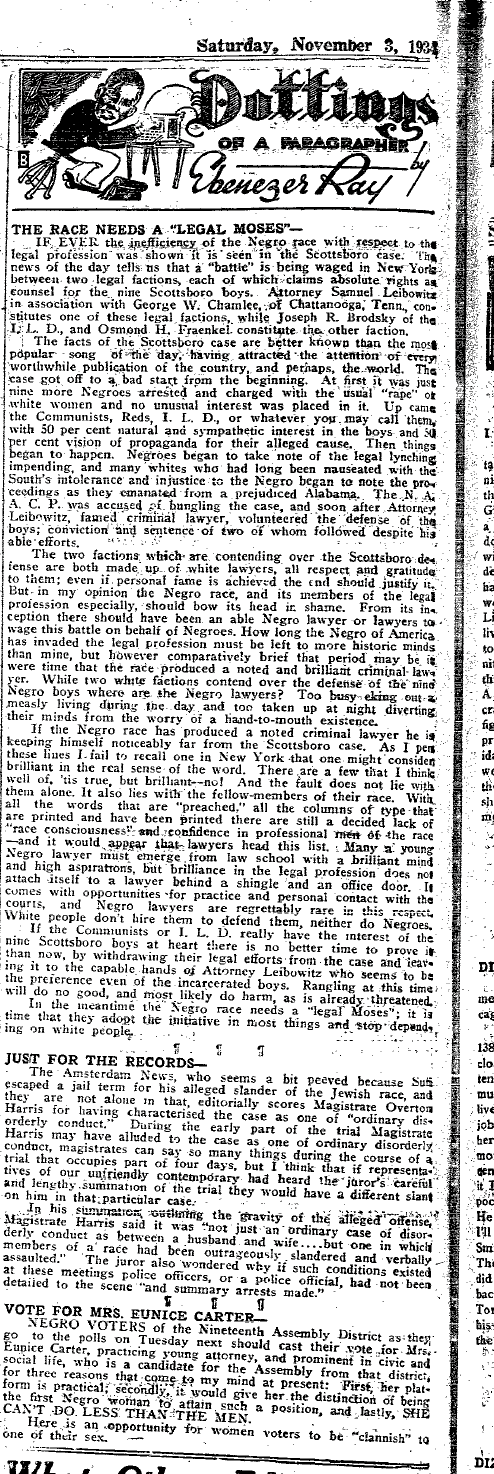
Looking for something fresh to write about on Election Day, I searched my father’s columns for wisdom from the past. A footnote in a column published in the New York Age on November 3, 1934, implored readers to elect “Mrs. Eunice Carter” to the New York State Assembly. The name had a familiar ring.

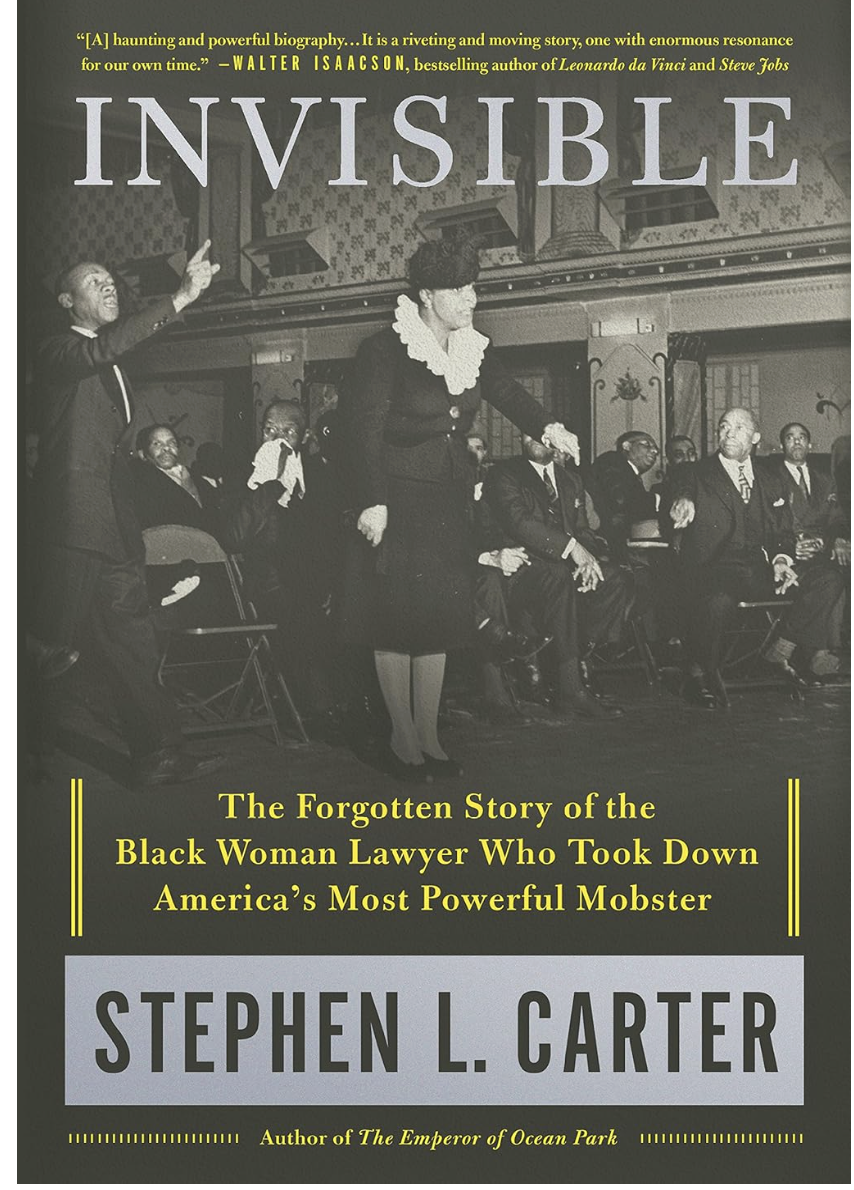
Five years ago, my cousin, Evelyn, sent me a text message with a copy of a paragraph from a book that quoted Ebenezer. The book, Invisible, by author and Yale legal scholar, Stephen L. Carter, is the biography of Stephen’s grandmother, Eunice Hunton Carter.  The book’s subtitle is: “The Forgotten Story of the Black Woman Lawyer Who Took Down America’s Most Powerful Mobster.”  

But before Eunice Carter became a prosecutor, developing the strategy that would bring down Mafia boss Lucky Luciano, she was picked by the Republican Party as their candidate for the Nineteenth District of the New York State Assembly. According to Stephen Carter, the GOP “needed a warm body” to run for the seat occupied by James Stephens, a Democrat and the only “colored” member of the Assembly at the time.

My father and his newspaper, The New York Age, were all in for Mrs. Carter.

“The Age, the more traditionalist of New York’s major Negro papers, labeled Eunice ‘exceptionally well qualified.’ The paper predicted ‘with certainty’ that she would win,” Stephen Carter wrote. “Age columnist Ebenezer Ray offered three reasons: ‘First, her platform is practical; secondly, it would give her the distinction of being the first Negro woman to attain such a position, and lastly, SHE CAN’T DO LESS THAN THE MEN.’  The column added: ‘Here is an opportunity for women voters to be clannish to one of their own sex.’”

Despite support from the Black press in New York and beyond and predictions that she was the “odds-on favorite,” Eunice Carter lost the election. The Baltimore Afro-American, which also had endorsed her, expressed surprise.

“The paper told readers that even as Eunice gave a conciliatory concession speech, she ‘looked as if her faith in humanity had been shaken,’” Stephen Carter wrote. “What went wrong?”

The author listed several possible reasons his grandmother lost, despite a “spirited campaign.” Her incumbent had likely benefitted from the patronage of Tammany Hall, the New York City Democratic political machine that dominated the city’s politics for decades. “In addition, although the impact would not be obvious for another decade, the segment of the community Eunice was seen to represent — tradition-bound, clannish, respectably middle-class — was losing its stranglehold on the politics of the darker nation. And, of course, at this time a substantial portion of the Negro and white electorate alike remained skeptical or perhaps even hostile toward female candidates,” Stephen Carter wrote.

Vote for Mrs. Eunice Carter

I’m happy to know that my father was forward-thinking enough to champion a woman’s candidacy. Still, there are echoes of today’s political climate.

My faith in humanity was shaken when Kamala Harris lost the 2024 presidential election.

Stories of Eunice crisscrossing Harlem, inspiring crowds at churches, political clubs and civic organizations; her direct appeals to specific constituencies such as Black beauticians, took me back to Harris’ whirlwind 107 days on the campaign trail.

In Invisible, Carter added that another factor in Eunice’s defeat was that Black folks were going through a “partisan transformation.” In 1929 “African America still trended Republican. By 1934, Harlem was voting Democratic— the party won every contest in the neighborhood that year—and the same partisan tide that defeated Eunice was sweeping the darker nation in election precincts around the country.”

The 2024 presidential election exposed some partisan realignments as well, including an increased portion of Black men who voted for Harris’ opponent. And while I would not call their slight right shift a tide, it is worrisome. I also worry that the “tradition bound,” Democratic establishment might court Republicans at the expense of its progressive left flank.

I wonder what Ebenezer and Eunice would think about Harris or New York Democratic Mayoral candidate Zohran Mamdani.

Happy Thanksgiving

20 Nov

My father plagiarized himself frequently, most notably in his Thanksgiving columns. In 1934, 1936 and 1938, he wrote about the Pilgrim fathers, who in 1623 faced “their second winter of hunger, cold and peril” until, after a day of prayer, sighted “a ship loaded with friends and supplies.” He ended every one of these columns with the question of whether “Negroes” should be thankful. He would give a nod to the Scottsboro Boys, who were  incarcerated in Alabama. A favorite refrain was that the  “Negro’s winter is still on” and the ideals of safety and happiness continued to elude American blacks.

In 1939 his column still included these elements, but had a more optimistic tone. That year, President Franklin Roosevelt decided that Thanksgiving should be celebrated the next to the last Thursday of the month, rather than the last Thursday, which had been American tradition dating back to the end of the Civil War.

“Now, in the year of 1939, Americans find themselves sandwiched between two Thanksgiving Days,”  Ebenezer wrote. According to my father about half of the nation’s bosses  “preferred to adhere to the traditional (Lincoln’s). . .”

Apparently, my father  thought the whole debate was silly.

“It is safe to say that the idea of giving thanks on this day has been lost in its routine acceptance. It is now rather a day of feasting. And to hear the opposition tell it, one is almost moved to believe that there IS a difference between gormandizing vittles and guzzling corn liquor on one Thursday as against another Thursday. But this is a Democracy.”

Under Stalin, Hitler or Mussolini, he asserted, the “thanksgiving edict” would have come without choice and accepted with the “clicking of the heels. Dictators’ proclamations have but one ‘alternative’: yes or YES.  . . Not in America. And that’s a good reason for giving thanks – any day.”

Ebenezer gave his customary nod to the Scottsboro boys.  Five of the original nine were still imprisoned. “Should the question of Thanksgiving Day penetrate those prison walls, those lads could well ask: What have we to be thankful for on the 23rd or the  30th of November?” he asked. “Their oppressors quibble over trifles.”

“Quibbling over when one should give thanks is hardly productive of the spirit of gratefulness  – at that. “

As for me, I’m giving thanks every day that America is changing, as evidenced by the recent election. Thankful that more Americans will have access to health care and that women will have agency over their own bodies. That race-baiting and big money don’t always prevail and that the Supreme Court’s activist slide will be slowed.

No doubt, our nation is still deeply divided between those who “want to  take their country back” and those who want to move forward.  But, as Ebenezer said,  “This is Democracy.”

By the way, I was going to wait until tomorrow to add a photo of President Obama pardoning a turkey, but I thought this video said more about thankfulness.

Dottings on a presidential reelection: Hate me if you dare

11 Nov

I’m re-posting an entry I originally published in February of 2011, which seems like ages ago. Last Tuesday, We The People overcame voter suppression campaigns, lies, bungled debates and obscene amounts of campaign spending to reelect President Barack Obama and to put down efforts to make him a one-term president. Now that the Florida vote has been counted, I thought I would add this year’s final electoral map.

The New New Deal, 2008, Photo illustration by Arthur Hochstein and Lon Tweeten. ( F.D.R. photo by Associated Press. Obama photo by John Gress, Reuters.)

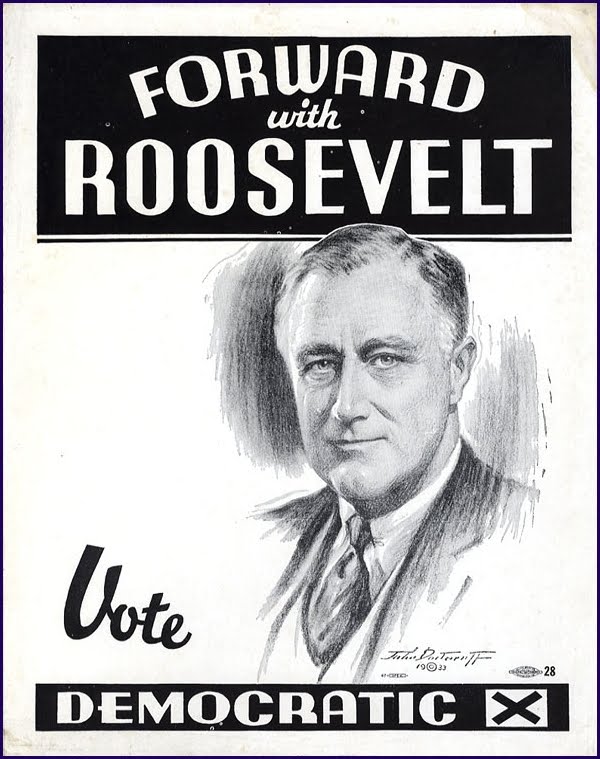
“Never before have these forces been so united against one candidate as they stand today. They are unanimous in their hate for me—and I welcome their hatred,” Franklin Delano Roosevelt said of Republicans during his reelection campaign in 1936.
Sound familiar? I wish.
Perhaps President Obama will take a page from FDR as he gears up for the 2012 campaign.
After all, these fightin’ words turned out to be winning words for FDR.
In honor of Presidents’ Day, I offer a column published by my father, Ebenezer Ray, on Nov. 14, 1936, shortly after the shellacking Roosevelt doled out to his opponent, Gov. Alf Landon of Kansas,  in 1936. Prior to the election, my father had written columns endorsing Roosevelt. But his support was not a given.  His employer, The New York Age, was a traditional supporter of the Republican Party.  The paper opposed the Democratic Party nationally because of its tolerance  of southern segregation.

FDR’s 1936 landslide.    Credit: 270toWin

Referring to himself in typical self-deprecating fashion, Ebenezer wrote: “This newcomer and political dunce failed to be convinced (1) that President Roosevelt was not the fit and proper person to guide the destiny of this country for the next four years and (2) that the Republican candidate was the better man.
. . . With his avalanche of votes in favor of the New Deal went the Negro vote, local and national, despite the fact that President Roosevelt represents the Party which disenfranchises the Negro in the South. Wherefore the Negro vote?
According to the man in the street, in the barbershop, in the restaurant and other proletariat among whom this writer moves, prosperity is the paramount issue. Up to 1929, they contend there was discrimination in the South, but we also had prosperity. Since 1929, and especially during the last Republican regime, there was still discrimination in the South but NO prosperity. In President Roosevelt is seen the capability of bringing prosperity from around  that elusive corner, made popular by Mr. Hoover.”
To illustrate his community’s support of the New Deal, Ebenezer described the changing atmosphere in the bank at the corner of 135th Street and Seventh Ave.
“In these premises, until president Roosevelt’s bank holiday, was situated the unlamented Chelsea Bank.  During its declining months one could easily race a bull about the premises without harming a depositor.  Nowadays, occupied by the Dunbar National Bank, during business hours the premises resemble a market rather than a bank. Of great concern to the poor man is the knowledge that whatever part of his earnings he is privileged to save is SAFE.
The great majority has reelected Roosevelt. ‘The voice of the people is the voice of God,'” Ebenezer concluded.
Robert Reich, former secretary of labor in the Clinton Administration, who is now a professor of public policy at the University of California at Berkeley, wrote a column before the midterm election last fall, titled “Why Obama should learn the lesson of 1936, not 1996,” In it, Reich said: “The relevant political lesson isn’t Bill Clinton in 1996, but Franklin Delano Roosevelt in 1936.”

Library of Congress

Reich continued:”By the election of 1936 the Great Depression was entering its eighth year. Roosevelt had already been president for four of them. Yet he won the biggest electoral victory since the start of the two-party system in the 1850s.” Reich wrote that while the key to Clinton’s victory was a booming economy, the key to Roosevelt’s was setting himself apart from the greed of the Republicans and their financiers and standing up for and with everyday people.

Back to Ebenezer’s column: At the end he offers a brief review of the theater adaptation of Sinclair Lewis’ novel It Can’t Happen Here, about a Hitler type character who attempts to dominate the United States:
“The capacity crowd which attended the Adelphi Theatre on West 54th Street Thursday evening last . . . is better testimony to the entertainment value of It Can’t Happen Here than any reviewer can write. For, after all, ‘It is the guest who is the judge of the meat,'” Ebenezer wrote.

From Barbados, with love

24 May

Zuri Adele on Accra Beach, Barbados

CHRIST CHURCH, BARBADOS, May 24, 2012 — Zuri, my sister-in-law Tracy and I are in Barbados for a little R&R after a whirlwind Spelman Commencement Weekend. It also happens to be my father’s birthday. He would be 115.

In a column he published shortly after his 43rd birthday  in 1940, he uses the occasion to commemorate Empire Day, the birthday of Queen Victoria, with whom he shared a natal day:

“It is difficult  if not at all impossible for ye paragrapher to forget Empire Day, though we may be many years removed from the British Empire, because it was on that day our late beloved mother told us we ‘came from somewhere in a box.’ Most readers of this column think we should have been left in the box.”

Tomorrow, I have an appointment with a specialist in Barbados genealogy who is going to try to help me get to the bottom of that box.

For today we’ll take a tour of the island, hit the beach and pour a libation in honor of Ebenezer’s birthday.

The New York Age, June 1, 1940