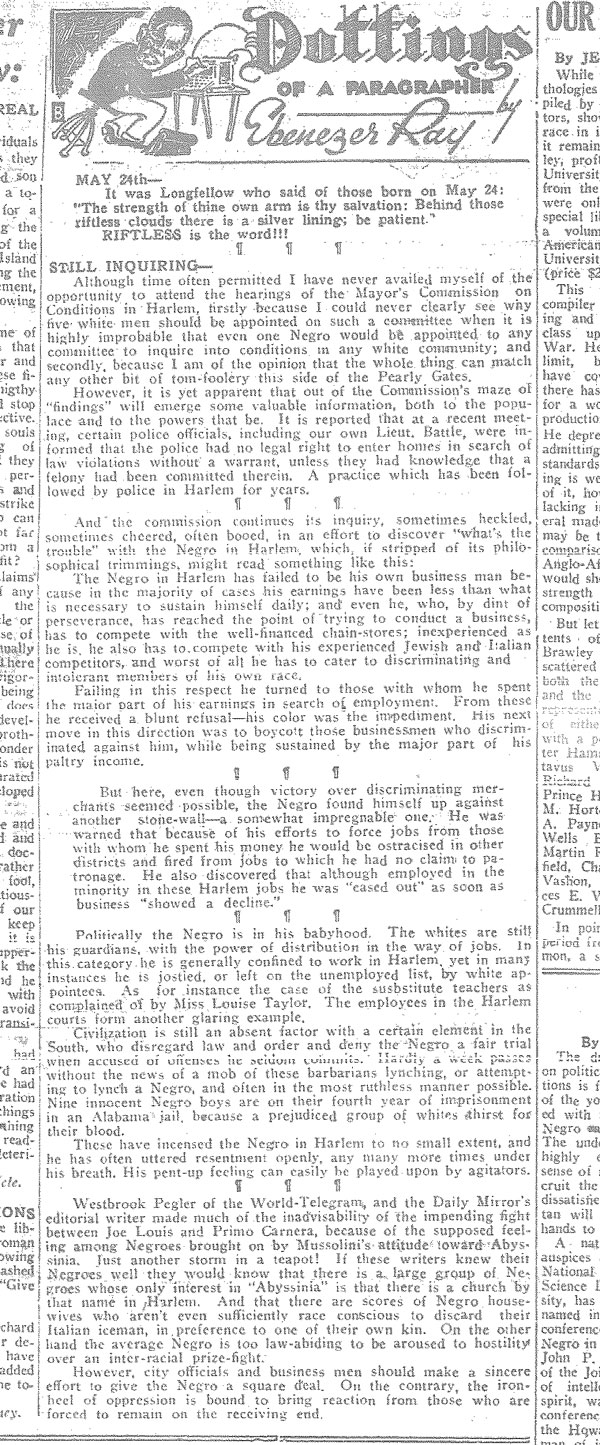
In a column my father wrote on the eve of the new year in 1934, he recalls seeing the Statue of Liberty for the first time 11 years earlier. He arrived on Ellis Island aboard the SS Fort Victoria on Nov. 1, 1923 at age 26, 48 hours after leaving Bermuda, where he worked as a printer for six months.
His entry seemed relatively easy. From the sound of it, he passed the physical and intelligence tests and the interrogations immigrants were put through fairly handily and headed straight for Harlem.
The biggest tests were yet to come: As he put it, he had to learn to be racial, to understand Jim Crow, both the southern and northern varieties. He had to weather the Great Depression and witness America’s promise and its shortcomings.
Although I lived in New York for several years in the 80s and still often see the city as a second home, it was not until this week that I set out like a tourist and visited the Ellis Island Museum and Liberty Island, where I finally saw the Lady up close.
It was probably divine intervention that kept me from there until now. It has so much more resonance.
Happy New Year, dear readers. Thanks for taking this journey with me.
In 1934, the United States was still in the throes of the Great Depression. The Scottsboro Boys had been locked up for more than three years. Lynchings were rampant, and many states still denied black folks the right to vote.
Ebenezer was not pleased.
“Three hundred and 11 years ago, a disconsolate group of humans who have since come to be known as the Pilgrim Fathers were facing their second winter of hunger, cold and peril,” my father wrote in his column published Dec. 1, 1934. [In the age of linotype, I suppose it was customary for the Thanksgiving column to come out after Thanksgiving.] “The spring crop of corn had been withered by a long drought; the vegetable gardens had been destroyed by fire. A day of prayers was declared, which was followed by a refreshing rain. Almost simultaneously a ship loaded with friends and supplies was sighted. The Governor proclaimed a day ‘for public thanksgiving.'”
My father went on to add that since that day in 1623, the United States had celebrated other days of thanksgiving in the midst of national crises:
“In the first year of his office, President Washington issued a proclamation making Nov. 26, [1789] [Typo alert! The actual column says 1879] a day of ‘national thanksgiving’ for the establishment of a government designed for safety and happiness. When the Civil War was slowly drawing to an end, President Lincoln set aside the last Thursday of November as a day of national thanksgiving ‘for the defense against unfriendly designs without and signal victories over the enemy who is of our own household.'”
But what did Thanksgiving mean for black people in America in 1934?
“As another Thanksgiving Day approaches, can the Negro as a race really be thankful for many material blessings? . . . Even the individual materialist may have much to be thankful for – he may be in good health, his family as well, he may even have a job and everyone knows that that is much to be thankful for nowadays. Yet the Negro as a race still needs much to complete his reasons for Thanksgiving Day in this anno domini 1934. He is still the victim of ruthless exploitation by an unyielding capitalist system; he is still being denied many constitutional rights as a citizen, including the right to vote in many states; he is still being discriminated against even under the dome of the nation’s capitol; he is still the victim of brutal lynchings. Nine Negro boys are nearing their fourth year of incarceration in an unsympathetic Alabama prison for a crime they did not commit, while a coterie of lawyers strive valiantly, but almost ineffectively to stave off a legal lynching of them.
“The Negro still needs sound reasons for a real honest-to-goodness Thanksgiving — his winter is still on, his ‘corn is still withered’ his ‘ship loaded with friends and supplies’ still to be sighted; his ‘government . .. for safety and happiness’ has not yet been established.'”
So, as Thanksgiving 2011 approaches, those of us fortunate enough to be employed, to have homes, health and abundance should be grateful. We also should continue the fight for those among us who continue to endure the chill of injustice.
At an outdoor concert featuring Aaron Neville in San Francisco’s Stern Grove yesterday, I was taken back to being 11 or 12 years old when my sister Ellen-Marie asked me to pick up Neville’s first hit, “Tell it Like it Is,” from the neighborhood record store. My friend Rosalyn and I were headed there for our own 45s, probably something along the lines of the Marvelettes or the Supremes. (Rosalyn and I were part of our own junior girl group called the Trangualettes – don’t ask – and we lip-synced a mean “Don’t Mess with Bill.”)
Rosalyn and I were barely out of elementary school. Ellen was in high school. And even though WAMO, the one black radio station in all of Pittsburgh, played everything from R&B to blues to jazz — the white radio stations didn’t play black music back then — we didn’t really have our ears tuned to Aaron Neville . . . yet.
On Sunday, as I listened to Neville’s still silky rendition of that 1967 ballad, I searched my memory for all of Ellen’s teenage crushes and suitors. I wondered who she might have been thinking about as she played that record. It could have been that she simply knew then what we’d all come to know, Neville’s capacity to make us swoon.
Romance aside, I suspect that song spoke to Ellen-Marie because it got to the core of who she was — direct and honest. Aggravatingly so. Sometimes brutally so. And not only did she take truth-telling seriously, she did not understand why others were incapable of doing the same.
Our mother, who was often given to being coy and indirect, used to drive Ellen-Marie crazy. I’m sure I did too, as I have a tendency to bury my ledes. Editorial writing was good training for getting to the point.
Ebenezer, on the other hand, was not one to mince words. Here are some gems I’ve found so far. All are excerpts from his “Dottings of a Paragrapher” column in the New York Age.
Dec. 22, 1934: “When the white man ‘lifts his foot off the neck’ of Negroes and when the Negro in turn lifts his own tiny foot off his own neck, when a Negro reporter, writer, cartoonist, or etc. can go to the News office and apply for a job with the assurance that he has the same chance as his white brother, his color regardless, then it will matter whether he is called colored, Negro, or Aframerican.”
June 1, 1935: “Although time often permitted, I have never availed myself of the opportunity to attend the hearings of the Mayor’s Commission on Conditions in Harlem, firstly because I could never clearly see why five white men should be appointed on such a committee when it is highly improbable that even one Negro would be appointed to any committee to inquire into conditions in any white community.” [Note: The 14-member commission, appointed by Mayor Fiorello LaGuardia following a 1935 race riot in Harlem, included several prominent blacks.]
May 30, 1936: “On a recent evening, what was scheduled to be an ‘all-star artist recital’ turned out to be just a parade of the ambitious, plus a little stardust.
How a promoter of this affair ever got together such a mixture is beyond imagination. It was little short of capital offense to associate the beautifully voiced Doris Trotman-Earle and Constance Berksteiner White with some of the other untutored apologies for singers. It was little short of a capital offense to place one sartorial blunder, in particular, on any program. He murdered ‘Then You’ll Remember Me’ — and all who had to listen to him certainly will.
Liberal applause followed all the efforts. It must have been admiration for their ‘nerve’ — or maybe the audience was made up mainly of relatives.”
“So we married,” my father wrote in his column a couple of weeks after he said, “I do’ to Lucille Manning, his first wife. In an April 29,1939 New York Age article describing the wedding, there was not a hint of sarcasm. But even as a newlywed, Ebenezer could not resist.
“Irrespective of what one hears and knows, yet something gets by you,” he wrote in his column on May 6, 1939. “We hadn’t heard of this ‘carrying your bride over the threshold’ business until very recently. What strikes us is, suppose we had married that hell-cat with plenty of pois — avoirdupois. ‘What strength can’t do art and resolution will,’ they tell us. Art would have failed. Resolution would have gotten us a piano-mover.
“We carried our 120 pounds over. She smiled broadly. We grinned. Who said a man isn’t born a chump?”
I’m sure we will never know who the “hell-cat” was. I trust Lucille appreciated his sense of humor.
It is a gruesome tale of unspeakable acts, including the mutilation, hanging, rehanging, dragging and shooting of one man.
And though we can only hope that this orgy of gratuitous hate and voyeurism was what Wilkerson says was “perhaps the single worst act of torture and execution in twentieth-century America,” we know it was illustrative of the reign of terror, humiliation and intimidation that prevailed in the American South well into the 1960s.
“Across the country, thousands of outraged Americans wrote to President Franklin D. Roosevelt demanding a federal investigation,” Wilkerson writes. “The NAACP compiled a sixteen-page report and more files on the Neal case than any other lynching in American history. But Neal had the additional misfortune of having been lynched just before the 1934 national midterm elections, which were being seen as a referendum on the New Deal itself. Roosevelt chose not to risk alienating the South with a Democratic majority in Congress at stake. He did not intervene in the case. No one was ever charged in Neal’s death or spent a day in jail for it,” Wilkerson adds. Continue reading →
Looking for something fresh to write about on Election Day, I searched my father’s columns for wisdom from the past. A footnote in a column published in the New York Age on November 3, 1934, implored readers to elect “Mrs. Eunice Carter” to the New York State Assembly. The name had a familiar ring. Five […]
My barber called Kamala Harris a “ho.” The shop I go to is not the stuff of Black culture lore. It’s not a boisterous place. It doesn’t reek with toxic masculinity. It’s a nice, quiet, family friendly kind of enterprise. The worst I have been subjected to in the nearly three years I’ve gone there […]
On Saturday, Feb. 17, I will be among several individuals inducted into the 2024 Class of the Black Legends of Silicon Valley. This is quite an honor. Previous recipients in the News and Documentary category in which I am being honored include journalists with stellar credentials. Loretta Green, an award-winning reporter for several local papers […]

 At an outdoor concert featuring


 My Father's Posts