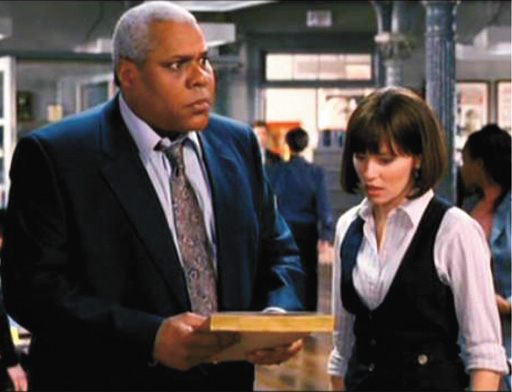
“He went to my high school!” I gestured excitedly in the movie theater last night. It was during the preview of “Won’t Back Down,” a film scheduled for release in late September. The cast includes Viola Davis, Maggie Gyllenhaal, Ving Rhames and Holly Hunter. And it also features Bill Nunn, whose father and grandfather worked with my father at the Pittsburgh Courier. Bill, well, we called him “Bubby,” also is a Morehouse grad.
Bill Nunn with Elizabeth Banks in Spider-man. Source: The Pittsburgh Courier
What I hadn’t noticed until I got home to read up on the film, is that it was shot in Pittsburgh.
And it’s about parents who take a stand to make sure their kids get the quality education they are entitled to. Gotta love that.
I haven’t seen the movie yet. I’ll try not to judge it based on the trailer, which seems pretty high on cheese.
I’ll go see it, though, just to see Bubby, who plays the school principal, and the Pittsburgh skyline, which makes my heart flutter.
This video, made in 2005, features my mother’s “baby” cousin Irving Williams and the work he and his wife, Elvira Fenton Williams, have done with the people of Tanzania, the Gambia and other developing countries.
He’s a devoted husband to Elvira, and a loving father to his four accomplished children: Irving, Donna, Andrea and Michael. He’s a super grandfather, brother, uncle and cousin.
He is funny and infectiously positive, a joy to be around.
Irving spent his early career in pediatric and adolescent medicine in Milwaukee and Boston. Then in 1974 the family went to Tanzania to help establish a pediatric sickle cell clinic for the Ministry of Health there. Inspired by that experience, he and Elvira ultimately founded Adventures in Health Education and Agricultural Development (AHEAD), Inc..
Founded in 1981, AHEAD works to reduce and eliminate disease and premature death, cultivate and advance healthy living and to foster sustainable environmental activity. The organization’s programs have helped more than 1.5 million children.
Cousin Irving celebrated his 80th birthday earlier this week, and even though the video is seven years old, it remains a fitting tribute. Thank you, Cousin Irving, and many happy returns.
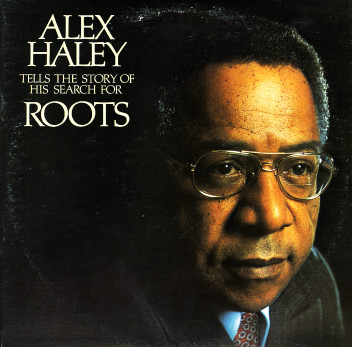
“When the griot dies, it is as if the library has burned to the ground,” Alex Haley wrote in the acknowledgments to his groundbreaking book Roots.
I thought the quote made for a perfect lede to the editorial tribute I wrote in the Boston Globe when Haley died in 1992.
My editor saw it differently. He had never heard of the word “griot,” which refers to the person in the African village who keeps the oral history alive, whether through stories or music. At that time, the word was not in the dictionary.
Cut.
The lead I ended up with was another quote from Haley:
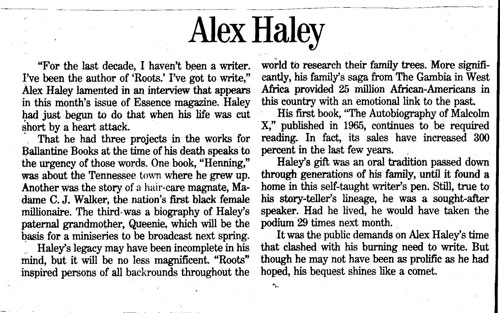
“‘For the last decade. I haven’t been a writer. I’ve been the author of Roots. I’ve got to write,’ Alex Haley lamented in an interview that appears in this month’s issue of Essence magazine. Haley had just begun to do that when his life was cut short by a heart attack.”
That I managed to get Essence magazine in the lead of a Globe editorial is pretty impressive. Nevertheless, 20 years later, I still bristle at the conversation with my editor.
I also wrote that “Roots inspired persons of all backgrounds throughout the world to research their family trees.”
True.
He also can take some credit for inspiring at least the titles of The Root and The Griot, two major blogs focused on the African American experience.
Haley would have celebrated his 91st birthday this weekend.
During the 1936 Summer Olympic Games, James Cleveland “Jesse” Owens won four gold medals in Berlin: He came in first in the 100 meters, the 200 meters, the long jump and was part of the 4×100-meter relay team that also took gold. Owens’ success was a poke in the eye of Adolf Hitler, who had hoped the 1936 games would serve as a showcase his Aryan propaganda.
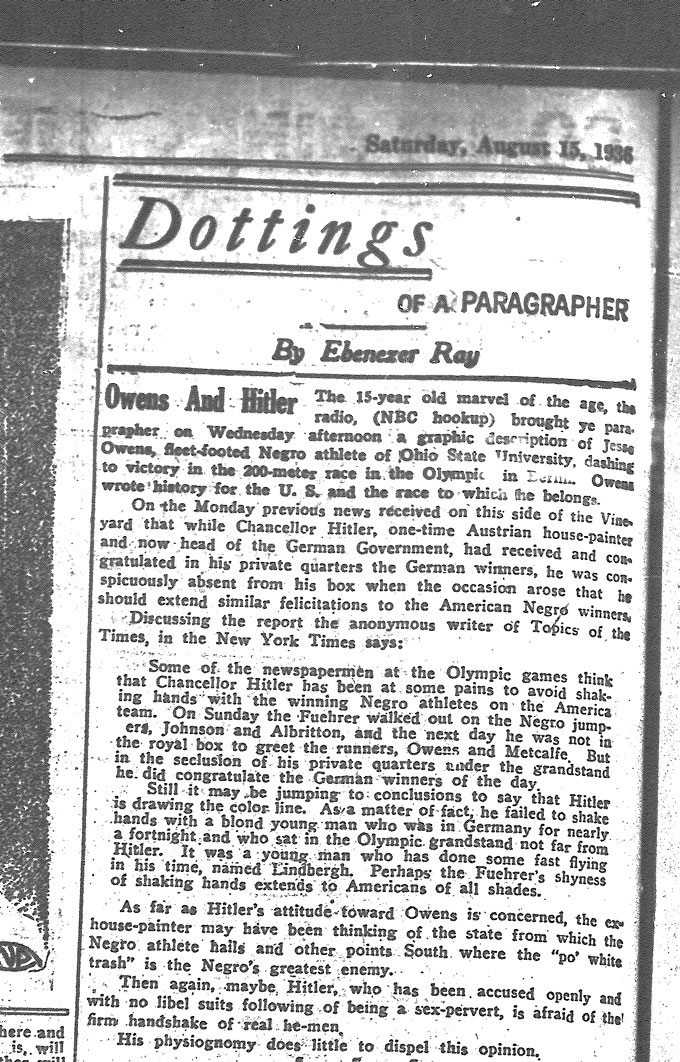
The column below, published Aug. 15, 1936, my father chided Hitler, whom he described as a “one-time Austrian house painter” and a “pervert,” who snubbed Owens. He cited news reports that while Hitler had “received and congratulated in his private quarters the German winners, he was conspicuously absent from his box when the occasion arose that he should extend similar felicitations to the American Negro winners.”
It remains unclear whether the reports of Hitler’s snub are true. The LA Times recently included the story as one of the “Top Ten Olympic Controversies.”
“Perhaps the most enduring myth of the Olympic Games is that Adolf Hitler refused to extend a congratulatory handshake to Jesse Owens, a claim for which Olympic historians have found no supporting evidence. It is clear that Hitler was neither pleased nor impressed by the four gold medals Owens won, even as the German crowd cheered him loudly and mobbed him for pictures and autographs. As Owens pierced the Nazi myth of Aryan superiority, his home country acted with regrettable caution, replacing two Jewish sprinters on the U.S. team. Owens got a hero’s welcome upon returning home, yet as a black man he had to ride the freight elevator to a New York hotel reception in his honor.”
My father’s Aug. 15 column was published the week my grandmother, Malvina Alkins, died. Guest columnists appear in the “Dottings” space in the two issues that followed.
“It is not news to those of you that read Mr. Ray’s columns that he has been an inspiration for many men who later found success in the field of journalism,” wrote Romeo Dougherty, whose bio describes him as a “well-known sports and theatrical writer.”
“To be considered worthy to take his place for even a week makes me feel that I have not labored in vain…,” he wrote in a guest column published Aug. 22, 1936.
“In the splendid showing of our boys in the Olympic Games,” Dougherty added, “we have practically sapped the climax and proved conclusively that we are worthy of being considered in every branch of athletics we seek to enter.”
Today, athletes spanning the African diaspora are representing countries across the world, including Germany.
Could an all-white cast ever pull off an August Wilson play?
It’s a provocative question that might not be answered for a few decades.
New Yorker theater critic John Lahr raised the issue last December when he set the blogosphere atwitter suggesting that black casts should not attempt Tennessee Williams’ work.
“And no more infernal all-black productions of Tennessee Williams plays unless we can have their equal in folly: all-white productions of August Wilson,” Lahr posted as part of his Christmas wish list on the New Yorker‘s culture blog.
The late Wilson probably would have agreed with Lahr, but for the producers and the multiracial cast of A Streetcar Named Desire currently playing on Broadway, Lahr’s comments were fighting words.
Blair Underwood, who plays the brutish Stanley in the production, said, “Having a multicultural cast is analogous to marrying some people’s daughters, because they don’t want it. But that’s OK. That’s what progress looks like, and progress is never easy.”
Nicole Ari Parker, who pretty well nails her Broadway debut as Blanche DuBois, said of Lahr’s comments: “I kind of respect his courage in a way. To come out in 2011 or 12, and say such a dismissive, kind of uninformed racial comment, he’s putting it on the table. The only way we can really affect any kind of change is if this white critic really tells how he feels, and he did.”
/Users/ray/Desktop/AT&T.pdf
Looking back on some old issues of my father’s paper, The New York Age, it seems like deja vu all over again.
In 1938, Wilella Waldorf of the New York Post, wrote that putting on the Mikado “with a cast of Negroes is just about as silly as it would be if the British Government were to revive Porgy and Bess in London’s West End with Noel Coward and Gertrude Lawrence in the title roles.”
The editors of the Age called Waldorf’s column, an “asinine effusion.”
The irony is that the Mikado is set in Japan and the Japanese characters were played by white actors.
My father did not weigh in on Waldorf’s comments, but apparently enjoyed the 1938 Broadway production of Swing Mikadowith its “torso shaking of the beefy girls and the terpsichorean efforts of the more petite ones . . . ” In 1939 another all-black production The Hot Mikado opened on Broadway. Someone apparently liked the idea.
I think Ebenezer would have enjoyed this version of Streetcar. He often complained about the dearth of black casts on Broadway’s stages. He would have been pleased by the fact that several current Broadway hits have significant black casts – The Gershwin’s Porgy and Bess, Memphis,Clybourne Park. In addition, James Earl Jones plays a former U.S. president in Gore Vidal’s The Best Man, a play set in 1960. (Talk about colorblind casting!) Corbin Bleu is playing the role of Jesus in Godspell, and Raven Symoné has the lead in Sister Act.
My father also complained in the 30s and 40s that few black folks supported the theater, even in Harlem. I can’t speak for Harlem venues today, but black theater goers packed the house during last Saturday’s Streetcar matinée.
Streetcar is definitely worth the price of the ticket. I enjoyed seeing screen actors Underwood, Parker and Wood Harris bring their talents to the stage. The cast also included a number of Broadway veterans, including Daphne Rubin-Vega, Count Stovall and Carmen de Lavallade. Terrence Blanchard composed the music.
Knowing some of the history of Louisiana, it was not a stretch to imagine that the fair-skinned black DuBois sisters could descend from wealthy Louisiana landowners. I admit that I shivered reflexively every time Blanche referred to Stanley as an ape. I had to remind myself that Williams did not have a black man in mind when he wrote those words.
But back to my original question: Could/should an all-white cast ever perform an August Wilson play?
“To mount an all-black production of a Death of a Salesman or any other play conceived for white actors as an investigation of the human condition through the specifics of white culture is to deny us our own humanity, our own history, and the need to make our own investigation from the cultural ground on which we stand as black Americans. It is an assault on our present, our difficult but honorable history in America; is an insult to our intelligence, our playwrights, and our many and varied contributions to the society and the world at large,” Wilson said.
I wonder, though, if there are not universal truths in Wilson’s examinations of the black experience that might someday resonate with others. Why not a Fences with a white family or an adaptation of Jitney featuring Puerto Rican or Dominican livery drivers?
Looking for something fresh to write about on Election Day, I searched my father’s columns for wisdom from the past. A footnote in a column published in the New York Age on November 3, 1934, implored readers to elect “Mrs. Eunice Carter” to the New York State Assembly. The name had a familiar ring. Five […]
My barber called Kamala Harris a “ho.” The shop I go to is not the stuff of Black culture lore. It’s not a boisterous place. It doesn’t reek with toxic masculinity. It’s a nice, quiet, family friendly kind of enterprise. The worst I have been subjected to in the nearly three years I’ve gone there […]
On Saturday, Feb. 17, I will be among several individuals inducted into the 2024 Class of the Black Legends of Silicon Valley. This is quite an honor. Previous recipients in the News and Documentary category in which I am being honored include journalists with stellar credentials. Loretta Green, an award-winning reporter for several local papers […]