My nephew, actor Lamman Rucker was in Barbados last week and was the talk of the town. Several local news outlets and blogs noted his arrival. Nationnews.com did a nice write up on him. Check it out.
He also did a nice video for Amtrak’s Black History month series “My Black Journey.”
*Editors note. Lamman mentions in the video that Ebenezer worked for the New York Amsterdam News. He actually spent most of his years in Harlem at the New York Age, the rival Harlem paper at the time. Of course, since this is a continuing journey and we don’t know the whole story, I can’t say definitively that he never worked for the Amsterdam News.
When I was a kid. The Pittsburgh Courier was the place my father worked. It was one of several newspapers on the coffee table, albeit the only one that featured people who looked like me or people we knew. Later, it was the employer that issued rubber paychecks, the company that kept my ailing father on the payroll as long as it could, the source of my mother’s conflicted feelings about black-owned publications. (When I called her from a pay phone in Rockefeller Plaza in 1981, breathless that I’d just landed my dream job at Essence, my mother’s response was, “Will you have health insurance?”)
But the Courier and the people who worked there shaped my personal and professional life far more than I would know. More importantly, it shaped the history of America, particularly in politics and sports.
The Courier was founded in 1910 by Nathaniel Harleston – a security guard at the pickle factory, H.J. Heinz Company – and several other black Americans. Around that time, African Americans were pouring into Pittsburgh from the South to take jobs in the city’s booming steel mills.
Robert L. Vann, who as an undergraduate at what is now the University of Pittsburgh was the first black man to serve as editor of the university’s student newspaper and later was the first black to earn a law degree from there, started out as the Courier’s incorporating attorney. Shortly thereafter, however, he became its editor, its principal stockholder and its publisher. Vann was key to building the paper’s readership and propelling it into its role as a national leader in national and international politics.
According to an article in Pitt Magazine, the newspaper was the “top-selling and most widely circulated newspaper for blacks nationwide in the 1930s with 14 separate editions delivered nationally every week.” At one point, it also had readers in Europe, Cuba, Canada and the West Indies.
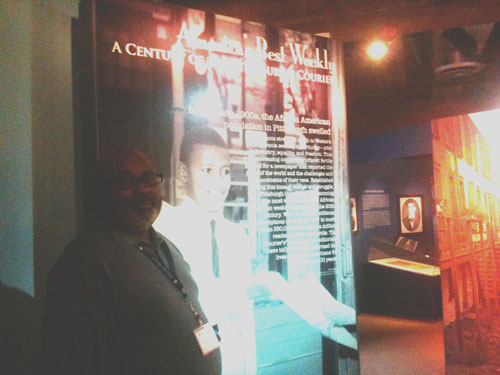
Samuel W. Black, curator of African-American collections at Pittsburgh's Heinz History Center, where "America's Best Weekly: A Century of the Pittsburgh Courier" is currently on exhibit until June 2, 2012.
Samuel W. Black, curator of African-American collections at the Heinz History Center, where America’s Best Weekly: A Century of the Pittsburgh Courier, is currently on exhibit, said the Courier was one of the first black weeklies to engage foreign correspondents. Author Joel Augustus “J.A.” Rogers, for instance, traveled to Europe and other parts of the world, covering blacks in the military during the world wars and interviewing such figures as Emperor Haile Sellassi during the Italian Ethiopian war. Other reporters were hired to go undercover to report on the Ku Klux Klan.
Even as Vann built the paper’s circulation to hundreds of thousands, he leveraged his legal and political skills. Before the 1932 presidential election, most African Americans leaned Republican, the party of Lincoln. But Vann urged readers to “turn Lincoln’s picture to the wall,” and throw their support behind the Democratic candidate, Franklin D. Roosevelt. Vann’s influence significantly helped Roosevelt to win the election, and the president appointed Vann a special assistant to the U.S. attorney general. While in that role from 1933 to 1935, Vann wrote regularly to FDR urging him to establish a standing black unit in the army commanded by an African American. Vann argued that it would provide a basis for black advancement in the military.
“He had been urging Roosevelt to do this for a long time,” Black said. “Two things came out of this, one was the appointment of Benjamin O. Davis, Sr. and the other was the establishment of what became the Tuskegee Airmen.”
According to ExplorePAHistory.com, it was not until after Vann’s death in Oct. 1940 that FDR appointed Davis, Sr. to be the first African-American brigadier general in American history. And even after Vann’s death the paper continued its legacy of advocacy. “In the spirit of its deceased editor, the Courier, in the same issue that it ran Vann’s obituary, editorialized that the elevation of Davis and two other African Americans in the Roosevelt administration was ‘too little and too late.’”
Ultimately, though, Davis, Sr.’s son, Benjamin O. Davis, Jr. would command the legendary all-black flying unit.
During a visit to the Heinz history center last fall, Black offered a fact-filled history of the Courier from its founding to its current iteration as the New Pittsburgh Courier. My primary interest was in the years leading up to and during my father’s tenure as a printer there.
Here are some highlights:
Dorie Miller Gets His Due.
According to Black, it was the Courier that was responsible shining a spotlight on Dorie Miller. An African American cook in the U. S. Navy who rescued wounded soldiers during the bombing of Pearl Harbor, Miller also took up arms against the Japanese, even though he had no weapons training.
“It was actually the Pittsburgh Courier that made Dorie Miller’s name famous,” Black said, noting that after the attack on Pearl Harbor, the War Department filed reports on Miller’s heroics, but never made them public. “In press conferences they mentioned some of the white people, but they never mentioned Miller. The Courier decided to read the report, and it was the Courier who first started talking about Dorie Miller, which forced the Navy to honor him.”
In 1942, Miller was given the Navy Cross, the third highest honor for the Navy at that time, which Black says was a direct result of the Courier’s coverage.
The Double V Campaign
Shortly after the United States entered World War II, The Courier launched The Double V Campaign, under the theme of “Democracy: Victory at Home, Victory Abroad.” The campaign’s message was that while blacks were patriotic in their support of the war, they should have full rights on American soil.
When the Courier came out with the Double V Campaign, Black says, FBI Director J. Edgar Hoover wanted to charge the paper with sedition, accusing it of undermining the war effort.
“The Courier was very open with the FBI and challenged them to find anyone who would say that they were against the war effort because of the Double V Campaign,” Black said, adding that the paper argued that the campaign was in fact an effort to recruit black support for the war. Black said the FBI interviewed everybody on the paper’s staff. “The FBI never really backed down, but they at least stopped posting agents outside the Courier offices.”
Riding the midnight train from San Francisco to Palo Alto the other night, a man sat across from me and politely asked if I was expecting anyone to take the seat next to mine. When I said no, he stretched his legs out, placed his sneakered feet on the seat and proceeded to take a nap.
My blood boiled. Not with the anticipation that I was going to have to wake him up when it was time for me to get off the train (which I did). Not because he was old enough (50 plus) to know that his feet, no matter how clean they seemed, did not belong on the “furniture.”
My blood boiled because he could enjoy the privilege of resting easy because he was white.
I should add that he was white, apparently middle class and well groomed; no one would mistake him for a homeless person in search of a night’s shelter.
My blood boiled because had he been a black or Latino man of any age, well-groomed or not, had he been a passenger on a New York subway rather than Caltrain, he would likely have been arrested and carted off to jail.
A New York Times article “Relax, if you want, but don’t put your feet up,” published earlier this month, precipitated my rage. The article chronicles the New York Police Department’s practice of arresting passengers who take up more than one seat, deliberately or inadvertently, or block the movement of the doors. Continue reading →
Last summer when Kaara Baptiste asked for my advice about getting into journalism, I refrained from telling the young Stanford graduate to run as fast as she could from a field that seems to be on life support.
What I did suggest was that she get out there and write, do some freelancing. I don’t remember whether it was Baptiste or I who first introduced the idea of contacting Henrietta Burroughs, a tireless wonder who publishes East Palo Alto Today, a community newspaper. It was Baptiste who followed up with Burroughs and landed her first assignment: Me.
In a column my father wrote on the eve of the new year in 1934, he recalls seeing the Statue of Liberty for the first time 11 years earlier. He arrived on Ellis Island aboard the SS Fort Victoria on Nov. 1, 1923 at age 26, 48 hours after leaving Bermuda, where he worked as a printer for six months.
His entry seemed relatively easy. From the sound of it, he passed the physical and intelligence tests and the interrogations immigrants were put through fairly handily and headed straight for Harlem.
The biggest tests were yet to come: As he put it, he had to learn to be racial, to understand Jim Crow, both the southern and northern varieties. He had to weather the Great Depression and witness America’s promise and its shortcomings.
Although I lived in New York for several years in the 80s and still often see the city as a second home, it was not until this week that I set out like a tourist and visited the Ellis Island Museum and Liberty Island, where I finally saw the Lady up close.
It was probably divine intervention that kept me from there until now. It has so much more resonance.
Happy New Year, dear readers. Thanks for taking this journey with me.
Looking for something fresh to write about on Election Day, I searched my father’s columns for wisdom from the past. A footnote in a column published in the New York Age on November 3, 1934, implored readers to elect “Mrs. Eunice Carter” to the New York State Assembly. The name had a familiar ring. Five […]
My barber called Kamala Harris a “ho.” The shop I go to is not the stuff of Black culture lore. It’s not a boisterous place. It doesn’t reek with toxic masculinity. It’s a nice, quiet, family friendly kind of enterprise. The worst I have been subjected to in the nearly three years I’ve gone there […]
On Saturday, Feb. 17, I will be among several individuals inducted into the 2024 Class of the Black Legends of Silicon Valley. This is quite an honor. Previous recipients in the News and Documentary category in which I am being honored include journalists with stellar credentials. Loretta Green, an award-winning reporter for several local papers […]

 My nephew, actor Lamman Rucker was in Barbados last week and was the talk of the town. Several local news outlets and blogs noted his arrival. Nationnews.com did a nice write up on him. Check it out.