Last week, I weighed in on the debate about the novel Huckleberry Finn in my colleague Cynthia Haven’s blog The Book Haven. There’s a current debate over a new edition of the novel in which the word “nigger” is replaced by the word “slave.” While the intention is noble, I think it misses the point.
My argument is that those who teach the novel need to be fully aware of what they are teaching, the feelings the novel and the word “nigger” evoke and the specific classroom context they find themselves teaching in.
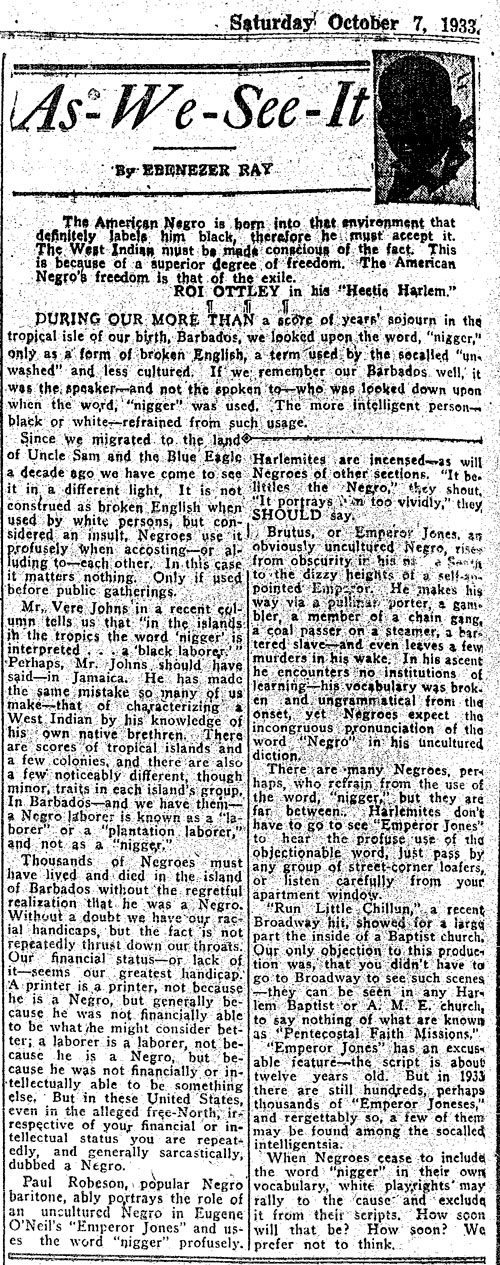
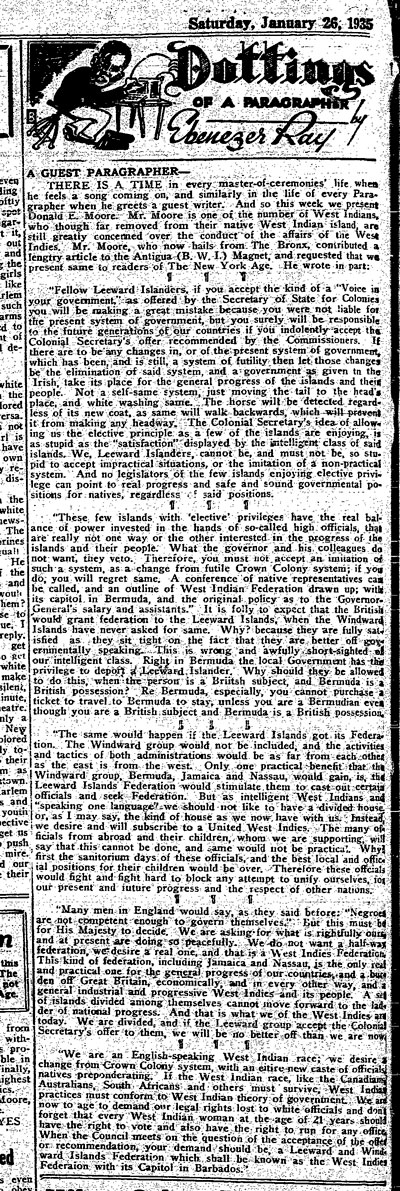
The debate over the use of the word is not new. My father wrote about it in the column below in 1933. He did not mention Huckleberry Finn, but he referred to the repeated use of the word in Eugene O’Neill‘s Emperor Jones, the 1933 film version of which featured Paul Robeson in the lead.
“Brutus, or Emperor Jones, an obviously uncultured Negro, rises from obscurity in his nation’s South to the dizzy heights of self-appointed Emperor. He makes his way [as] a Pullman Porter, a gambler, a member of a chain gang, a coal passer on a steamer, a bartered slave – and even leaves a few murders in his wake. In his ascent he encounters no institutions of learning – his vocabulary is broken and ungrammatical from the onset – yet Negroes expect the word ‘Negro’ in his uncultured diction. . . . Harlemites don’t have to go to see Emperor Jones to hear the profuse use of the objectionable word, just pass by any group of street-corner loafers, or listen carefully from your apartment window.”
He noted that in Barbados, it was the speaker – not the spoken to – who was looked upon as uncultured when the word was used. He took issue with one of his fellow New York Age columnists, who was Jamaican, who generalized that in the West Indies the word was used to refer to the black laborer.
“He has made the same mistake so many of us make – that of characterizing a West Indian by his knowledge of his own native brethren. There are scores of tropical islands and a few colonies, and there are also a few noticeably different though minor traits in each island’s group. In Barbados – and we have them – a Negro laborer is known as a “laborer,” and not as a nigger.
Thousands of Negroes must have lived and died in the island of Barbados without the regretful realization that he was a Negro. Without a doubt we have our racial handicaps, but the fact is not repeatedly thrust down our throats. Our financial status – or lack of it – seems our greatest handicap. A printer is a printer not because he is a Negro, but generally because he as not financially able to be what he might consider better . . . ” (I wonder if he was referring to himself.)
 One of the comments on the Book Haven discussion, accused those of us who were concerned about teaching and reading Huckleberry Finn of hypocrisy.
The reader said, “many who defend the unlimited freedom of artists to create graphically sexual and blasphemous photos at public expense in the name of freedom of speech and against the bugabear of censorship (even though these images hurt and offend many) now seem willing to bend the same principles, for what? Because some people will be hurt and offended by the N word? And the people who will be hurt and offended are who? The same people who listen to music whose lyrics use the N word constantly?Anybody besides me see this as a huge contradiction?”
Talk about generalizations! Is this person suggesting that all of the people who are offended by the use of “nigger’ in Huckleberry Finn are not offended by the use of the word in rap lyrics? Black people have been conflicted about the use of the word in the public sphere for decades. Remember when  Richard Pryor came back from Africa and vowed never to use the word again?
Robeson himself stopped singing the word in renditions of Showboat‘s “Ol’ Man River” that he performed in recitals. (He did not change the lyrics when he appeared in Showboat productions.) In those recitals, he replaced he word “nigger” with “darkies.” “Colored folks,” has been used in revivals of Showboat since the mid 40s.
Ebenezer was of the mind that if black folks stopped using the word, perhaps others would stop using it too.
“When Negroes cease to include the word ‘nigger’ in their vocabulary, white playwrights may rally to the cause and exclude it from their scripts,” my father writes. “How soon will that be? How soon? We prefer not to think.”
How about 77 years and counting?

The New York Age, October 7, 1933
Tags: 1933, Adventures of Huckleberry Finn, african american history, barbados, black history, ebenezer ray, elaine ray, emperor Jones, Eugene O'Neill, genealogy, harlem, Huckleberry Finn, journalism, Mark Twain, new york, nigger, Ol' Man River, paul robeson, richard pryor, Showboat, the new york age
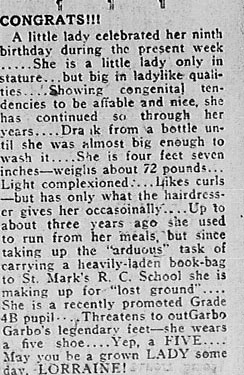
 In a column my father published Feb. 10, 1934, he devotes the last paragraph to a young girl he refers to as “Lady Lorraine.” In honor of her ninth birthday, Ebenezer waxed on about her “ladylike qualities,” her accomplishments in the classroom and her big feet. He wrote that she “threatens to outGarbo Garbo’s legendary feet.” How rude, particularly considering that Lorraine was his landlord’s daughter.
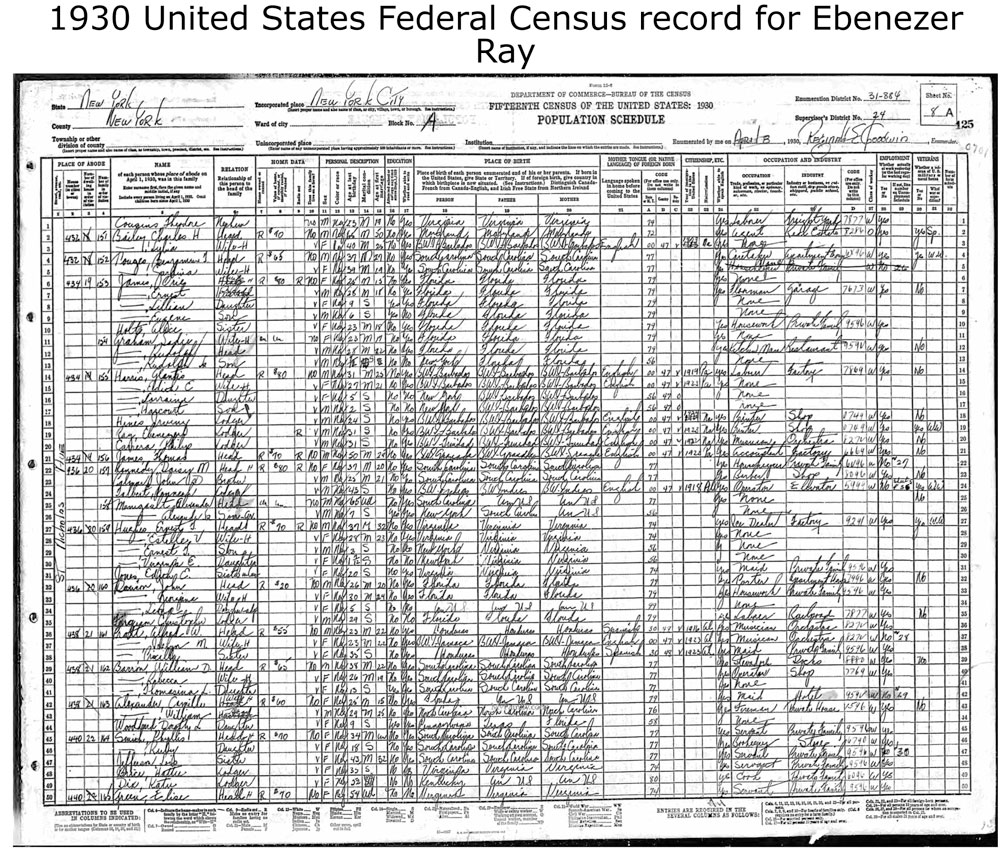
 Initially, when I posted that column, I was rather curious about who Lorraine was and whether she was some long lost half-sibling. Then I remembered that the 1930 Census record I found a few months ago lists my father as a “lodger” in the home of Glantis Harris, his wife, Edith, son Harcourt and daughter Lorraine. She was five at the time of the Census, so turning nine four years later makes it all add up.