A miracle in Alabama?

24 Dec
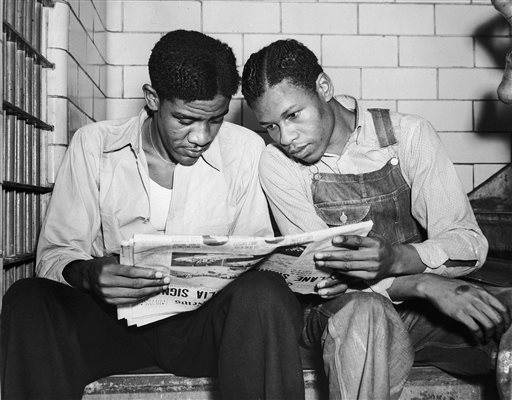
In this July 16, 1937 file photo, Charlie Weems, left, and Clarence Norris, Scottsboro case defendants, read a newspaper in their Decatur, Ala. jail after Norris was found guilty for a third time by a jury which specified the death penalty. Weems was to be tried a week later. Nine black teenagers known as the Scottsboro Boys were convicted by all-white juries of raping two white women on a train in Alabama in 1931. All but the youngest were sentenced to death, even though one of the women recanted her story. All eventually got out of prison, but only one received a pardon before he died. (AP Photo)

In this July 16, 1937  photo, Charlie Weems, left, and Clarence Norris, Scottsboro case defendants, read a newspaper in their Decatur, Ala. jail after Norris was found guilty for a third time by a jury which specified the death penalty. Weems was to be tried a week later. Nine black teenagers known as the Scottsboro Boys were convicted by all-white juries of raping two white women on a train in Alabama in 1931. All but the youngest were sentenced to death, even though one of the women recanted her story. All eventually got out of prison, but only one received a pardon before he died. (AP Photo)

From his earliest New York Age columns in the early 1930s to his very last in 1942, my father championed the cause of the Scottsboro Boys, nine young black men accused of raping two white women despite overwhelming evidence to the contrary.

The teenagers were arrested in 1931 and a series of trials spanned more than a decade. The U.S. Supreme Court reversed two sets of convictions but several of the defendants languished in jail for years. My father wrote frequently about the young mens’ plight.  When he wrote his final column for the Age in 1942, five of the Scottsboro Boys were still in prison.

In his first Christmas column in 1933, my father wrote:

“Not so far away in unsympathetic cells in a Southern prison recline nine boys whose only offense to humanity is the color of their skin, in whose greatest mistake in life was to hobo on a freight train when two white prostitutes were also ‘passengers.’

At this point, we pause to wonder how much of the Christmas spirit has managed to evade therein. How much can they give glory to God in the Highest? Which God they may ask: The God who delivered Daniel from the lions’ den; The God who delivered the three Hebrew children from the fiery furnace; the God who delivered Jonah from the belly of a whale; the God who loosened the gods of Paul and Silas and opened the prison doors or the God who caused bears to devour little children because they mocked a baldheaded man?

If those boys have studied these parts of the scriptures, thinking of Victoria Price [one of the accusers] or Judge Callahan and the Alabama jurors they must conclude that the days of omnipotence are over, or some religious historian has appealed to our fantastic and superlative imagination.

Perhaps Judge Callahan, a visible disgrace to any hand that holds the scales of justice, will go to his church and tell his God that “his all is on the altar” and he will not share the fate, we read, that was meted out to Ananias and Sapphira.

While indulging in our Christmas delicacies and cocktails we might invoke a miracle for these boys’ deliverance.”

I’m not sure Ebenezer would consider the pardons of  three Scottsboro Boys 80 years later a miracle. But that’s as good as it gets.  In November, the Alabama board of Pardons and Paroles voted unanimously to grant posthumous pardons to the three remaining defendants, Haywood Patterson, Charles Weems and Andy Wright.

According to a Nov. 21, New York Times article, the decision “brought to an end to a case that yielded two landmark Supreme Court opinions — one about the inclusion of blacks on juries and another about the need for adequate legal representation at trial — but continued to hang over Alabama as an enduring mark of its tainted past.

I can’t imagine that he would be happy that it would take 80 years for justice to be delivered.”

I’ve often wondered what my father, a lover of musical theater, would think of the case being the subject of a Broadway play.

And I wonder whether posthumous pardons 80 years hence would restore or challenge his faith.

Justice for Trayvon Martin in 2093?

Obama’s speech in honor of Nelson Mandela

10 Dec

Back to school

6 Sep

From the moment she was born, my daughter, Zuri Adele, talked with her eyes. They took in everything, registered centuries of wisdom, expressed a range of emotion she could not logically understand.

zuri_blackboard_closeup

Zuri at three years old. Photo by Mary Ray.

I remember watching her at a birthday party with a group of kids she didn’t know well. They were taking turns acting out a nursery rhyme “Five Little Monkeys Jumping on the Bed.” Zuri,  who was about 3 years old,  sat quietly, observing.  I wasn’t sure she was going to participate. Then, after everyone else had taken a turn, she stood on the bed without fanfare and acted out the pantomime flawlessly, complete with dramatic hand gestures. A star was born.

Not really. Stars, or I should say great performers, no matter how much natural talent they may have, work hard, study, push themselves through disappointments and go back at it.

This summer was a busy and exciting one for her. She performed in Georgia Shakespeare’s Mighty Myths and Legends, had a guest appearance on the CBS hit Under the Dome (the episode airs Monday, Sept. 16 at 10 p.m.); and starred in a short film Plenty. The screenplay was her inspiration.  Having her cousin Lamman Rucker join the cast was icing on the cake.

As we speak, Zuri is packing the car to head west to hone her acting chops in the MFA acting program at UCLA. Imagine how fierce she will be after three years of immersion.

Video

‘The arc of the moral universe may bend toward justice, but it doesn’t bend on its own’

28 Aug
obama_march_on_wasington

President Barack Obama speaks at the 50th Anniversary of the March on Washington where Martin Luther King Jr., spoke, Wednesday, Aug. 28, 2013, at the Lincoln Memorial in Washington. The bell at left rang at the 16th St Baptist Church in Birmingham, Ala. which was bombed 18 days after the March On Washington killing four young girls. (AP Photo/Charles Dharapak)

Dreaming in context

27 Aug

hand-made_signStanding on the National Mall on Saturday, inspired by the presence of tens of thousands, it would be easy to get caught up in the gauzy, dreamy reminiscence of the summer of 1963. But we would do well to remember just how ugly those times really were.

On June 12 of that year, Medgar Evers, field secretary for the NAACP, was gunned down in his driveway while his wife and children cowered inside their home. On Sept. 15, Addie Mae Collins, Cynthia Wesley, Carole Robertson and Denise McNair died when the 16th Street Baptist Church was bombed by members of the Ku Klux Klan. In between those two horrifying acts of domestic terrorism, and many unpublicized ones, was the March on Washington for Jobs and Freedom.

keeping-the-dream-alive“In a sense we’ve come to our nation’s capital to cash a check,” Martin Luther King, Jr. said during his speech on Aug. 28, 1963. “When the architects of our republic wrote the magnificent words of the Constitution and the Declaration of Independence, they were signing a promissory note to which every American was to fall heir. This note was a promise that all men – yes, black men as well as white men – would be guaranteed the unalienable rights of life, liberty, and the pursuit of happiness.

“It is obvious today that America has defaulted on this promissory note insofar as her citizens of color are concerned. Instead of honoring this sacred obligation, America has given the Negro people a bad check; a check that has come back marked ‘insufficient funds.’ But we refuse to believe that the bank of justice is bankrupt. We refuse to believe that there are insufficient funds in the great vaults of opportunity of this nation.”

Yes, the extemporaneous “Dream,” portion of King’s speech is what is most often remembered, but the bulk of his remarks were rooted in the harsh realities of the day. One of those harsh realities was that five years earlier on that very date, Aug. 28, Emmett Till, a 14-year-old from Chicago who was visiting family in Mississippi, was shot and his body mutilated after he was accused of making a flirtatious remark to a white woman.

 Simeon Wright, Emmett Till's cousin, speaks at the podium in front of the Lincoln Memorial in Washington, Saturday, Aug. 24, 2013, with Sabrina Fulton, mother of slain teenager Trayvon Martin, center, Trayvon's brother Jahvaris Fulton, second from right and Trayvon's father Tracy Martin during the commemoration of the 50th anniversary of the Aug. 28, 1963 March on Washington. (AP Photo/Carolyn Kaster)


Simeon Wright, Emmett Till’s cousin, speaks at the podium in front of the Lincoln Memorial in Washington, Saturday, Aug. 24, 2013, with Sybrina Fulton, mother of slain teenager Trayvon Martin, center, Trayvon’s brother Jahvaris Fulton, second from right and Trayvon’s father Tracy  (AP Photo/Carolyn Kaster)

At Saturday’s 50th Anniversary of the March on Washington, Simeon Wright, a cousin of Till who was with him that day in 1955 drew parallel’s between Till’s murder and the murder of Trayvon Martin and the verdicts that followed the trials of their assailants.

Myrlie Evers-Williams, the widow of Medgar Evers, who was scheduled to speak at the 1963 march, but didn’t make it that day, told Saturday’s crowd to reclaim the notion of “Stand Your Ground” changing its meaning from a law that gives license to kill those whom citizens deem a threat, to something positive and proactive.

“Make ‘stand your ground’ a positive ring for all of us who believe in freedom and justice and equality,” Evers-Williams said. “That we stand firm on the ground that we have already made and be sure that nothing is taken away from us, because there are efforts to turn back the clock of freedom.”


Rev. Al Sharpton
, whose National Action Network coordinated Saturday’s march, questioned why voter ID laws have only become necessary in the era of the nation’s first black president.

Peter Sussman, who was at the march in 1963, returned to the National Mall with his children and grandchildren.

Peter Sussman, who was at the march in 1963, returned to the National Mall with his children and grandchildren.

“When they ask us for our voter ID take out a photo of Medgar Evers; take out a photo of [Andrew] Goodwin [James] Cheney and [Michael] Schwerner; take out a photo of Viola Liuzzo. They gave their lives so we could vote.”

Sharpton harked back to the theme of the returned check.

“50 years ago Dr. King said that America gave blacks a check that bounced in the bank of justice and was returned marked ‘insufficient funds.’ Well, we’ve redeposited the check. But guess what? It bounced again. But when we look at the reason this time it was marked ‘stop payment.'”

They had the money to bail out banks and major corporations and give tax breaks to the one percent, but not for municipal workers, teachers or Head Start, Sharpton noted.

Sharpton said we also must work together to end  violence and mysogyny.

“We cannot sit around and watch the proliferation of guns in our communities or any other community. Let me say to our young brothers and sisters. We owe a debt to those that thought enough of you to put their lives on the line. We owe a debt to those who believed in us when we didn’t believe in ourselves. We need to conduct ourselves in a way that respects that. Don’t you ever think that men like Medgar Evers died to give you the right to be a hoodlum or to give you a right to be a thug.

incarceration“We need to teach our young folk, I don’t care how much money they give you, don’t disrespect your women. We’ve got some housecleaning to do and as we clean up our house, we will then be able to clean up America.”

Sharpton also addressed the theme of the “dream.”

“They will romanticize Dr. King’s speech. But the genius of his speech was not just the poetry of his words. The genius of his speech is, the with bloodshed in Birmingham, with Evers having been killed, with James Farmer one of his core leaders in jail. He didn’t stand here and discuss the pain. He didn’t stand here and express the anger. He said in the face of those that wanted him dead that no matter what you do, I can dream above what you do. I see a nation that will make change if we pay the price. Others saw voting booths we couldn’t use. King saw and possibility of an Obama 50 years ago. The world is made of dreamers that change reality because of their dream. And what we must do is we must give our young people dreams again.”