Last Thursday, I got a call from a fellow blogger, Valerie Bailey, who was doing research on a Ted Yates, a black newspaper columnist whose career overlapped with my dad’s. I told Bailey, whose fascinating video blog is febone1960.net, that the name was familiar, and that I would get back to her if I found anything.
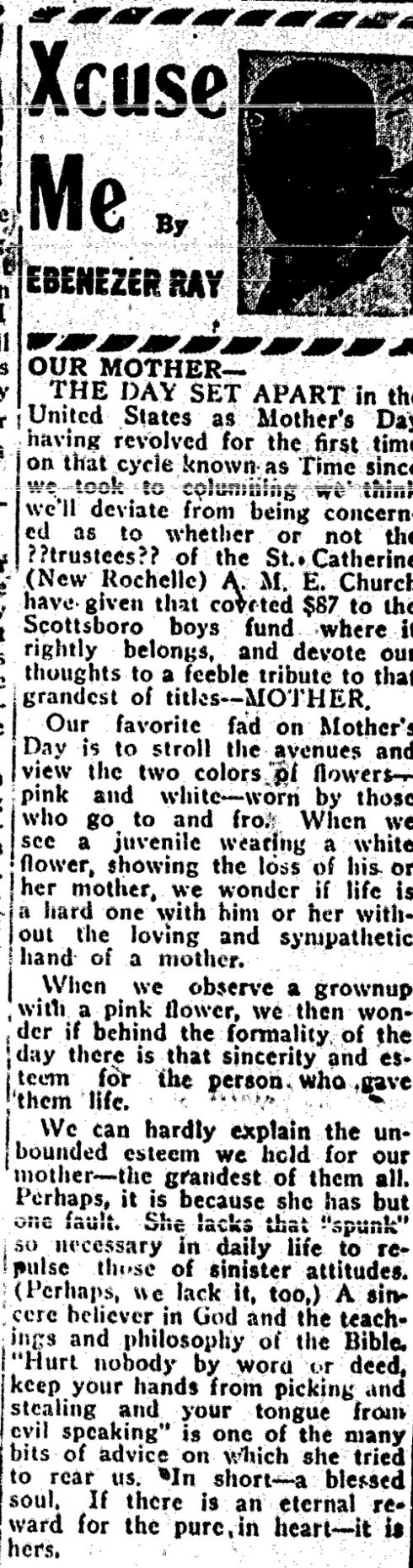
Then, while looking for a column to feature this week, I came across one my father published on April 14, 1934 titled “If I were Mayor of Harlem.” It is one of several “If I were . . . ” pieces Ebenezer wrote, including “If I were editor ” and “If I were the Hitler of Harlem.” (I’m not quite ready to delve into that one.)
 Under the headline of the mayoral column was a note: “With apologies to W.W.” Could that be Walter White, then head of the NAACP? Not sure. What I did find was a note in another of my father’s columns that referred to Ted Yates. That column was likely what led Bailey to me.
In the April 14, 1934 column, my father rails against “soap box orators,” those who used the street corners of Harlem as their bully pulpits. My father, staunch defender of the King’s English that he was, seemed less offended by their opinions and more put off by their imperfect grammar.
“Those allowed on Lenox Avenue would have to pass a grammatical test by answering three questions on the principles of correct speaking. One of these questions would be: Why should IS not be used for ARE, not ARE for IS? Most of them, having apparently paid little attention to such principles, their elimination would be easy.”
Ebenezer also pledged to deal with teenagers who frequented movie theaters on school nights and who “interrupt older patrons with their premature bits of sophistication” and parents who kept their little ones out past their bedtimes.
“I would give power to police officers to issue summonses to parents and guardians seen hauling tired looking little children behind them from theatres between 10 p.m. and midnight. In court they would be fined. Later than midnight they would be put in a cell without a bed so they could realize what it is to be sleepy and not be able to lie down. “
Further, he would call a press conference for the black press, with editors from the rival New York Age and the Amsterdam News sitting front and center. “Then I would advise them to bury the hatchet.”
Back to Ted Yates: In a column published a month later, there is a note under the subhead “Petty Larceny.” It read, “Ted Yates column: If I Were Mayor of Harlem in the Afro-Amer. After all, Ted, there is still something you can glean from an ancient rag.”
I guess Yates, who wrote for the Age and a number of other black papers, borrowed that line for one of his own columns published in the Afro-American, which was based in Baltimore, but had a national edition. I’ve done a bit of searching in the Afro-American’s archives, but haven’t turned up the Yates’ column in question yet.
Perhaps my dad should have taken his own advice about burying the hatchet.
Click “continue reading” for the full column: BTW: Tap dancer Bill “Bojangles” Robinson was nicknamed “The Mayor o Harlem.”
Continue reading →
Tags: Baltimore Afro American, Bill Bojangles Robinson, ebenezer ray, harlem, Lenox Avenue, New York Age, New York Amsterdam News, Ted Yates







 My Father's Posts