Tag Archives: the new york age

Election days, then and now

4 Nov

Looking for something fresh to write about on Election Day, I searched my father’s columns for wisdom from the past. A footnote in a column published in the New York Age on November 3, 1934, implored readers to elect “Mrs. Eunice Carter” to the New York State Assembly. The name had a familiar ring.

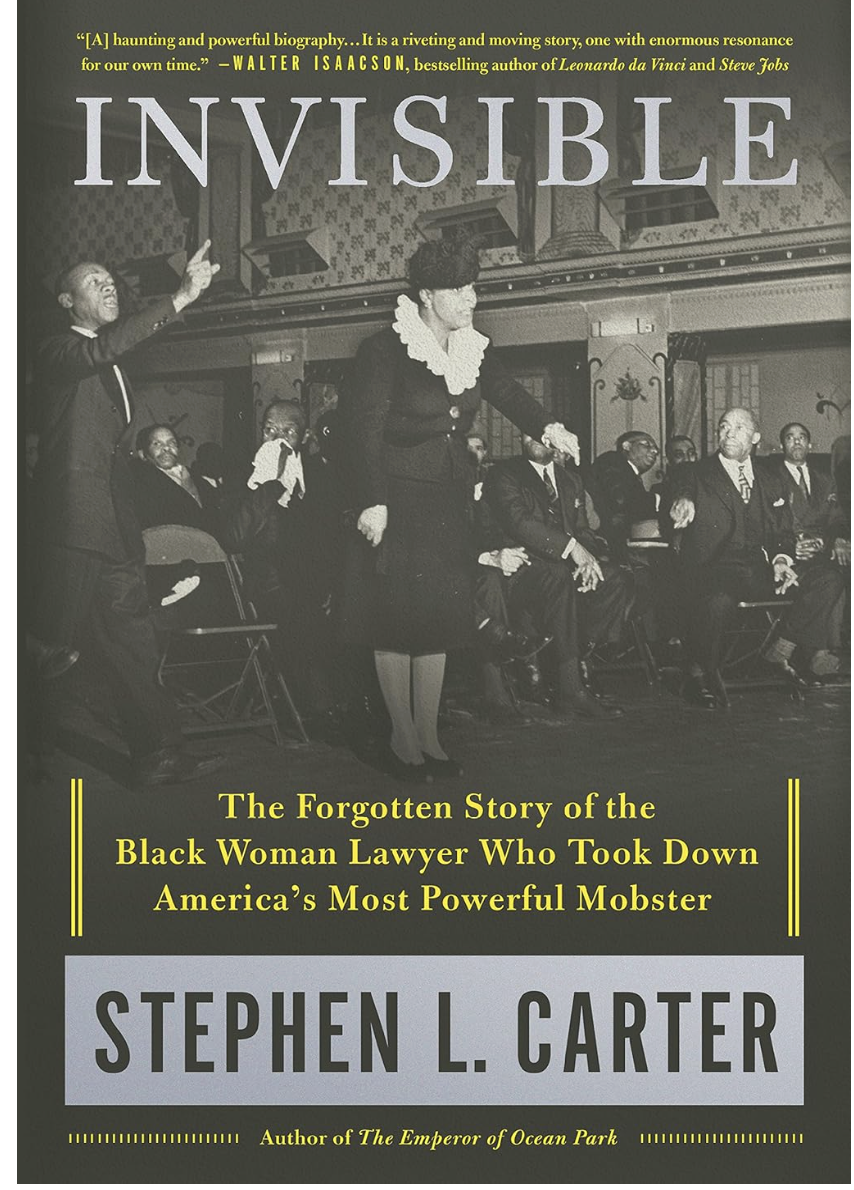
Five years ago, my cousin, Evelyn, sent me a text message with a copy of a paragraph from a book that quoted Ebenezer. The book, Invisible, by author and Yale legal scholar, Stephen L. Carter, is the biography of Stephen’s grandmother, Eunice Hunton Carter.  The book’s subtitle is: “The Forgotten Story of the Black Woman Lawyer Who Took Down America’s Most Powerful Mobster.”  
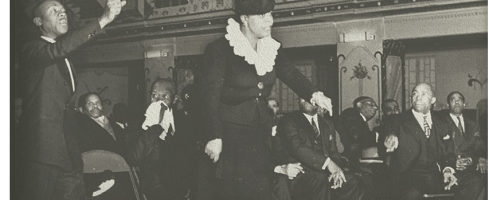
But before Eunice Carter became a prosecutor, developing the strategy that would bring down Mafia boss Lucky Luciano, she was picked by the Republican Party as their candidate for the Nineteenth District of the New York State Assembly. According to Stephen Carter, the GOP “needed a warm body” to run for the seat occupied by James Stephens, a Democrat and the only “colored” member of the Assembly at the time.

My father and his newspaper, The New York Age, were all in for Mrs. Carter.

“The Age, the more traditionalist of New York’s major Negro papers, labeled Eunice ‘exceptionally well qualified.’ The paper predicted ‘with certainty’ that she would win,” Stephen Carter wrote. “Age columnist Ebenezer Ray offered three reasons: ‘First, her platform is practical; secondly, it would give her the distinction of being the first Negro woman to attain such a position, and lastly, SHE CAN’T DO LESS THAN THE MEN.’  The column added: ‘Here is an opportunity for women voters to be clannish to one of their own sex.’”

Despite support from the Black press in New York and beyond and predictions that she was the “odds-on favorite,” Eunice Carter lost the election. The Baltimore Afro-American, which also had endorsed her, expressed surprise.

“The paper told readers that even as Eunice gave a conciliatory concession speech, she ‘looked as if her faith in humanity had been shaken,’” Stephen Carter wrote. “What went wrong?”

The author listed several possible reasons his grandmother lost, despite a “spirited campaign.” Her incumbent had likely benefitted from the patronage of Tammany Hall, the New York City Democratic political machine that dominated the city’s politics for decades. “In addition, although the impact would not be obvious for another decade, the segment of the community Eunice was seen to represent — tradition-bound, clannish, respectably middle-class — was losing its stranglehold on the politics of the darker nation. And, of course, at this time a substantial portion of the Negro and white electorate alike remained skeptical or perhaps even hostile toward female candidates,” Stephen Carter wrote.
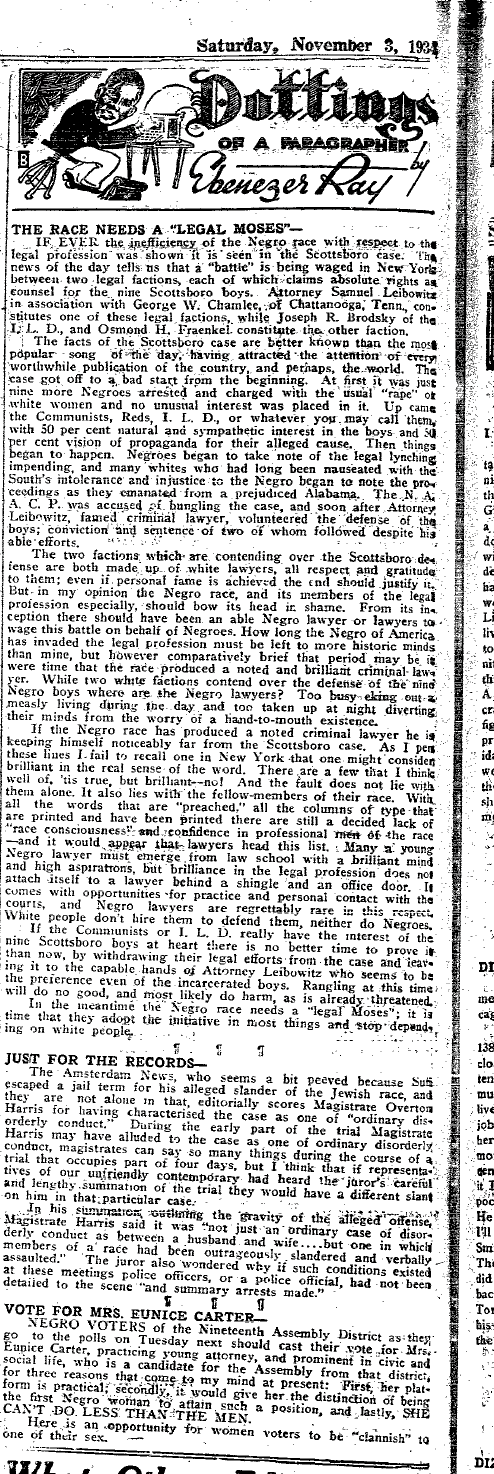
Vote for Mrs. Eunice Carter

I’m happy to know that my father was forward-thinking enough to champion a woman’s candidacy. Still, there are echoes of today’s political climate.

My faith in humanity was shaken when Kamala Harris lost the 2024 presidential election.

Stories of Eunice crisscrossing Harlem, inspiring crowds at churches, political clubs and civic organizations; her direct appeals to specific constituencies such as Black beauticians, took me back to Harris’ whirlwind 107 days on the campaign trail.

In Invisible, Carter added that another factor in Eunice’s defeat was that Black folks were going through a “partisan transformation.” In 1929 “African America still trended Republican. By 1934, Harlem was voting Democratic— the party won every contest in the neighborhood that year—and the same partisan tide that defeated Eunice was sweeping the darker nation in election precincts around the country.”

The 2024 presidential election exposed some partisan realignments as well, including an increased portion of Black men who voted for Harris’ opponent. And while I would not call their slight right shift a tide, it is worrisome. I also worry that the “tradition bound,” Democratic establishment might court Republicans at the expense of its progressive left flank.

I wonder what Ebenezer and Eunice would think about Harris or New York Democratic Mayoral candidate Zohran Mamdani.

Eerie Echos of ‘Democracy Losing’

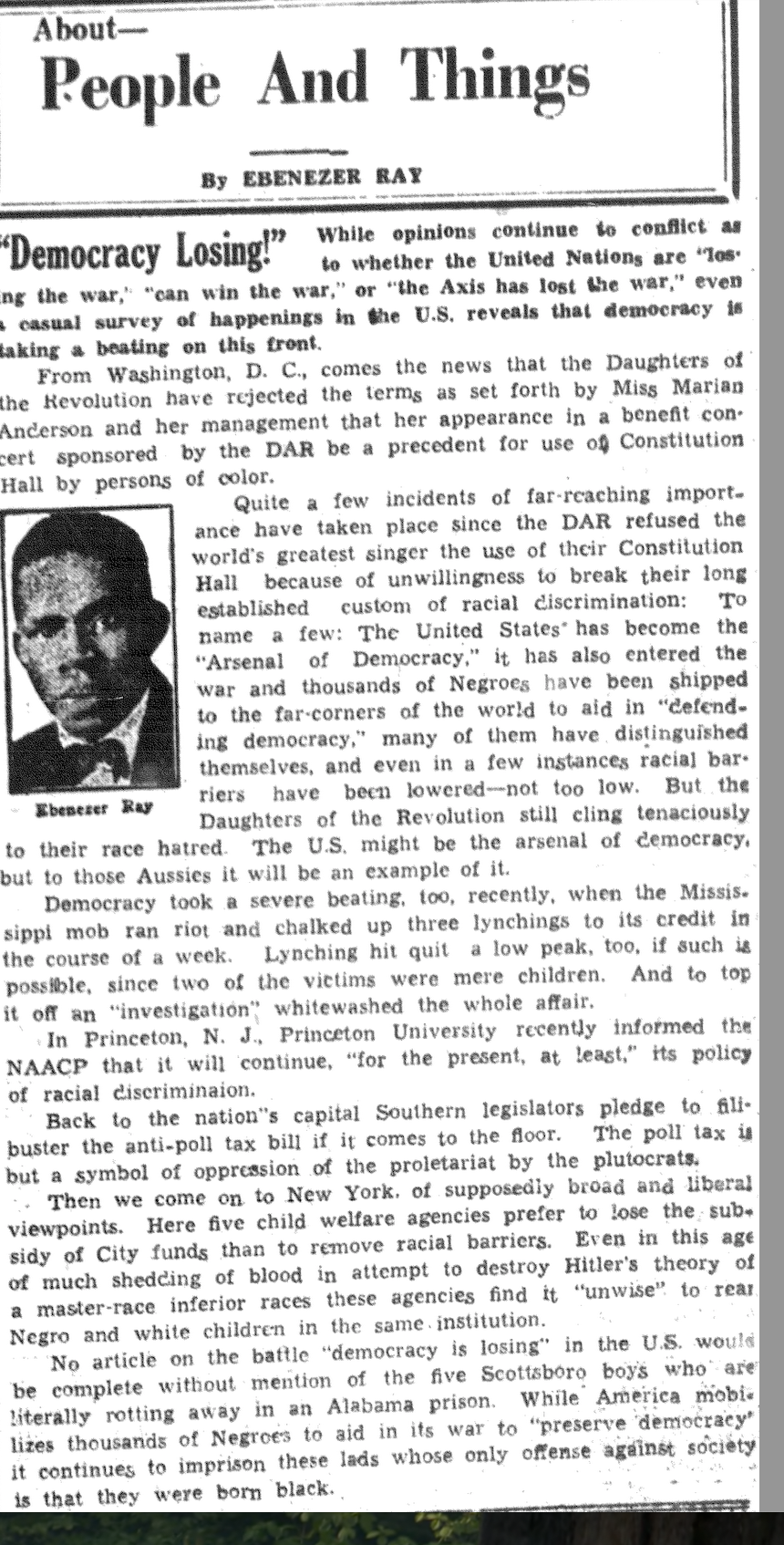
25 Oct People and Things November 14, 1942

Eighty-three years ago, my father wrote a column titled “Democracy Losing!” asserting that while Americans were debating whether the world was winning or losing the war against the Nazis, “a casual survey of happenings in the U.S. reveals that democracy is taking a beating on this front.”

In November of 1942, Ebenezer lamented that the Daughters of the American Revolution (DAR), were still balking at the terms “set forth by, Miss Marian Anderson, and her management that her appearance in a benefit concert sponsored by the DAR be precedent for use of Constitution Hall by persons of color.”

My father loved Marian Anderson, so it is no surprise that three years after her historic 1939 Easter concert at the Lincoln Memorial  —  an alternative venue arranged with the help of First Lady Eleanor Roosevelt after the DAR refused to abandon its whites-only policy — Ebenezer was still outraged.

But that was not the only bee in his bonnet.

“Quite a few incidents of far-reaching importance have taken place since the DAR refused the world’s greatest singer the use of the Hall because of unwillingness to break their long-established custom of racial discrimination.”

My father pointed to three lynchings in Mississippi  — two of the victims were children — and that an ‘”investigation’ whitewashed the whole affair.”

He also mentioned that Princeton University had informed the NAACP that it would continue ”’for the present at least,’ its policy of discrimination.”

There also was the pledge by Southerners in Congress to filibuster an anti poll-tax bill. “The poll tax is but a symbol of oppression of the proletariat by the plutocrats.”

“Then we come to New York,” he added. “Here five child welfare agencies prefer to lose the subsidy of City funds than to remove racial barriers. Even in this age of much shedding of blood in attempt to destroy Hitler’s theory of a master race, these agencies find it ‘unwise’ to rear Negro and white children in the same institution.”

Several months after this column, in 1943, the DAR agreed to allow Marian Anderson to perform for a racially integrated audience in their venue.

I have not been able to pinpoint my father’s NAACP/Princeton University reference,. However, according to April Armstrong, author of “Erased Pasts and Altered Legacies: Princeton’s First African American Students,” the first African American to receive an A.B. from Princeton University was John Leroy Howard in 1947. (At least two other Black men had received graduate degrees in 1891 and 1893. Bruce Wright, a future member of the New York Supreme Court, was accepted into Princeton as an undergraduate in the mid-1930s, but his admission was revoked when he showed up on campus and administrators realized he was Black.)

While there has been significant progress since my father wrote this column 83 years ago, “Democracy Losing” is certainly a concept that is currently trending. With President Donald Trump’s takeover of the Kennedy Center for the Performing Arts; Republican efforts to put the final nail in the coffin of the Voting Rights Act; the assault on universities, particularly their commitment to Diversity, Equity and Inclusion; and the violent attacks on people perceived to be undocumented immigrants by Immigration and Customs Enforcement agents based on their race, has eery echoes of the past.

People and Things November 14, 1942

Standing on the shoulders of Black Legends

15 Feb

On Saturday, Feb. 17, I will be among several individuals inducted into the 2024 Class of the Black Legends of Silicon Valley. This is quite an honor. Previous recipients in the News and Documentary category in which I am being honored include journalists with stellar credentials. Loretta Green, an award-winning reporter for several local papers and a former columnist for the San Jose Mercury News, has been a mentor and role model, not only for her work as a journalist but as someone who is well regarded for her community service. David Early, another seasoned award-winning editor and writer whom I also have looked up to since I arrived in the Bay Area, is a previous Legend. Henrietta Burroughs, executive director of the East Palo Alto Center for Community Media, is 2018 winner of this award and someone I deeply admire for her commitment to the East Palo Alto and Belle Haven communities.

The award recognizes my work as a journalist and communications professional including Essence magazine, where I wrote and edited articles on a variety of subjects, including careers, relationships and travel. At the Boston Globe, my editorials effected policy changes in city and state education reform, child welfare, domestic violence and community development. I also wrote editorials, op-ed articles and features on Haiti and South Africa.

This recognition also honors my community service. In addition to my work at Stanford and in journalism, my significant contributions in Silicon Valley have been in the nonprofit and educational advocacy space. I currently serve as vice president of the board of the Pear Theatre, a performance theater based in Mountain View, Calif. The Pear strives to amplify diverse voices through the performing arts. I served for several years as a board member and board president of Foundation for a College Education, an organization based in East Palo Alto, Calif. that is committed to college access and success. In 2005,  I co-founded the Parent Network for Students of Color, an advocacy group for students attending the Palo Alto Unified School District. That organization has evolved into Parent Advocates for Student Success. I was a founding board member of the Girls’ Middle School, when it was established in 1998, with a core vision  of recruiting and retaining high-achieving girls from diverse racial and socioeconomic backgrounds.

We live in an age in which journalists are verbally denigrated as purveyors of “fake news,” and politicians insult our intelligence with “alternative facts.” Journalists across the world are physically assaulted and even killed simply for trying to do their jobs.

Our democracy requires a free press to ensure that our political leaders and public institutions act in our interests and to make sure our tax dollars are used to support, protect and uplift all of us and particularly those most in need. We need well-resourced media organizations to make sure that corporate interests do not harm or exploit us in the name of profit.

At Saturday’s ceremony I will accept the award on behalf of my father, Ebenezer Ray, a journalist for Harlem’s New York Age and the Pittsburgh Courier, whose commitment to truth telling is in my blood.

In the photo above, I’m the one in the middle.

The Black Legends of Silicon Valley awards ceremony takes place Saturday, Feb. 17 at the Hammer Theatre in San Jose, Calif. Visit the website for information.

Here is a list of all of the 2024 inductees and a bit more information about the award vision behind the effort:

The Alexander-Green News & Documentary Award recipient is Elaine Carolyn Ray. This honor is awarded to journalists, historians, photojournalists, documentarians, editors and community people who record local black community history & events, as well as significant world events that have enhanced the quality of life in the Black Community and the broader community.  

The Banks-Gage Education Award recipients are Brenda J. Smith-Ray and Dr. Harriett B. Arnold, (Ed.D). This honor is awarded to individuals who had outstanding careers as teachers, administrators, and policymakers, who had a significant impact on the quality of educational services for the community, and who enhanced the lives of people in the Black community.

The Clay-Williams Business & Entrepreneur Award recipient is Reginald Swilley. This honor is awarded to those business owners and entrepreneurs who created successful businesses or services in the community and used their success to enhance people’s lives in the Black community.

The Dean-Greene S.T.E.M Award recipient is Donald G. James. This honor is awarded to individuals who helped produce, enhance, and improve today’s social network and were instrumental in landmark changes in S.T.E.M. (Science, Technology, Engineering, and Mathematics) to enhance and improve the general public’s lives and those in the Black community.

The English-Higgins Health & Medicine Award recipient is Dr. Carol A. Somersille, (M.D.) This honor is awarded to those doctors, nurses, and health practitioners who provided healthcare to people in the broader community and enhanced the lives of people in the Black community.

The Joyner-Stroughter Community Service Award recipients are Angela Warren and Robert Hoover. This honor is awarded to businesspeople and volunteers who created and/or volunteered for non-profit agencies that provide essential services to enhance the quality of life for people in the Black community.

The Piper-Whye Art/Theater/Music Award recipient is Ron E. Beck. This honor is awarded to individuals who have distinguished themselves and have had outstanding careers in art, theater, television, or movies in the broader community and have used their influence to enhance people’s lives in the Black community.

Community Organization Award recipients are Santa Clara County Black Lawyers Association and Delta Sigma Theta Sorority, Inc. San Jose Alumnae Chapter. This honor is awarded to Black organizations that have served and enhanced the lives of people in the Black community and Silicon Valley.

Black Legend Awards Silicon Valley also celebrates the publication of Legacy: The History and Stories of African Ancestry & African Americans in Silicon Valley. More than a history book, it is the must-have missing piece of the puzzle that firmly reinserts African Ancestry and African Americans back into the halls of history. Legacy is available in Hardcover and Paperback and can be purchased on site at the Hammer Theatre before the event begins. It can also be purchased online at Barnes & Noble, Amazon and various bookstores. For bulk purchase for schools and other organizations, please contact Black Legend Awards Silicon Valley at 408.320.2111 or info@blacklegendawards.org. The books are available for individual purchase online or at bookstores.

It happens here, and now

20 Jun

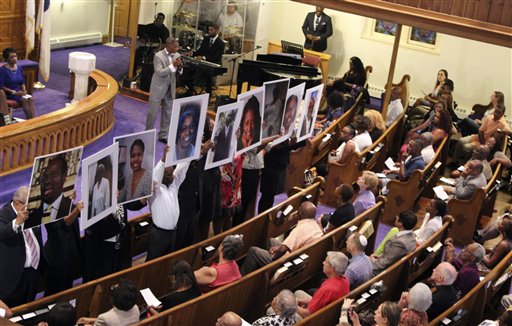
In this photo taken June 19, 2015, photos of the victims of the shooting at Emanuel AME Church in Charleston, S.C., are held during a vigil at the Metropolitan African Methodist Episcopal Church in Washington. The black church has long been the cornerstone and sanctuary for African American life. It has also long been a target for racists and white supremacists trying to strike blows against the African American psyche. The latest attack came Wednesday in Charleston, South Carolina, when 21-year-old Dylann Storm Roof joined a prayer meeting inside historic Emanuel African Methodist Episcopal Church and shot nine people dead, including the pastor, the Rev. Clementa Pinckney, and other ministers. (AP Photo/Glynn A. Hill)

In this photo taken June 19, 2015, photos of the victims of the shooting at Emanuel AME Church in Charleston, S.C., are held during a vigil at the Metropolitan African Methodist Episcopal Church in Washington. (AP Photo/Glynn A. Hill)

From his columns, I know my father as someone who believed America thought too much of itself when it came to racial justice.

He often used his writing to remind readers that while the United States was promoting itself around the world as the land of the free, it had a lot to answer for at home. He chastised white American leaders who responded vocally to the scourge of Nazism, but were mum on “the many injustices to which Negroes of America have been subjected during the past many years.”

“Truly, the oppression of Negroes in America is of a more subtle nature than the present ruthless persecution of Jews by the Nazi regime,” he wrote, but “there are individual cases which compare remarkably well with the deeds perpetrated by proponents of the brown shirt and swastika.”

dottings_1_7_1939

The New York Age, January 7, 1939

Much of that column, published in the New York Age on January 7, 1939, was devoted to an incident a few weeks prior involving a wealthy black Chicago businesswoman  — Noblesse Boyd  — who was racially profiled, jailed and charged with vagrancy in Indianapolis for the crime of wearing an expensive coat.

But that weekly offering also referenced lynchings, including one notorious case in which several members of a family — the Lowmans — were brutally murdered by a mob in Aiken, South Carolina, in 1926.

“It Happens Here!” was the title of that column.

And it happens still. It happened in America on June 17, 2015, when nine black women and men were gunned down during bible study at Emanuel AME Church in Charleston by a white supremacist who allegedly spewed racial epithets along with his bullets.

The dead are Cynthia Hurd, 54; Susie Jackson, 87; Ethel Lance, 70; Rev. DePayne Middleton-Doctor, 49; Hon. Rev. Clementa Pinckney, 41; Tywanza Sanders, 26; Rev. Daniel Simmons, Sr., 74; Rev. Sharonda Singleton, 45, and Myra Thompson, 59.

I refuse to utter this terrorist’s name or publish his photograph, as it will just give him another platform for his hatred. But photos show him wearing a jacket with the flags of apartheid-era South Africa and Rhodesia. His neo-Nazi and Klan inspired diatribes appear to be well documented. His terror indeed compares, as my father said, “remarkably well with the deeds perpetrated by proponents of the brown shirt and swastika.”

“It happens here,” Ebenezer Ray reminded his readers in 1939. As we approach Father’s Day 2015, I am forced to say, “Daddy, you were, and still are right.”

Happy Birthday, Ebenezer

24 May

My father would be 117 years old today. Eighty years ago his birthday wish was for a typewriter with the same configuration of keys as a Linotype machine.  I wonder what he would think of our writing implements and communications platforms today.  A dear friend recently gave me a bracelet made of typewriter keys. I’m wearing in honor of my Daddy’s birthday today.