Archive by Author

Harlem Jubilee

3 Jun

I love this emblem, “ER” of course stands for Elizabeth Regina,” but my father and I also share these initials.

My father would have loved all the pomp and circumstance associated with Queen Elizabeth II’s Diamond Jubilee. After all, before he was a naturalized American, he was technically a Brit.
Apparently, he was not the only Harlemite with an affinity for the Crown. In 1937, a year after King George VI, Elizabeth’s father, ascended to the throne, folks on this side of the Pond went all out to reenact the Coronation Day celebration taking place in Great Britain.

In a column published in the New York Age on May 21, 1937, my father wrote:

“On Wednesday evening last (May 12) British patriotism reared its head in no uncertain terms here in Harlem when approximately four thousand persons, motley as motley is, descendants of British soil and their descendants, jammed the spacious Rockland Palace, where a Coronation Ball and Pageant was held under sponsorship of the Church of St. Ambrose, of which the Rev. E. Elliott Durant is rector.

Sir Gerald Campbell, British Counsel General, Lady Campbell and an official and family entourage added distinguished patronage.
National colors flew liberally from the gallery of the casino. The Union Jack was there, no doubt. . . .

Conservative and discriminating faces looked down from the gallery at the horde of dancers below. For this night they were Britain’s aristocracy, the dancers below the proletariat.

As one observed the revelry of the fashionably dressed ladies and their escorts, and the occasional greeting of friends, one was inclined to ask whether it was patriotism that prompted the turnout, or just another social affair. But when the rafters of the casino literally shook with legion voices raised in singing the British National Anthem, followed by Rule Britannia, one quickly concluded that when origin of birth is accentuated, the span between it and the land of one’s adoption is brief, very brief. The singing of the Star-Spangled Banner climaxed this song fest.

It was long after midnight when the replica of the Coronation took place. Preceded by a procession of ‘representatives’ of various colonies, Gordon Ward, by selection of the church, was bestowed the paraphernalia befitting a King. The Queen was represented by Mrs. Ulrica Baird, chorister. Mrs. Baird’s selection was by acquisition of 1,340 votes. Her closest runner-up was Miss Alma Simmons, ‘Queen of Scotland’ with 1,228 votes. Murcott Wiltshire, lay reader, essayed the role of Archbishop. Africa was not forgotten, as Acolyte Charles Cheesman, portraying Haile Selassie, received a rousing ovation from the spectators.”

Ebenezer goes on to quote Rev. Durant, a native of Barbados, who said:

“’It is joy unspeakable to me to address you on this most joyful occasion, which comes to us once in a generation. Once we were Britishers and now we are Americans. But because we were good Britishers, we are now better Americans.’”

Aunt Maude’s tragic death

27 May

Barbados Supreme Court Building

CHRIST CHURCH, BARBADOS, MAY 27, 2012 I spent a good part of Friday at the Barbados Supreme Court in Bridgetown to see what I could find out about my father’s sister, Maude Alkins, whom he wrote about in a column when she died in February 1934.

The item simply said: “News was received Friday evening last of the death of my sister Maude Victoria, aged 26 years on Friday, February 2, at her home in Barbados, BWI. May the sod rest lightly on her.”

When the administrator at the courthouse came back with the death certificate, he commented on what a tragic, horrible death Maude’s had been. “She died in childbirth, he said, “five days of labor.”

The death certificate lists the cause of death as “Puerperal septicemia; Cardiac failure and exhaustion from prolonged and difficult labour.” The “informant” was listed as “Noel Alkins, printer,” my father’s brother. It was a role he would take on again; two years later when their mother, Malvina, died.

There was a lot of waiting and appealing (Getting such documents is not usually a one-day process. Many of the court staff worked right through their lunch hours to accommodate the lines of those seeking records.) I did not find out whether the child (or children) Maude was birthing lived or died.

Malvina did apparently have a granddaughter, Carmen, who I had assumed was Noel’s child, but perhaps not.

My father’s column item about Maude’s death seemed much more detached than what he wrote when his mother died. He did refer to her as “my” sister rather than referring to himself in his customary third-person. Of course, it is always a tragedy when you lose someone in their mid 20s, but my father’s column betrayed no indication of Maude’s agony, or that a baby died or was born an orphan.

I imagine Malvina was heartbroken at the time of her own death in 1936. She’d lost her husband just a month before her own death and two years before she had buried her own child.


This item appeared in the New York Age, August 17, 1940, four years after Malvina, my grandmother died. It is the first and only mention I have found of Carmen.

Meanwhile, I had a delightful meeting with Barbados family historian Patricia Stafford Friday morning. She took copious notes on the Wray/Ray/Alkins clan and, with no guarantees, said she would try to find more on our family’s tree.

From Barbados, with love

24 May

Zuri Adele on Accra Beach, Barbados

CHRIST CHURCH, BARBADOS, May 24, 2012 — Zuri, my sister-in-law Tracy and I are in Barbados for a little R&R after a whirlwind Spelman Commencement Weekend. It also happens to be my father’s birthday. He would be 115.

In a column he published shortly after his 43rd birthday  in 1940, he uses the occasion to commemorate Empire Day, the birthday of Queen Victoria, with whom he shared a natal day:

“It is difficult  if not at all impossible for ye paragrapher to forget Empire Day, though we may be many years removed from the British Empire, because it was on that day our late beloved mother told us we ‘came from somewhere in a box.’ Most readers of this column think we should have been left in the box.”

Tomorrow, I have an appointment with a specialist in Barbados genealogy who is going to try to help me get to the bottom of that box.

For today we’ll take a tour of the island, hit the beach and pour a libation in honor of Ebenezer’s birthday.

The New York Age, June 1, 1940

Zuri Adele: We knew her when

16 May

I’ve been looking for an excuse to post this video in this blog since I launched it. Now it seems like this is my last chance. My good friend Jack Hubbard shot it when my daughter Zuri, whom he calls “The Swan” graduated high school. I can’t believe it’s been four years.

On Sunday, Zuri Adele will graduate from Spelman College, BA in Theatre, Phi Beta Kappa, Magna Cum Laude.

Ebenezer would have been proud.

She’s all grown up, but her essence has not changed. She is still, as the citation for the Gunn High School Faculty Cup Award, written by teacher Jessica Hawkins, stated:

“Observant, wise, generous and funny. All the light she shines makes the rest of us look better, want to ‘be’ better, on stage and off. She doesn’t steal scenes, she makes you want to give them to her – but she’d never abuse the privilege. She’s impossible not to watch and listen to: a live, beating heart with a ready mile-wide smile and the brains to back it up. The only consolation in her leaving is the understanding that she was meant for greatness beyond the boundaries of the school she’s already helped make great. She walks to a rhythm everyone wants to follow and the world will be a better place with her leading it.”

A Mother’s Day tribute

8 May

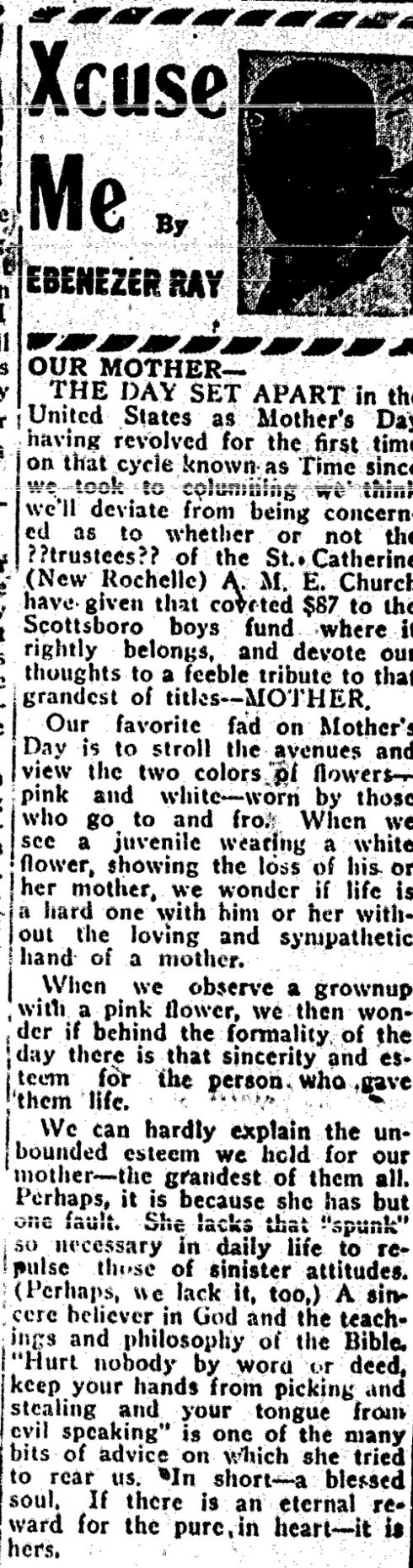
I queued this up a year ago just so I would remember to revisit it for Mother’s Day 2012. (Apparently, it went live several days ago.) My father never missed an opportunity to sing the praises of he mother, Malvina. It’s clear my grandmother was God-loving and generous to a fault. I wish I had a photo.

The New York Age May 20, 1933


Continue reading