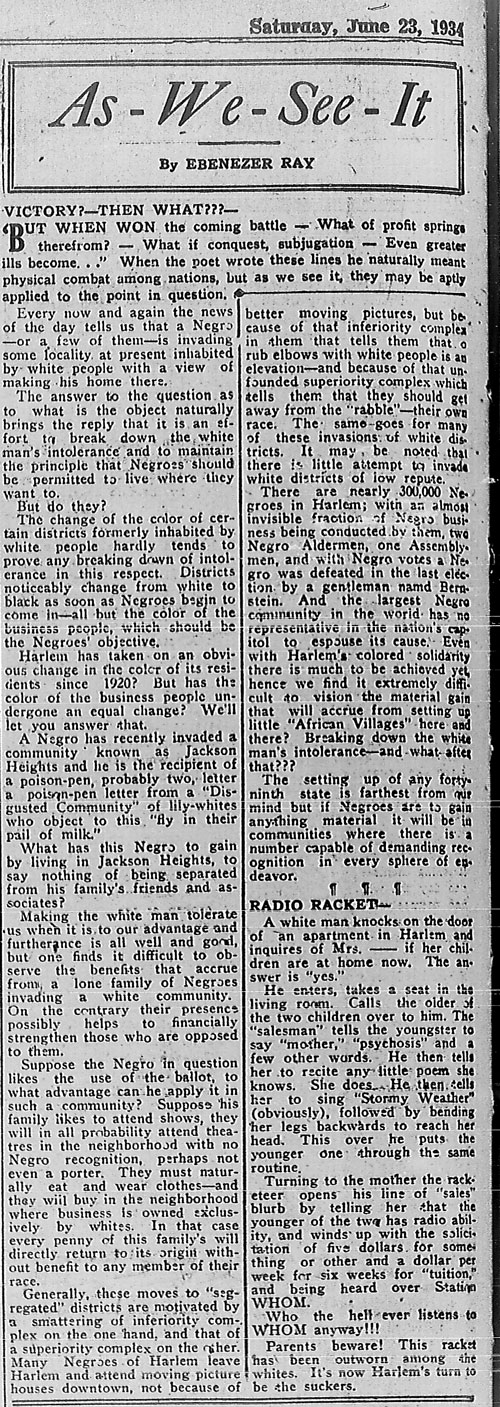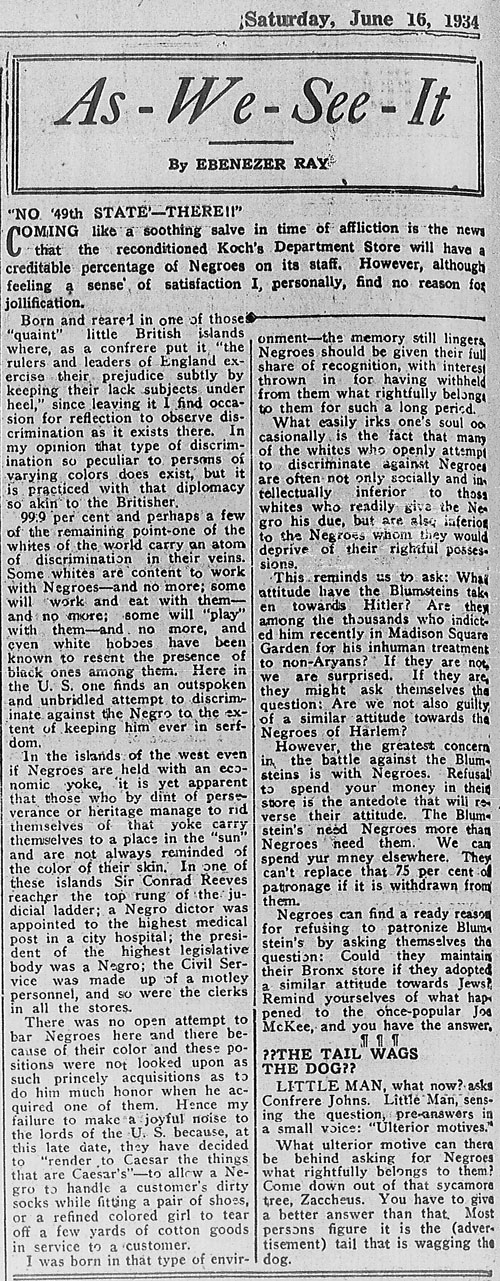
There are some interesting bits of historical information, such as Marcus Garvey’s wife’s divorce complaint and his eventual deportation and the acquisition of the Schomburg collection by the Carnegie Corporation. Schomburg has particular meaning to me, as it was at the 135th Street library that I found these columns. Didn’t know the Amsterdam News tried to go daily – for a day. I didn’t know anything about Florence Mills, a well-regarded singer, dancer and comedienne who died of tuberculosis.
Why my father chose June 30, 1934 to reprint a list of 1927 events from another publication is beyond me.
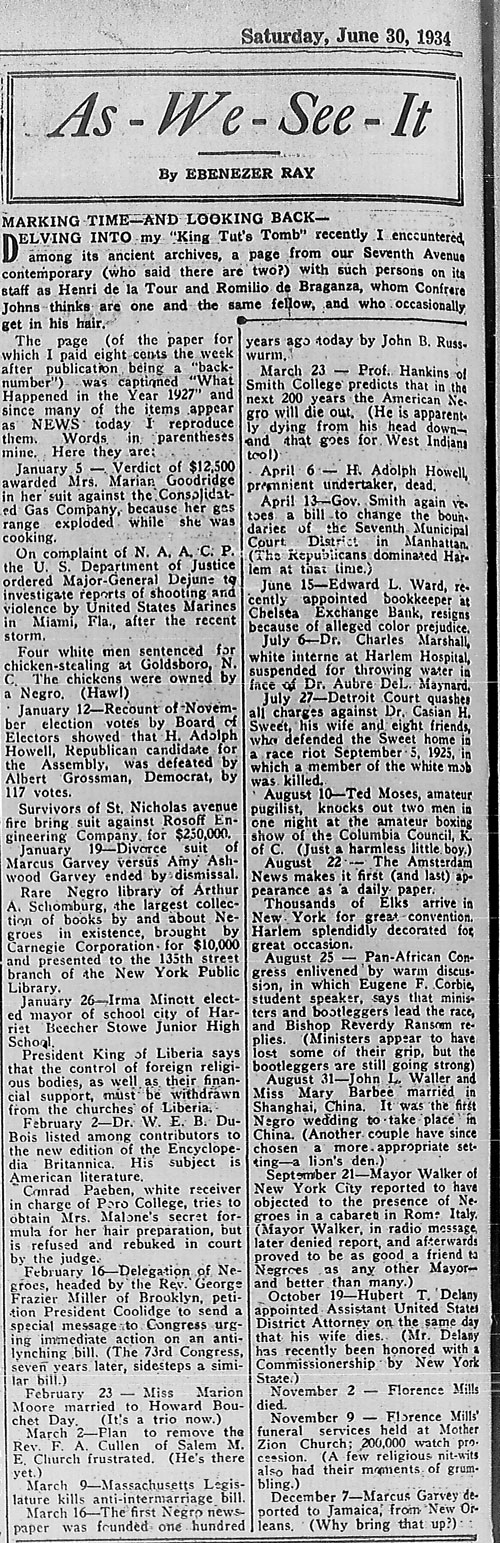
What happened in 1927?
30 Jul‘No reason for jolification’
27 Jul
Long before the Montgomery bus boycott, leaders in Harlem were calling on members of the black community to refrain from spending their money in stores that refused to hire them. Blumstein Department Store was a primary target. In this column it looks as if Koch’s Department store made some concessions, but Blumstein was a harder case. “This reminds us to ask: What attitude have the Blumstein taken towards Hitler?” Ebenezer asks. “Are they among the thousands who indicted him recently in Madison Square Garden for his inhuman treatment to non-Aryans? If they are not, we are surprised. If they are, they might ask themselves the questions: Are we not also guilty to a similar attitude towards the Negroes of Harlem?” The reference to “Little Man,” appears to be an attack on William H. Davis, the publisher and part owner of the New York Amsterdam News. It appears that Davis suggested that the advocates of the Blumstein boycott had ulterior motives. My father suggested that Davis sold out for advertising dollars.