I just watched HBO’s Confirmation, which told the story, but mostly the back story, of Clarence Thomas’ appointment and ultimate confirmation as an associate justice to the U.S. Supreme Court in 1991. Unlike my reaction to FX’s The People v. O.J. Simpson, which I found much too painful to endure, I found Confirmation oddly validating and inspiring, even as it steered clear of taking a hard side. Some reviews have described it as boring, particularly compared with the 10-hour O.J. miniseries. (I’ve only watched one episode.) But I had lived through the salacious version of the confirmation story – the real-time television saga of 1991. I was glad that in the age when reality TV pervades every aspect of our lives, including presidential politics, a historical drama could be produced without hysteria in every scene. I was happy to see Kerry Washington, whom I’ve loved since I first saw her in Save the Last Dance, show her understated emotional range as Anita Hill, and Wendell Pierce’s controlled and searing portrayal of Thomas under siege. Jeffrey Wright as Charles Ogletree was an added treat.
Back in 1991, I wrote a few columns about the Thomas, Hill and the confirmation process. Here’s one that imagines a big screen portrayal of the hearings, with a bit of commentary on Hollywood.
Minutes after the news broke that Prince Rogers Nelson had died, my phone started blowing up. “Prince!” one friend simply wrote. “How are you? I’m so sorry,” wrote another. “Purple Rain. Midnight Show Opening Day! A Good Memory,” wrote another old friend.
I was both comforted, moved and amused by the texts, emails, Facebook posts and phone calls from people who have known me from different stages of my life over several decades. I did love Prince’s musicianship, his artistry, his energy, his sexiness, his introverted nature, his insistence on being himself. I dug out an article published about me in the Pittsburgh Post-Gazette in 1986 when I visited my hometown. Over the years, I’d been a bit embarrassed about my response to the question about my favorite movie. After all, I remember hating Purple Rain the first time I saw it, with its misogyny and horrible acting. But I loved the music and went back to see it several times, so it was an honest answer. And in honor of his Purple Majesty, I embrace it.
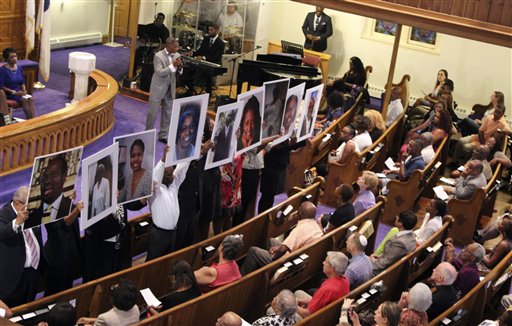
In this photo taken June 19, 2015, photos of the victims of the shooting at Emanuel AME Church in Charleston, S.C., are held during a vigil at the Metropolitan African Methodist Episcopal Church in Washington. (AP Photo/Glynn A. Hill)
From his columns, I know my father as someone who believed America thought too much of itself when it came to racial justice.
He often used his writing to remind readers that while the United States was promoting itself around the world as the land of the free, it had a lot to answer for at home. He chastised white American leaders who responded vocally to the scourge of Nazism, but were mum on “the many injustices to which Negroes of America have been subjected during the past many years.”
“Truly, the oppression of Negroes in America is of a more subtle nature than the present ruthless persecution of Jews by the Nazi regime,” he wrote, but “there are individual cases which compare remarkably well with the deeds perpetrated by proponents of the brown shirt and swastika.”
The New York Age, January 7, 1939
Much of that column, published in the New York Age on January 7, 1939, was devoted to an incident a few weeks prior involving a wealthy black Chicago businesswoman — Noblesse Boyd — who was racially profiled, jailed and charged with vagrancy in Indianapolis for the crime of wearing an expensive coat.
But that weekly offering also referenced lynchings, including one notorious case in which several members of a family — the Lowmans — were brutally murdered by a mob in Aiken, South Carolina, in 1926.
“It Happens Here!” was the title of that column.
And it happens still. It happened in America on June 17, 2015, when nine black women and men were gunned down during bible study at Emanuel AME Church in Charleston by a white supremacist who allegedly spewed racial epithets along with his bullets.
The dead are Cynthia Hurd, 54; Susie Jackson, 87; Ethel Lance, 70; Rev. DePayne Middleton-Doctor, 49; Hon. Rev. Clementa Pinckney, 41; Tywanza Sanders, 26; Rev. Daniel Simmons, Sr., 74; Rev. Sharonda Singleton, 45, and Myra Thompson, 59.
I refuse to utter this terrorist’s name or publish his photograph, as it will just give him another platform for his hatred. But photos show him wearing a jacket with the flags of apartheid-era South Africa and Rhodesia. His neo-Nazi and Klan inspired diatribes appear to be well documented. His terror indeed compares, as my father said, “remarkably well with the deeds perpetrated by proponents of the brown shirt and swastika.”
“It happens here,” Ebenezer Ray reminded his readers in 1939. As we approach Father’s Day 2015, I am forced to say, “Daddy, you were, and still are right.”
I confess. I am under the spell of Riley, Warrior Princess.
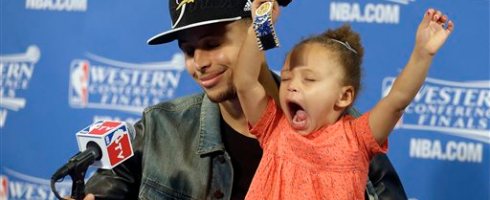
I wait with bated breath for the next time I can get to see her don an invisibility cloak, disappear under a press conference table, then reappear, headband gone, ready for her next conquest.
I, like the rest of the world, watch as she melts the hearts of the most jaded sports reporters who abandon their worries about looming deadlines and just let this pint-sized super hero take them away.
I swoon as I watch her father, Steph Curry, multitask, deftly responding to questions about offensive and defensive strategy on the basketball court, while putting on his daughter’s bracelet and keeping an eye out to make sure she doesn’t run away with the mic or bonk her head.
When the Warrior Princess disappears behind the dark curtain, we escape too, from extrajudicial police killings; from Boko Haram and ISIS; from the widening wealth gap and the evaporation of affordable housing; from super storms and drought. For just a few minutes, we too can be two again.
But that’s just the problem. We, the public, with our cell phones and Twitter accounts and Instagram postings, too often act like toddlers ourselves. We – often led or followed by the mainstream media – have an insatiable hunger for proximity to fame. But then we get bored, forget about boundaries, insist that our hunger be sated, without regard for the toll our constant demands have on those whose lives we covet.
So we wait, until we can snap photos of the Warrior Princess turning into a teenager, rolling her eyes at her dad’s bad jokes or wearing her skirt shorter than we deem appropriate. Soon someone is training a long lens on Riley’s first kiss. We are speculating about what is in that red cup or whether that’s a cigarette in her hand or something else.
And when Steph and her mom, Ayesha, invoke her right to privacy we, like toddlers, pretend not to hear, toss our once favorite toy aside or worse, we bite, or stomp away in a fit of pique and insist that her parents are not playing fair.
I am dazzled by Riley, Warrior Princess, and the image of a free, black girl full of joy and self-confidence. I am inspired by the image of the healthy African American family, a tender, humble superstar athlete, husband and dad. But I think it’s time to let Riley go back to being what she is, a little girl.
Managing the public spotlight is a lot like parenting: You have to set clear boundaries from the get-go, or risk losing your moral authority for a long time to come.
My mother and father walked everywhere; neither one of them drove a car. My family has its share of dancers, actors and athletes whose bodies are the tools of their trades. Yet on the downside, that same family has been ravaged by the devastating consequences of hypertension and heart disease. At the risk of sounding morbid, we’re all going to die of something. But too many of my relatives’ lives were cut short too early by strokes and heart attacks. So I am literally running with the clock. As I say in this video, I think I’ve found what works for me.
Looking for something fresh to write about on Election Day, I searched my father’s columns for wisdom from the past. A footnote in a column published in the New York Age on November 3, 1934, implored readers to elect “Mrs. Eunice Carter” to the New York State Assembly. The name had a familiar ring. Five […]
My barber called Kamala Harris a “ho.” The shop I go to is not the stuff of Black culture lore. It’s not a boisterous place. It doesn’t reek with toxic masculinity. It’s a nice, quiet, family friendly kind of enterprise. The worst I have been subjected to in the nearly three years I’ve gone there […]
On Saturday, Feb. 17, I will be among several individuals inducted into the 2024 Class of the Black Legends of Silicon Valley. This is quite an honor. Previous recipients in the News and Documentary category in which I am being honored include journalists with stellar credentials. Loretta Green, an award-winning reporter for several local papers […]





 My Father's Posts