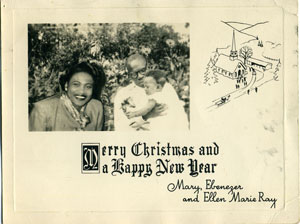
With all of the blessings many of us enjoyed in 2010, there was a great deal of sorrow. A few of my dearest friends lost their fathers in the waning months and days of 2010 and are facing the new year without them. Some were blessed with very close and loving bonds. Others had relationships that were more complicated. All of those relationships will now take on a more poignant cast in 2011. But 2010 also brought an abundance of gifts. A year ago, I had no idea this gold mine of my father’s columns existed in the universe! And speaking of his writings, he may have had his own complicated relationship with his dad. At least so far, Ebenezer has not mentioned his father in his writings, though he gives props to his mom on a regular basis. Our fathers, living and dead, present or absent, helicopter dads and rolling stones, are alive in us and have a profound impact on who we are. Here’s hoping that their legacy makes us stronger and wiser.
The ‘racial ills’ of the Episcopal Church
28 Nov“The Episcopal Church might find an antidote for its racial ills by first cleaning house, and then by directing its evangelistic and missionary activities toward those barbarians in the South who ruthlessly violate the constitutional rights of Negroes, denying them fair and impartial trials when accused of offences they seldom commit. Toward this appalling condition, the Episcopal Church has been noticeably apathetic,” Ebenezer writes.
Here is a link to information on Rev. Alexander McGuire, who founded the African Orthodox Church in response to racism in the Episcopal Church.
Tags: african american history, black history, ebenezer ray, elaine ray, genealogy, journalism, new york, The African Orthodox Church, The Epicopal Church, the new york age
- Comments 1 Comment
- Categories 1935, Columns, Dottings of a Paragrapher, The Episcopal Church
Black airmen, then and now
21 NovIn the middle of this column, under the heading “The Goodwill Flight “Ebenezer talks about a goodwill flight to the Caribbean and South America that was undertaken by Dr. Albert Forsythe and C. Alfred Anderson. They were dubbed the “first transcontinental Negro flyers.”
A New York Times obituary on Forsythe in 1986, said: “In 1933, Dr. Forsythe and C. Alfred Anderson became the first black pilots to complete a cross-country flight, traveling from Bader Field in Atlantic City, N.J., to Los Angeles. The flight, along with trips to Montreal and the Caribbean in 1934, was made in an attempt to break down the color barrier in aviation.”
An obituary of Anderson, who died in 1996, recalled: “He and Forsythe made the first land plane flight from Miami to Nassau in 1934. They island hopped throughout the Caribbean, to the Northeastern tip of South America. They overflew the Venezuelan straits and landed in Trinidad as national heroes.” It described Anderson as a mentor to Tuskegee Airmen.

First Lady Eleanor Roosevelt with C. Alfred “Chief” Anderson, a pioneer black aviator and respected instructor at Tuskegee Institute. (U.S. Air Force photo)
I also found a 1933 Time magazine story about their trip.
The itinerary did not include a visit to Barbados, which was a disappointment to those, including my father, with connections to the island. The column and the letter make it sound like the pilots were black Americans, but according to his obituary, Forsythe was born in the Bahamas. Perhaps there was a little bit of Caribbean rivalry.
The connections here are a little uncanny. Lamman Rucker, Ebenezer’s grandson, is co-producer of Black Angels Over Tuskegee, a play about the Tuskegee Airmen. Lamman, who plays Elijah in the production, is a founding member of the company, The Black Gents of Hollywood, an all-male ensemble devoted to redefining the images of African American men in entertainment.
In a few weeks I’ll be headed for Barbados, my father’s birthplace. I’ve been there only once, back in 1984 and only for a couple of days. I’m looking forward to reconnecting with the place, perhaps beginning the journey of finding family. It is interesting that while in his thirties, my father’s emotional connection to the island still seemed very strong. My impression was that later in his life, by the time he was married and living in Pittsburgh, that connection seemed to be lost, or at least frayed.
I can’t tell whether “The little Englander” my dad quotes is him or someone else. (Editor’s update 8/3/11: It’s possible it is his brother, Noel, who worked at the Barbados Advocate.) Perhaps I can find the archives of the Barbados Advocate while I am there.
Tags: 1933, 1935, Albert Forsythe, barbados, Black Angels Over Tuskegee, Black Gents, C. Alfred Anderson, ebenezer ray, elaine ray, genealogy, journalism, Lamman Rucker, letters, the new york age, Tuskegee Airmen

- Comments Leave a Comment
- Categories 1935, Columns, Dottings of a Paragrapher, Immigration
‘The Negro is a marked race’
6 Nov“Not many generations out of slavery, and forging our own existence despite heavy odds, the Negro is a marked race, hence our activities share the spotlight of constant scrutiny. when we reach the height of success none will be able to deny us our rightful share of recognition and applause. We should strive to leave great footprints in the sands of time,” my father writes below.
But I cannot help but think that 75 years later it’s still not so easy. In this so-called “post-racial era,” the struggle continues. I’m sure my father could not have imagined that in his children’s lifetime America would have a black president. And though Barack Obama has reached the “height of success” by any measure, he continues to be a member of a “marked race.” Conservatives cry that they “want to take their country back,” which is code for we want to take the country back to a time when having blacks in power was only a dream. They call him elitist, which is code for “uppity Negro.”
I also found the last item, about the assaults on domestics by the men they work for, interesting. That’s one subject that was not broached in The Help.
As he did when he wrote about the illegal numbers, or so-called “policy games,” Ebenezer expressed sympathy for prostitutes, who he referred to as “pavement pounders.” He argued that the lack of legal means available for these men and women to support themselves made it almost impossible for folks to avoid “easier money.”
“When social and economic agencies move to protect their youngsters vice crusades will not be necessary; when they do not – vice crusades will be ineffective,” he said.
P. S.: I’m still trying to find a source of information on the Mills brothers and the incident my father notes regarding their being barred from watching white baseball players play in Detroit.
Tags: african american history, ebenezer ray, elaine ray, genealogy, Green Pastures, harlem, History, hitler, journalism, Mills Brothers, Negro, Prostitution, Race, Richard Barry Harrison, The Great Depression, the new york age
- Comments Leave a Comment
- Categories 1935, Columns, Dottings of a Paragrapher
Featured Posts
-
Election days, then and now
Looking for something fresh to write about on Election Day, I searched my father’s columns for wisdom from the past. A footnote in a column published in the New York Age on November 3, 1934, implored readers to elect “Mrs. Eunice Carter” to the New York State Assembly. The name had a familiar ring. Five […]
-
‘Was silence not an option?’
My barber called Kamala Harris a “ho.” The shop I go to is not the stuff of Black culture lore. It’s not a boisterous place. It doesn’t reek with toxic masculinity. It’s a nice, quiet, family friendly kind of enterprise. The worst I have been subjected to in the nearly three years I’ve gone there […]
-
Standing on the shoulders of Black Legends
On Saturday, Feb. 17, I will be among several individuals inducted into the 2024 Class of the Black Legends of Silicon Valley. This is quite an honor. Previous recipients in the News and Documentary category in which I am being honored include journalists with stellar credentials. Loretta Green, an award-winning reporter for several local papers […]
-
‘The Donna Collection’
My short story, “The Donna Collection” is included in the new anthology 166 Palms 2020. Buy the anthology on Amazon.
-
Elaine Ray wins 2016 Gival Press Short Story Award
Blown away and humbled. The first piece of fiction I’ve ever gotten published wins an award. The story is published here.
Recent Posts
- The Schomburg Center for Research in Black Culture celebrates its centennial
- Elections: Facing Forward
- Election days, then and now
- ‘Was silence not an option?’
- Eerie Echos of ‘Democracy Losing’
- Shout-out to bus drivers
- Standing on the shoulders of Black Legends
- Nearly 200 will gather for the Brown, Kell, Tildon, Williams Family Reunion
- “Good Trouble” nominated for a GLAAD Media Award
- Harriet Tubman at the Crossing