Tag Archives: harlem

‘If I were mayor of Harlem’

15 Apr

Last  Thursday, I got a call from a fellow blogger, Valerie Bailey, who was doing research on a Ted Yates, a black newspaper columnist whose career overlapped with my dad’s. I told Bailey, whose fascinating video blog is febone1960.net, that the name was familiar, and that I would get back to her if I found anything.

Then,  while  looking for a column to feature this week, I came across one my father published on April 14, 1934 titled “If I were Mayor of Harlem.” It is one of several “If I were . . . ”  pieces Ebenezer wrote, including “If I were editor ” and “If I were the Hitler of Harlem.” (I’m not quite ready to delve into that one.)

Under the headline of the mayoral column was a note: “With apologies to W.W.” Could that be Walter White, then head of the NAACP? Not sure.  What I did find was a note in another  of my father’s columns that referred to  Ted Yates. That column was likely what led Bailey to me.

In the April 14, 1934 column, my father rails against “soap box orators,” those who used the street corners of Harlem as their bully pulpits. My father, staunch defender of the King’s English that he was, seemed less offended by their opinions and more put off by their imperfect grammar.

“Those allowed on Lenox Avenue would have to pass a grammatical test by answering three questions on the principles of correct speaking. One of these questions would be: Why should IS not be used for ARE, not ARE for IS? Most of them, having apparently paid little attention to such principles, their elimination would be easy.”

Ebenezer also pledged to deal with teenagers who frequented movie theaters on school nights and who “interrupt older patrons  with their premature bits of sophistication” and parents who kept their little ones out past their bedtimes.

“I would give power to police officers to issue summonses to parents and guardians seen hauling tired looking little children behind them from theatres between 10 p.m. and midnight. In court they would be fined. Later than midnight they would be put in a cell without a bed so they could realize what it is to be sleepy and not be able to lie down. “

Further, he would call a press conference for the black press, with editors from the rival  New York Age and the Amsterdam News sitting front and center. “Then I would advise them to bury the hatchet.”

Back to Ted Yates: In a column published a month later, there is a note under the subhead “Petty Larceny.”  It read, “Ted Yates column: If I Were Mayor of Harlem in the Afro-Amer. After all, Ted, there is still something you can glean from an ancient rag.”

I guess Yates, who wrote for the Age and a number of other black papers,  borrowed that line for one of his own columns published in the Afro-American, which was based in Baltimore, but had a national edition. I’ve done a bit of searching in the Afro-American’s archives, but haven’t turned up the Yates’ column in question yet.

Perhaps my dad should have taken his own advice about burying the hatchet.

Click “continue reading” for the full column: BTW: Tap dancer Bill “Bojangles” Robinson was nicknamed “The Mayor o Harlem.”
Continue reading

No rest for the weary

16 Jan

Riding the midnight train from San Francisco to Palo Alto the other night, a man sat across from me and politely asked if I was expecting anyone to take the seat next to mine.  When I said no, he stretched his legs out, placed his sneakered feet on the seat and proceeded to take a nap.

My blood boiled. Not with the anticipation that I was going to have to wake him up when it was time for me to get off the train (which I did).  Not because he was old enough (50 plus) to know that his feet, no matter how clean they seemed, did not belong on the “furniture.”

My blood boiled because he could enjoy the privilege of resting easy because he was white.

I should add that he was white, apparently middle class and well groomed; no one would mistake him for a homeless person in search of a night’s shelter.

My blood boiled because had he been a black or Latino man of any age, well-groomed or not, had he been a passenger on a New York subway rather than Caltrain, he would likely have been arrested and carted off to jail.

A New York Times article “Relax, if you want, but don’t put your feet up,” published earlier this month, precipitated my rage.  The article chronicles the New York Police Department’s practice of arresting passengers who take up more than one seat, deliberately or inadvertently, or block the movement of the doors. Continue reading

Telling it like it is

8 Aug

At an outdoor concert featuring Aaron Neville in San Francisco’s Stern Grove yesterday, I was taken back to being 11 or 12 years old when  my sister Ellen-Marie asked me to pick up Neville’s first hit, “Tell it Like it Is,” from the neighborhood record store. My friend Rosalyn and I were headed there for our own 45s, probably something along the lines of the Marvelettes or the Supremes. (Rosalyn and I were part of our own junior girl group called the Trangualettes  – don’t ask – and we lip-synced a mean “Don’t Mess with Bill.”)
Rosalyn and I were barely out of  elementary school. Ellen was in high school.  And even though WAMO, the one black radio station in all of Pittsburgh, played everything from R&B to blues to jazz  —  the white radio stations didn’t play black music back then —  we didn’t really have our ears tuned to Aaron Neville . . . yet.

On Sunday, as I listened to Neville’s still silky rendition of that 1967 ballad, I searched my memory for all of Ellen’s teenage crushes and suitors. I wondered who she might have been thinking about as she played that record. It could have been that she simply knew then what we’d all come to know, Neville’s capacity to make us swoon.

Romance aside, I suspect that song spoke to Ellen-Marie because it got to the core of who she was — direct and honest. Aggravatingly so. Sometimes brutally so. And not only did she take truth-telling seriously, she did not understand why others were incapable of doing the same.

Our mother, who was often given to being coy and indirect, used to drive Ellen-Marie crazy. I’m sure I did too, as I have a tendency to bury my ledes. Editorial writing was good training for getting to the point.

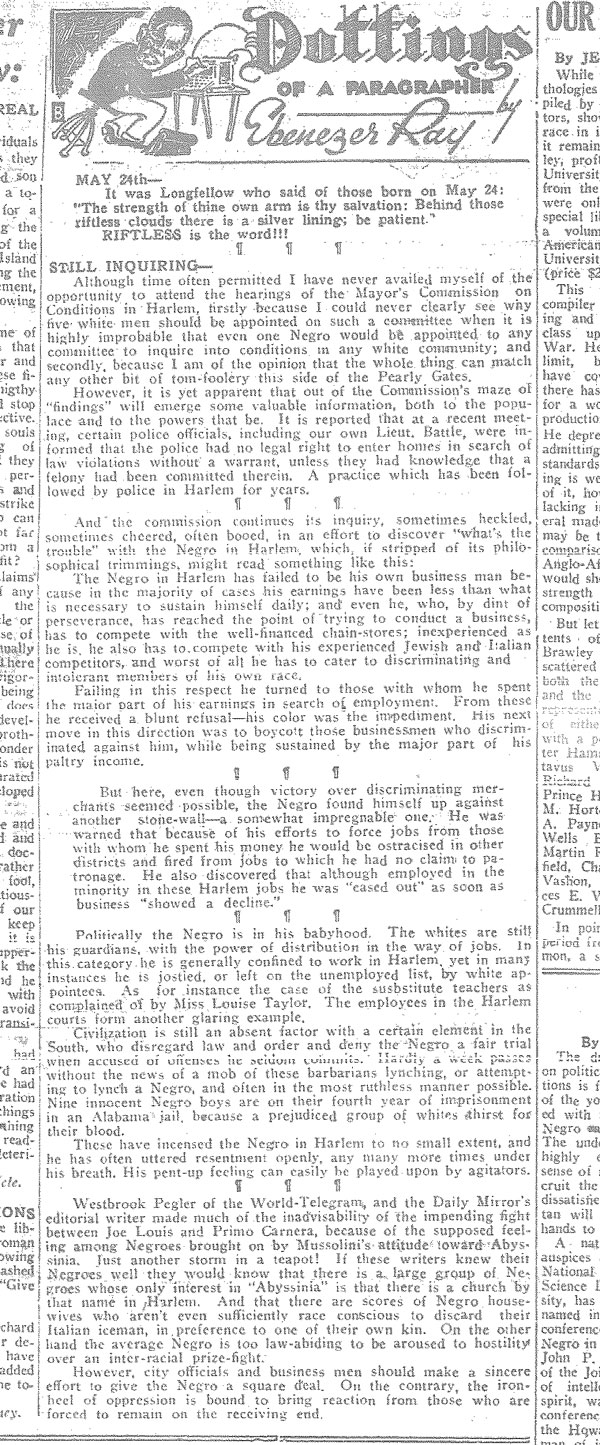
Ebenezer, on the other hand, was not one to mince words. Here are some gems I’ve found so far. All are excerpts from his “Dottings of a Paragrapher” column in the New York Age.

Dec. 22, 1934:  “When the white man ‘lifts his foot off the neck’ of Negroes and when the Negro in turn lifts his own tiny foot off his own neck, when a Negro reporter, writer, cartoonist,  or etc. can go to the News office and apply for a job with the  assurance that he has the same chance as his white brother, his color regardless, then it will matter whether he is called colored, Negro,  or Aframerican.”

June 1, 1935: “Although time often permitted, I have never availed myself of the opportunity to attend the hearings of the  Mayor’s Commission on Conditions in Harlem, firstly because I could never clearly see why five white men should be appointed on such a committee when it is highly improbable that even one Negro would be appointed to any committee to inquire into conditions in any white community.”  [Note: The 14-member commission, appointed by Mayor Fiorello LaGuardia following a 1935 race riot in Harlem, included several prominent blacks.]

May 30, 1936: “On a recent evening, what was scheduled to be an ‘all-star artist recital’ turned out to be just a parade of the ambitious, plus a little stardust.
How a promoter of this affair ever got together such a mixture is beyond imagination. It was little short of capital offense to associate the beautifully voiced Doris Trotman-Earle and Constance Berksteiner White with some of the other untutored apologies for singers. It was little short of a capital offense to place one sartorial blunder, in particular, on any program. He murdered ‘Then You’ll Remember Me’ — and all who had to listen to him certainly will.
Liberal applause followed all the efforts. It must have been admiration for their ‘nerve’ — or maybe the audience was made up mainly of relatives.”

Ouch! Ellen-Marie got it honest.

What’s a mother to do?

7 May

Stanford's Center for Comparative Studies in Race and Ethnicity sponsored a lecture featuring Lonnie Bunch, director of the Smithsonian's National Museum of African American History and Culture on May 5.

Recently, Lonnie Bunch, director of the Smithsonian’s National Museum of African American History and Culture, gave a talk at Stanford about the challenges he has faced as he develops the museum, which is scheduled to be completed in 2015.  Bunch talked about the “treasures” people often bring him as potential items for the museum’s collection.

Bunch told the story of a pillowcase someone brought him that had been passed among family members for several generations. The pillowcase was embroidered by an enslaved African American woman who had just learned the day before that she would be sold.

The embroidery was a message to her daughter:

“In this pillowcase, you will find a dress, you will find some biscuits, but what you will find is that it’s filled with my love. And though I may never see you again, always know how close you are to my heart. “

According to Bunch, that mother never saw her daughter again.

Bunch’s story put into perspective all the chatter about tiger and helicopter moms. There’s even a new one, snowplow parents  – who try to move all the difficulties out of their children’s lives.  I used to say that most of my black friends thought I was a pushover when it came to parenting and many of my white friends thought I was too tough. I’m not sure what my other friends thought.  In the end, all of our children have made us pretty damn proud.

Kimberly Elise, Oprah Winfrey and Thande Newton in "Beloved." Winfrey is a member of the advisory board of the National Museum of African American History and Culture.

In an age when everybody’s got an opinion about how children should be raised, protected, nurtured, etc., the pillowcase story makes it all seem so silly. Who among us would have had the resolve to embroider that farewell before being sold to another slave owner?  Or who would not have been tempted to do what Sethe did in Toni Morrison’s Beloved?

Maybe this is a downer as Mother’s Day approaches.  It’s not meant to be.  It’s intended to be a tribute to mothers who, under the worst and best circumstances, did and do their best with every ounce of what they have.  Here’s to our mothers, who made sure we had clothes on our backs and something to eat and who stitched together a legacy of love that has sustained us through generations.

On a more uplifting note, and speaking of generations, here’s what my father wrote for Mother’s Day in 1937.

The New York Age, May 8, 1937

Adam Clayton Powell Jr. marries an actress

15 Mar

Adam Clayton Powell Jr. is sworn in to the New York City Council by Mayor Fiorello H. La Guardia. From left, Joe Ford; Powell's mother, Mattie; Powell; Powell's wife, Isabel; Powell's father, Adam Clayton Powell Sr., and La Guardia, January 1942. Copyright All rights reserved by La Guardia and Wagner Archives

On  this day in 1933, Adam Clayton Powell Jr., the assistant minister of Abyssinian Baptist Church (The church where my ex and I married, by the way) wedded  a “showgirl” named Isabel Washington.
According to my former Boston Globe colleague and Powell biographer Wil Haygood, the relationship caused a stir. “The older deacons recoiled, as did his father. Showgirls stayed out late, danced with gangsters, drank gin. Adam Junior knew better. There were veiled threats that his father would not give him money.”
In  my dad’s  “Xcuse Me” column published three days after the wedding, you have to get to the penultimate paragraph before he even mentions the names “Adam” and “Is,” but it is clear before then who the column is about.
By the way, in Roman mythology, Jupiter Pluvius was the rain-giver who ended droughts.
I didn’t have any luck finding a photograph of the wedding, but I did find this photo from Powell’s swearing in to the New York City Council in 1942.  That was in nine years after the wedding.  From the look on his mother’s face, she still had not gotten over it. 🙂

The New York Age, March 18, 1933